 C.K. Gupta
In short
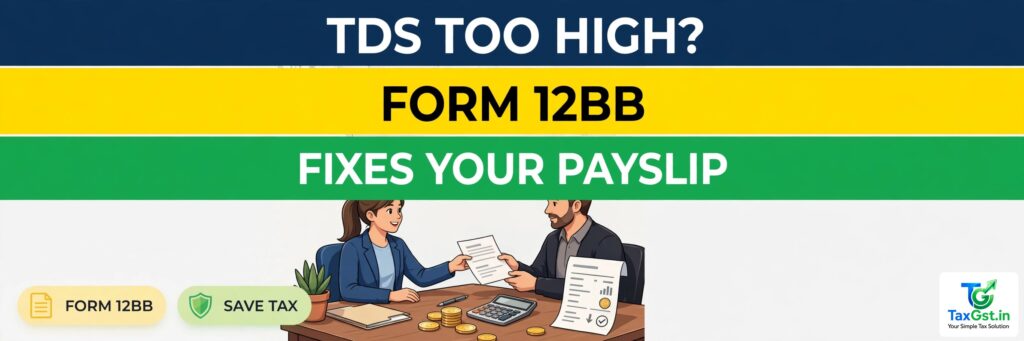
If your employer’s monthly TDS is higher than your actual tax, the usual cause is missing information, not a wrong slab: your employer is deducting on your full salary because it does not know about your deductions, your HRA, or your other income and its TDS. The fix is Form 12BB — the declaration you give your employer (not the tax department) listing your investments, rent, other income and TDS already deducted — plus a correct old-vs-new regime choice at the start of the year. Your employer can correct TDS in the remaining months of the year; after Form 16 is issued, the excess comes back only as a refund in your ITR.
Verified October 2026 · TaxGST.in
Meera, a Bengaluru product manager on ₹15,00,000 a year, noticed her March payslip: ₹12,000 of TDS that month, every month, all year — ₹1,44,000 in total. Her actual tax, once her ₹1,50,000 of 80C investments, ₹25,000 health premium and HRA were counted, was roughly ₹36,000 lower. She had lent the government an interest-free loan of ₹36,000 for a year, and the only reason was a form she never submitted. Meera’s story repeats in every payroll in India, and it is almost always fixable in one afternoon.
Salary TDS sits at the centre of the salaried filing season. If you also earn on the side, read how to file salary plus side income so the AIS cannot ambush you; if a filing deadline is looming, check the extended 21 November ITR deadline for audit cases. For the full income-tax picture, see the income-tax guide hub.
Why your employer over-deducts: it only knows your salary
From 1 April 2026, salary TDS is governed by Section 392 of the Income-tax Act, 2025 (the successor to Section 192 of the 1961 Act, which still governs AY 2026-27 returns for income earned before that date). The employer’s duty is simple: estimate your annual salary income, apply the regime you chose, and deduct tax in equal monthly slices. What the employer cannot know unless you tell it: your 80C investments, your health premium, your HRA rent, your home-loan interest, your other income, and the TDS already cut on that other income.
So the default is over-deduction: an employer that assumes no deductions deducts tax on the whole salary. That is not a payroll error — it is an information gap, and Form 12BB exists to close it.
Form 12BB: the one form that fixes most cases
Form 12BB is your declaration to your employer. It is not filed with the tax department and it is not a return — it is evidence your employer uses to compute your TDS correctly. It covers:
- House Rent Allowance: rent paid, landlord name and address, and landlord PAN if annual rent exceeds ₹1,00,000.
- Deductions: 80C investments (PPF, ELSS, EPF, tuition fees), 80D health premium, 80G donations, 80TTA/80TTB interest, and others you claim.
- Home-loan interest and any loss from house property you want set off against salary.
- Other income (interest, freelance receipts, rent) and the TDS already deducted on it, so your employer can deduct only the net balance instead of double-counting.
Submit it early in the financial year, with proof — rent receipts or agreement, investment statements, premium receipts — and update it when something changes mid-year (a new policy, a rent change, a fresh freelance receipt). Most payroll teams collect it once a year and again at proof-submission time in January–February; the January window is your last real chance to correct the year’s TDS, because February and March are the only months left to absorb the adjustment.
A worked example: where ₹36,000 went
Meera’s numbers, simplified to the old regime (which she had chosen): salary ₹15,00,000; no declarations submitted, so her employer deducted tax on the full amount. Her real position: 80C investments ₹1,50,000 and an 80D premium of ₹25,000 — total deductions ₹1,75,000 — bringing taxable income down by that amount. At her 20% marginal slab, that is ₹35,000 of tax, plus 4% health and education cess: ₹36,400.
That ₹36,400 is what Form 12BB would have saved her month by month — about ₹3,000 extra in hand every month instead of a refund chase after March. And note the direction of the fix: deductions reduce tax at your marginal slab, so the same ₹1,75,000 of deductions saves a 30%-slab earner roughly ₹54,600. The higher your slab, the more expensive a missing 12BB becomes.
The regime choice: the other silent over-deduction
At the start of the year your employer asks which regime to apply. Choose the new regime and your employer ignores 80C, 80D and HRA entirely — correctly, because the new regime does not allow them. Choose the old regime without submitting proofs and your employer may still deduct on the full salary until proofs arrive. The expensive mistake is choosing the new regime by default while holding ₹1,75,000 of deductions that only the old regime honours: on Meera’s numbers that alone costs ₹36,400.
Before choosing, run both regimes on your actual figures and tell payroll the answer in writing. You can change your regime choice when you file your return, but your employer’s monthly TDS follows the choice you gave payroll, so a return-time switch only converts the excess into a refund wait.
Mid-year fixes, in order of power
- Submit or update Form 12BB now. Your employer spreads the correction over the remaining months. This is the only fix that puts money in your monthly payslip.
- Declare other income and its TDS. If a bank already cut TDS on your interest, declaring it stops your employer from deducting tax on the same income twice.
- Correct the regime choice with payroll if you picked the wrong one — it applies prospectively to remaining months.
- After Form 16: claim the excess in your ITR. TDS is a prepayment, not the final tax — the return computes the real liability and refunds the difference. File on time: a belated return still gets the refund, but late filing costs you the late fee and, for some taxpayers, the ability to carry forward losses, as explained in our belated and revised return guide.
One limit: Form 12BB cannot reduce TDS below your real liability. Declare only what you can prove.
When higher TDS is not a mistake at all
Sometimes the payslip is right and the expectation is wrong. If you switched jobs mid-year, submit your previous Form 16 to the new employer or it will deduct without credit for earlier TDS. A one-month bonus also spikes TDS because payroll annualises it. And if you never declared significant other income, the “excess” may be covering a real liability — check the AIS before assuming a refund is due.
FAQs
Is Form 12BB filed with the Income Tax Department?
No. It goes to your employer, who uses it to compute your monthly TDS. The department sees the result (your Form 16 and your TDS credit) but never receives the 12BB itself.
Can my employer refund excess TDS already deducted?
Your employer can adjust TDS in the remaining months of the same financial year. Once the year ends and Form 16 is issued, only your ITR can return the excess, as a refund.
I chose the new regime but have big 80C investments. Can I switch?
Salaried taxpayers can choose the more beneficial regime when filing the return. But your employer’s TDS during the year follows the choice you gave payroll, so switching at return time means waiting for a refund rather than getting the money monthly.
What if I never submitted Form 12BB at all?
Your employer deducts on full salary. You lose nothing permanently — the excess comes back via your ITR refund — but you lose the monthly cash flow and, if you file late, you may pay a late fee on top.
Sources
Section 392 of the Income-tax Act, 2025 (salary TDS from Tax Year 2026-27; previously Section 192 of the Income-tax Act, 1961, which continues to govern AY 2026-27 returns) — Income Tax Department. Form 12BB, the employee’s statement of particulars for TDS on salary (employer declaration covering HRA, deductions under Chapter VI-A, other income and TDS thereon) — Income Tax Department. Section 234F late-fee and refund mechanics for belated returns — Income-tax Act, 1961. November filing and deadline context: November 2026 tax due dates calendar.
Discover more from TaxGst.in
Subscribe to get the latest posts sent to your email.