
 C.K. Gupta
In short
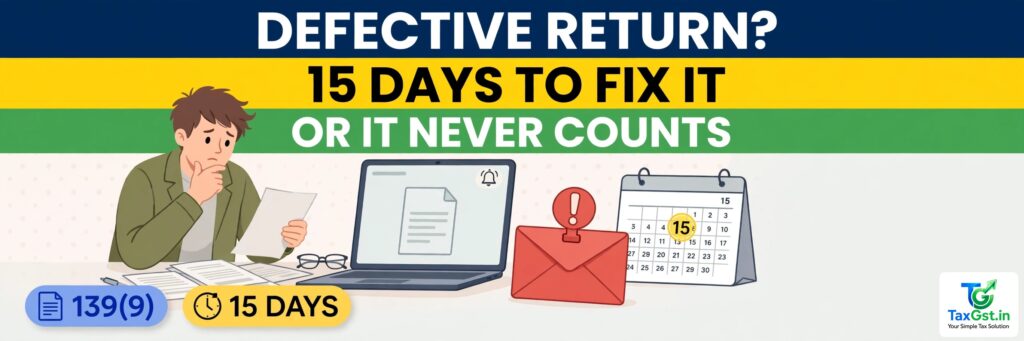
A defective-return notice under Section 139(9) of the Income-tax Act, 1961 gives you 15 days to file a corrected return — and if you ignore it, your return is treated as never filed, which blocks your refund and can cost you loss carry-forwards. The six common defects are: TDS claimed without the matching income, 26AS receipts higher than income shown, nil income with tax paid, a PAN-name mismatch, business income without balance sheet and profit-and-loss account, and a missing audit report. Reply on the e-filing portal under e-Proceedings: agree and correct the defect, or disagree with reasons — and note the response cannot be changed once submitted.
Verified October 2026 · TaxGST.in
A freelance designer filed her return in July, claimed a ₹40,000 refund, and waited. In October an email arrived instead: her return was defective. She had claimed TDS credit on ₹4,00,000 of receipts but shown only ₹2,50,000 of income — one client’s invoices forgotten entirely. She corrected the income within the 15 days and the recomputed refund arrived. Had she ignored the email, there would have been no refund at all: in the department’s eyes she would never have filed.
This notice arrives during return-processing season, which is why it pairs with the audit-season calendar: check the extended 21 November ITR deadline and the November 2026 due-dates calendar for what else is landing this month. If you also earn beyond salary, the salary-plus-side-income guide explains the AIS mismatches that often sit behind a defective notice. For the full income-tax picture, see the income-tax guide hub.
What “defective” actually means
A defective return is not a wrong return — it is an incomplete one. Under Section 139(9), the Assessing Officer (or the Centralised Processing Centre) can call a return defective when it is missing something the law requires, or when its own figures contradict each other. This article covers AY 2026-27 notices, which run under the 1961 Act because they concern income earned before 1 April 2026; the portal flow described here is the same flow a notice for a later year follows, even though the Act reference printed on that notice changes.
The distinction matters: a defective return is curable by supplying the missing piece within the window, while a return that is simply wrong on a chosen figure is corrected by a revised return, not a 139(9) reply.
The six common defects, and the fix for each
1. TDS claimed, income not shown. The commonest defect by far. You claim TDS credit but omit the receipts that suffered the TDS. Fix: add the missing income under the correct head; the TDS credit then matches, and your tax is recomputed on the full income. This is the designer’s case above — and the reason the AIS exists: the department already knows about those receipts.
2. 26AS receipts exceed income in the return. The gross receipts in Form 26AS on which you claimed TDS are higher than the total receipts shown under all heads in your return. Fix: reconcile 26AS line by line against your books before correcting — sometimes the gap is a receipt belonging to another year, or a receipt already offered under a different head, in which case your reply explains rather than amends.
3. Gross total income and all heads shown as nil or zero, but tax computed and paid. A return that says “no income” while paying tax contradicts itself. Fix: enter the income under the correct heads; this defect usually comes from a partially filled form saved and submitted by mistake.
4. Name mismatch with PAN data. The name in the ITR does not match the name in the PAN database — a married-name change, a spelling variation, an old PAN record. Fix: correct the PAN record first (or the return’s name field to match PAN), then file the corrected return. Filing a corrected return without fixing the underlying mismatch just earns a second notice.
5. Business income without balance sheet and profit-and-loss account. You show profits and gains of business or profession but have not filled the balance sheet and P&L schedules the form requires. Fix: complete those schedules from your books; presumptive taxpayers should check they used the right form and schedules for their scheme instead.
6. Audit report not filed with the return. Your books were audited but the audit report and audited financial statements were not filed with the return. Fix: get the report uploaded and file the corrected return referencing it. With the audit-report deadline for AY 2026-27 extended to 21 October 2026 by CBDT Circular No. 07/2026, this defect is appearing in audit-season returns right now.
How to reply, step by step
- Log in to incometax.gov.in with your PAN/Aadhaar and password.
- Go to Pending Actions → e-Proceedings and find the Section 139(9) notice under “For Your Action”. Read the notice PDF — it names the specific defect and usually its probable resolution.
- Click Submit Response. You get two options, and this choice cannot be undone:
- Agree: you accept the defect. Correct it in the return (online utility for minor fixes, offline utility with a JSON upload for larger ones) and submit.
- Disagree: you do not accept the defect. Enter your reasons in the text box — for example, that the receipt belongs to another year or is already offered under another head — with the supporting figures.
- Tick the declaration (“Response cannot be modified after submission”) and submit. Save the acknowledgement number.
- E-verify the corrected return if the portal requires it. A corrected return that is never verified is as useless as the defective one.
If 15 days is genuinely not enough — you are waiting on a CA, a bank statement or an audit report — write to the Assessing Officer asking for an extension before the deadline expires. In practice, officers often accept a correction filed after the 15 days but before assessment is completed; but that is discretion, not a right, so never plan around it.
What happens if you do nothing
The return is treated as invalid — as if it was never filed for that year. Consequences stack up: no refund is processed; losses that needed a timely return cannot be carried forward (house-property loss excepted); and you may need to file a belated return if the window is still open, paying the late fee and interest described in our belated and revised return guide. For AY 2026-27, the belated window runs to 31 December 2026 — but a defective notice answered late is cheaper than a belated return filed from scratch, so answer the notice first.
Do not file a fresh return while the notice is pending: once the filing window for the year has lapsed, the department’s FAQ says you must respond to the notice, not file afresh.
Preventing the next one
- Reconcile AIS, 26AS and your books before filing. Any receipt in 26AS must appear in the return or be explained.
- Never claim a TDS credit without the income behind it in the same return.
- Check the PAN-name match before submitting, especially after a name change.
- Read department emails within days — the 15-day clock runs from receipt, and your refund is frozen until you act.
FAQs
How long do I get to reply to a 139(9) notice?
15 days from receipt, or the time specified in the notice. You can request an extension from the Assessing Officer, but file within the window whenever possible.
Can I change my response after submitting?
No. The portal states the response cannot be updated or withdrawn once submitted — agree or disagree deliberately, with the figures checked first.
What if I disagree with the defect?
Choose “Disagree” and state your reasons with figures — for instance, that the receipt falls in another year. Keep the workings: if the officer does not accept the disagreement, you will need them for the next stage.
Sources
Section 139(9) of the Income-tax Act, 1961 (defective returns; 15-day cure window; return treated as invalid if not cured) — Income Tax Department. Income Tax Department e-filing FAQ, “Response to Defective Notice 139(9)” (common errors including TDS-without-income, 26AS mismatch, nil income with tax paid, PAN-name mismatch, missing balance sheet/P&L) — incometax.gov.in. CBDT Circular No. 07/2026 (F. No. 225/128/2026/ITA-II), dated 28 September 2026 — extension of tax audit report and ITR timelines for AY 2026-27 (audit report to 21 October 2026; ITR to 21 November 2026) — CBDT.
Discover more from TaxGst.in
Subscribe to get the latest posts sent to your email.