
 C.K. Gupta
In short
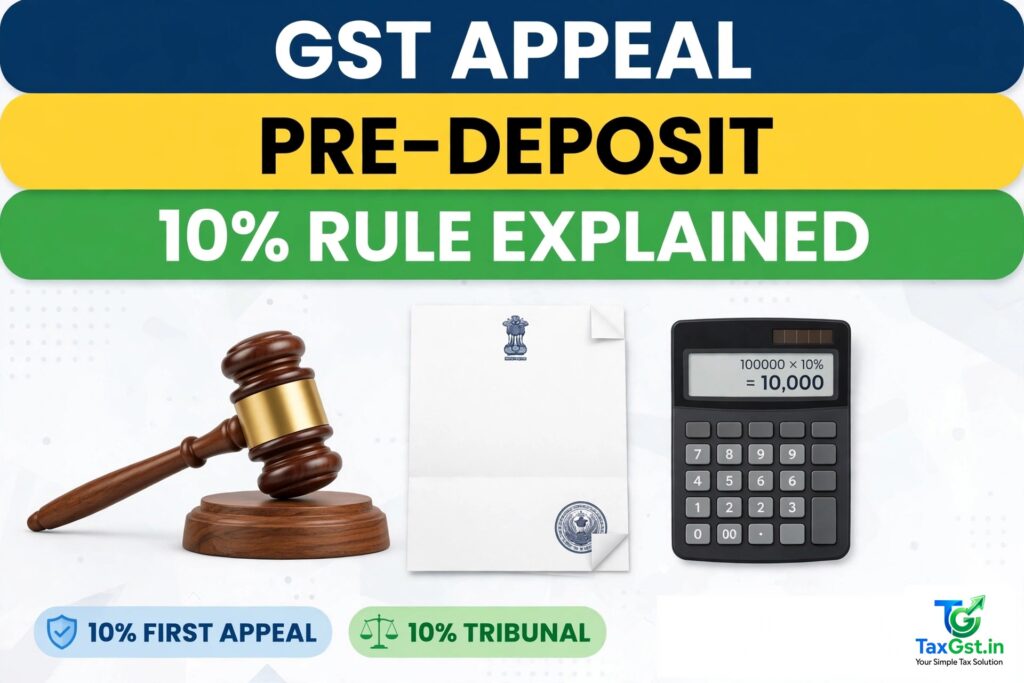
Before a GST appeal is heard, you must deposit 10% of the disputed tax at the first appeal stage and a further 10% at the tribunal stage — but only on the disputed part, never on tax you have already admitted. CBIC Circular No. 259/05/2026-GST, dated 26 October 2026, settles six long-running arguments about that deposit: how it is calculated when an order is modified, how its refund works, and how interest is computed when you paid at both stages. Get the admitted-versus-disputed split right on the appeal form, and the rest of the appeal gets much simpler.
Verified October 2026 · TaxGST.in
A Jaipur trader lost a GST case for ₹8 lakh of tax. He admitted ₹2 lakh of it — a genuine error in his own returns — and wanted to fight the remaining ₹6 lakh. His adviser told him the pre-deposit would be 10% of ₹8 lakh. It was not. It was 10% of ₹6 lakh: ₹60,000, not ₹80,000. That ₹20,000 difference is exactly the kind of mistake CBIC Circular No. 259/05/2026-GST, dated 26 October 2026, was written to stop, and it is the first thing to get right before you file any GST appeal.
If you have just received a demand, start with the step-by-step DRC-01 demand-notice reply guide and the GST notice portal survival guide — an appeal is what you file after the order, not instead of replying to the notice. For the wider GST picture, see the complete GST guide hub, and if a refund is stuck anywhere in the process, the GST refund process guide explains the current timelines — and the compliance calendar hub tracks the appeal and filing dates that run alongside it.
What a pre-deposit is — and what it is not
A pre-deposit is the price of admission to an appeal, not a penalty and not a payment of the demand. Under Section 107(6) of the CGST Act, an appeal to the Appellate Authority (the first appeal) requires a pre-deposit of 10% of the tax in dispute. Under Section 112(8), an appeal to the Appellate Tribunal requires a further 10%. In both cases the percentage applies to the disputed tax only. Tax you admit — the part of the order you accept as correct — must be paid in full, separately, before the appeal is filed. Here’s the catch: if you lump admitted and disputed tax together on the form, you will overpay the deposit and then spend months chasing a refund of your own money.
Worked example: an order demands ₹10 lakh tax plus interest and penalty. You admit ₹3 lakh and dispute ₹7 lakh. You pay the ₹3 lakh admitted tax in full, plus interest on it, and deposit ₹70,000 (10% of ₹7 lakh) as the first-appeal pre-deposit. If you later go to the tribunal, you deposit a further ₹70,000. The deposit is capped in practice by the statutory ceilings in the two sections, but for most small and mid-size demands the 10% figure is the one that bites.
The six clarifications in Circular 259, in plain English
1. Admitted versus disputed is your call to make on the form. The circular confirms that the taxpayer determines the admitted and disputed amounts when filing the appeal, and the appeal forms capture those particulars. Do not wait for the department to split the demand for you — it will not. Write the split down, keep the working, and make sure the numbers on the form match your reply to the original notice.
2. If the first appeal modifies the demand, the tribunal deposit follows the modified figure. Suppose the Appellate Authority reduces a ₹10 lakh disputed demand to ₹6 lakh and you appeal further. Your tribunal-stage pre-deposit is 10% of ₹6 lakh — the liability confirmed by the Appellate Authority and disputed by you — not 10% of the original ₹10 lakh. This was genuinely unclear before the circular, and it saves real money on every partially successful first appeal.
3. You do not need the appellate order to say “refund the deposit”. If you win, the order does not have to expressly direct a refund of the pre-deposit. You claim it by filing a refund application in FORM GST RFD-01, under the “on account of order” category. Many taxpayers have waited for an order to mention the refund; the circular says that wait is unnecessary — file the RFD-01.
4. A department appeal does not freeze your refund. Your pre-deposit refund cannot be withheld merely because the department intends to appeal, or has appealed, against the order in your favour — unless that favourable order has actually been stayed by the tribunal or a court. An intention to appeal is not a stay. If your refund is held up on that ground alone, cite this clarification in your follow-up.
5. Interest is computed separately for each payment date. If you paid a deposit at the first-appeal stage and another at the tribunal stage, interest on the refund is computed separately by reference to each actual payment date. Keep both challans; the interest clock on the second deposit starts later, and a single blended calculation will short-change you.
6. Remand means refund — with one condition on a partial remand. Where the tribunal remands the matter to the original adjudicating authority, the pre-deposit is refundable within the prescribed time. On a partial remand, the confirmed demand and applicable interest must first be recovered or adjusted, and only the balance is refunded. Do not expect the full deposit back on a partial remand; expect the balance.
Your appeal checklist
- Read the order and split it into admitted tax and disputed tax, in writing, before opening the appeal form.
- Pay the admitted tax in full, with interest, and keep the challan.
- Deposit 10% of the disputed tax only, and label it as pre-deposit — not as a payment towards the demand.
- File within the limitation period for the appeal (three months from the order, with a further condonable month at the first stage) — a late appeal with a perfect deposit is still a late appeal.
- Keep every challan separately dated; you will need both dates for the interest calculation if you win.
- If you win, file RFD-01 promptly rather than waiting for the order to mention the refund.
What this circular does not change
Circular 259 does not reduce the 10% rate, does not waive the deposit for anyone, and does not change the limitation period. It also does not touch the separate question of whether fraud provisions were properly invoked in your case — that is governed by the companion CBIC Circular No. 258/04/2026-GST, which requires officers to establish intent to evade tax with specific evidence before invoking Section 74. If your demand rests on a fraud allegation with no evidence of intent, that is a ground of appeal in its own right, and the pre-deposit is still payable while you argue it.
FAQs
Is the pre-deposit 10% of the whole demand?
No. It is 10% of the disputed tax only. Admitted tax is paid in full, separately, and is not part of the deposit calculation.
Do I pay another 10% at the tribunal?
Yes — a further 10% of the disputed tax as confirmed at the first-appeal stage, in addition to what you paid at the first stage.
How do I get the deposit back if I win?
File FORM GST RFD-01 under “on account of order”. The appellate order need not expressly direct the refund.
Can the department hold my refund because it plans to appeal?
Not on that ground alone. Withholding requires an actual stay of the favourable order by the tribunal or a court.
What if my case is remanded?
On a full remand the pre-deposit is refundable within the prescribed time; on a partial remand, the confirmed demand and interest are adjusted first and the balance is refunded.
Sources
CBIC Circular No. 259/05/2026-GST, dated 26 October 2026, issued by the Central Board of Indirect Taxes and Customs — “Clarification on various issues pertaining to the amount paid as pre-deposit as per sub-section (6) of section 107 or sub-section (8) of section 112 of the CGST Act” (admitted versus disputed split; tribunal deposit on the modified liability; RFD-01 refund route; no withholding on a mere departmental appeal; separate interest computation per payment date; remand refunds). CBIC Circular No. 258/04/2026-GST, dated 26 October 2026 (intent-to-evade evidence requirement for Section 74), for the companion fraud-provision point. Sections 107(6) and 112(8) of the CGST Act, 2017, for the 10% pre-deposit rates.
Discover more from TaxGst.in
Subscribe to get the latest posts sent to your email.