C.K. Gupta
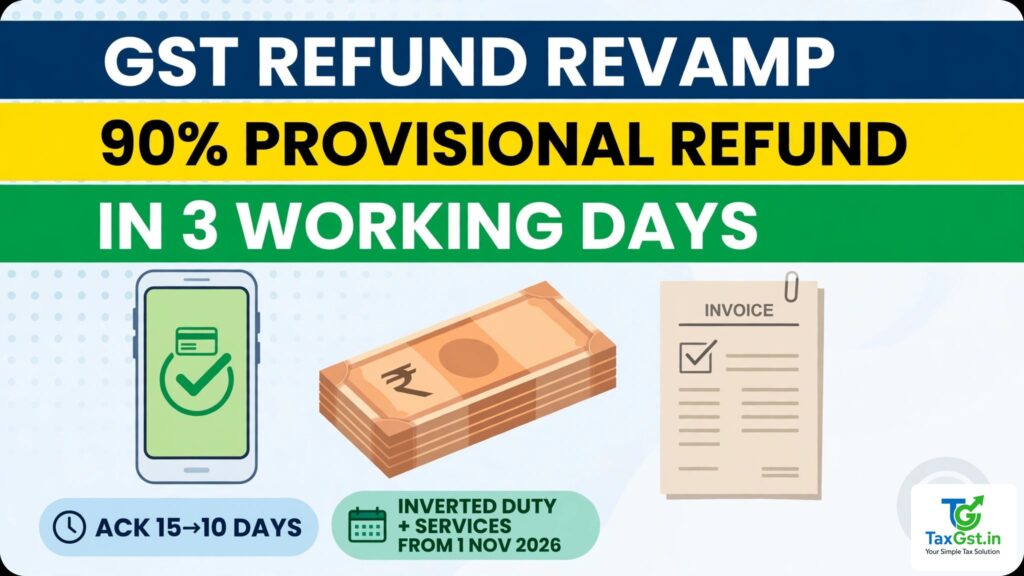
The 57th GST Council (8 October 2026, New Delhi) recommended a full revamp of the GST refund system: refund acknowledgement cut from 15 to 10 days, 90% of eligible export and inverted-duty claims sanctioned by the system within 3 working days on risk evaluation, and automatic refunds of excess cash-ledger balances. Inverted-duty refunds extend to input services from 1 November 2026 and plant & machinery over 60 months from 1 April 2027. All changes are recommendations needing CGST Act/state law amendments before they become law. Verified October 2026 · TaxGST.in
If you are an exporter, you know the ritual well: file Form RFD-01, wait for an acknowledgement, then wait some more — sometimes months — while your working capital sits locked in the system. A textile exporter with a ₹12 lakh refund claim could easily spend half a quarter just waiting for an officer to open the file. The 57th GST Council meeting, held on 8 October 2026 in New Delhi under Finance Minister Nirmala Sitharaman, has recommended changing that equation fundamentally: the system itself, not an officer, would sanction 90% of your refund within three working days of acknowledgement.
Read our overview of all 19 decisions taken at the 57th GST Council meeting for the full picture — this article focuses only on the refund overhaul, who benefits, what is still pending, and what to do right now. For day-to-day GST deadlines while these changes move through Parliament, keep our GST hub bookmarked.
What the Council recommended: refund timeline at a glance
Under the proposed framework, reported by Business Standard, Economic Times and taxguru from the Finance Ministry’s post-meeting briefing, refund processing becomes largely automated. Here is the old versus proposed comparison:
| Step | Current | Recommended |
|---|---|---|
| Acknowledgement of RFD-01 | 15 days (RFD-02/RFD-03) | 10 days |
| Silence on the claim | No deemed acknowledgement | Deemed acknowledged if neither acknowledgement nor deficiency memo is issued in 10 days (Phase 2) |
| Provisional sanction | Officer-driven; refund order within 7 days of acknowledgement | 90% sanctioned by the system within 3 working days of acknowledgement, on risk evaluation — no officer intervention |
| Excess cash-ledger balance | Refund on application, officer scrutiny | Refunded automatically (Phase 1) |
| Zero-rated refunds | Scrutiny before full sanction | Full sanction after adjusting outstanding dues (Phase 2) |
| Document uploads | Scanned supporting documents | No scanned uploads for export and inverted-duty claims — system-readable data in RFD-01 instead |
| Rule 89(4)(C) cap | Zero-rated goods turnover capped at 1.5x domestic like-goods value | Cap removed |
| Minimum refund ₹1,000 (Sec 54(14)) | Tested per tax head | Tested on combined CGST+SGST+IGST |
Worked example: what a ₹12 lakh export claim looks like
Say you are a Tiruppur garment exporter filing a zero-rated export refund of ₹12,00,000 for November 2026. Under the recommended framework:
- The portal must acknowledge your claim within 10 days of filing — by about 15 November 2026 if you file on 5 November. If nothing arrives, the claim is deemed acknowledged.
- The system’s risk engine then evaluates your claim against invoice-matching and network-analysis checks. If it clears, ₹10,80,000 (90%) is sanctioned within 3 working days of acknowledgement — money back in your account in roughly half the time a single officer-level step takes today.
- The remaining ₹1,20,000 (10%) is held for the balance scrutiny and adjusted against any outstanding tax dues before full sanction.
- You do not scan and upload your invoices again — RFD-01 captures system-readable data directly.
Here is the catch, though: the 90% system sanction applies to eligible claims, which means a clean compliance record. If your GSTR-1 and GSTR-3B are not reconciled — invoices not reported by suppliers, missing GSTR-2B entries — the risk score fails and the claim drops back into manual scrutiny. This is the practical reason to keep your returns reconciled every month, and why the 30 November 2026 ITC claim deadline for FY 2025-26 matters even more than before: unclaimed or mismatched ITC is the fastest way to a flagged refund.
Bigger win: inverted-duty refunds now cover services and machinery
This is the change that reaches beyond exporters. An inverted duty structure — where GST paid on inputs is higher than the tax on your final product — leaves businesses sitting on accumulated ITC they cannot use. Until now, refund of that credit was restricted to inputs (goods) under Section 54(3) of the CGST Act. The Council recommended two extensions:
- Input services from 1 November 2026: refund of accumulated ITC on specified input services, for credit availed on or after 1 November 2026. Pharma, FMCG, food processing and textiles stand to gain the most.
- Plant & machinery from 1 April 2027: refund of ITC on capital goods — both for exporters and inverted-duty businesses — with the refund spread over 60 months of operational life.
A worked example for the machinery change: a manufacturer with ₹60,00,000 of ITC locked in plant and machinery would, under the proposed scheme, recover ₹1,00,000 per month for 60 months starting April 2027 — roughly ₹12,00,000 a year of working capital unlocked, instead of sitting dead on the ledger.
What is still NOT law — read the fine print
Everything above is a recommendation approved in principle, not yet law. The tax rates themselves are unchanged, and most of the refund overhaul needs amendments to the CGST Act and matching state GST laws, plus new rules and notifications. What is confirmed so far:
- The only two changes carrying firm commencement dates are the 1 November 2026 input-services extension and the 1 April 2027 plant-and-machinery extension.
- Automatic cash-ledger refunds roll out in Phase 1; deemed acknowledgement and full zero-rated sanction after dues adjustment come in Phase 2. No full calendar has been published — there is no announced date for the amending Bill or for the 3-day sanction to go live.
- Export-of-services relief — aligning the Section 2(6) IGST definition with practice, omitting Section 13(3)(a) for specified services, and clarifying zero-rating for goods supplied to overseas buyers but delivered in SEZ/FTWZ — also needs legislative amendment.
In practice, this means: do not plan your cash flow on 3-day refunds until the amending law is passed and GSTN implements the phases. Track upcoming obligations through our compliance calendar hub, which will reflect the new timelines once they are notified.
FAQs
1. Is the 90% refund in 3 days applicable right now?
No. It is a recommendation of the 57th GST Council (8 October 2026) and needs CGST Act/state law amendments plus phased system rollout. Until then, the existing RFD-01 process — 15-day acknowledgement, officer-driven sanction — continues to apply.
2. What does “system sanctioned, not by an officer” actually mean?
The GST system will run risk evaluation — invoice matching between suppliers and buyers, and network analysis to spot suspicious credit chains — and sanction 90% of eligible export and inverted-duty claims automatically. An officer intervenes only if the risk score fails or for the balance 10%.
3. Can I claim refund on ITC accumulated from input services now?
Not yet. The Council recommended eligibility for input services for credit availed on or after 1 November 2026, subject to the implementing amendments. Track services-related ITC separately from 1 November so you are ready to claim once notified.
4. How does the 60-month plant-and-machinery refund work?
ITC on eligible plant and machinery becomes refundable from 1 April 2027, but the refund is spread over the machinery’s 60-month operational lifecycle — i.e., in equal monthly instalments over five years rather than one lump sum. It covers both exporters and inverted-duty-structure businesses.
5. What was the Rule 89(4)(C) 1.5x cap, and why does its removal matter?
Rule 89(4) formula capped the turnover of zero-rated goods at 1.5 times the value of like domestic goods, which shrank export refunds for businesses whose export prices differed from domestic prices. Removing the cap means the refund formula will use actual export turnover — materially larger refunds for exporters in that situation.
Sources
- 57th GST Council meeting press release / official minutes — Ministry of Finance, Government of India, 8 October 2026 (recommendations on automated refunds, acknowledgement timeline, inverted-duty extension, Rule 89(4)(C) removal, Section 54(14) ₹1,000 threshold; no notification number issued yet — these remain recommendations pending legislative amendment)
- “GST Council unveils major reforms, eases penalties and speeds up refunds” — Business Standard, 8 October 2026 (Finance Minister’s post-meeting briefing; 90% provisional sanction within 3 working days; 1 Nov 2026 / 1 Apr 2027 dates)
- “GST Council bets on faster refunds, lower penalties to ease business burden” — The Economic Times (BFSI/Retail), 9–10 October 2026 (acknowledgement 15→10 days; excess cash-ledger automatic refunds)
- “57th GST Council: Automatic Refunds, 90% Provisional Refund and ITC Relief” — taxguru.in, October 2026 (two-phase rollout; RFD-01 system-readable data; deemed acknowledgement)
Discover more from TaxGst.in
Subscribe to get the latest posts sent to your email.