C.K. Gupta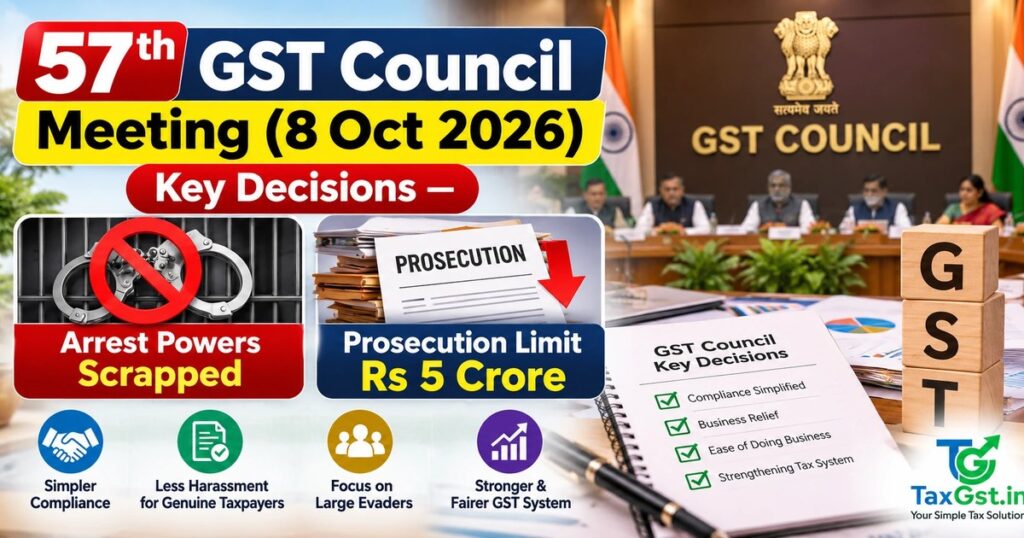
The 57th GST Council meeting on October 8, 2026 will be remembered as the meeting that changed the tone of GST — not its rates. After the 56th Council’s sweeping rate rationalisation in September 2025 (read our breakdown: 56th GST Council Meeting), this meeting delivered the second half of “GST 2.0”: process and enforcement reforms built around trust instead of fear.
The Council met at 11:00 AM on Thursday, October 8, at the Summit Room, Bharat Mandapam, New Delhi, chaired by Finance Minister Nirmala Sitharaman, with state finance ministers and senior officials in attendance. It was the first Council meeting in over a year — and it had already been rescheduled twice, from September 12 (BRICS Summit clash) to October 7, and then to October 8.
Here is what was actually decided, what it means for you, and what still needs Parliament’s stamp.
The headline decision: GST officers lose the power to arrest
The single biggest decision of the day: the power of arrest is being removed from GST law. Until now, Section 69 of the CGST Act let the Commissioner authorise the arrest of a taxpayer where specified offences were suspected — a provision businesses have long called the most feared weapon in the tax officer’s arsenal.
Enforcement will now shift to civil consequences: recovery of the tax due, with interest and a proportionate penalty. Serious fraud can still be prosecuted through the courts, but the era of arrest as an enforcement tool under GST is ending.
One important caveat: a Council decision is not instant law. Removing arrest powers needs Parliament to amend the CGST Act first, followed by an official notification. Until that amendment is enacted, the existing provisions technically remain on the books. We will update this article when the amendment is notified.
Prosecution threshold raised five-fold: Rs 1 crore → Rs 5 crore
Criminal prosecution for GST offences will now kick in only where the amount involved crosses Rs 5 crore, up from Rs 1 crore earlier. This single change shields lakhs of ordinary operational, valuation and classification disputes from ever entering a criminal courtroom.
The message is consistent with the day’s theme: genuine mistakes get civil treatment; criminal law is reserved for big-ticket fraud.
General penalty cut: Rs 25,000 → Rs 10,000
The general penalty under GST has been reduced from Rs 25,000 to Rs 10,000. Combined with the government’s stated position — a taxpayer who files late, makes an error or delays payment will face recovery, interest and a proportionate penalty, “but nothing beyond that” — this materially lowers the cost of honest mistakes.
No rate changes — and rates go on a yearly calendar
The Council made no changes to GST rates at this meeting. Going further, the Finance Ministry indicated that GST rate matters will now be taken up just once a year, at a meeting called specifically for that purpose. For businesses, that means rate stability you can plan around — no more watching every Council meeting for a slab surprise.
E-commerce relief: small sellers can sell across states without a local office
In a major ease-of-doing-business win, the Council approved a simplified GST registration mechanism for small sellers on e-commerce platforms. Small businesses will be able to sell across states without establishing a place of business in each state — they can use the platform’s warehouse as their registered place of business where they have no premises of their own.
With 9 in 10 digital sellers estimated to be small businesses, this removes one of the biggest compliance walls in online selling.
What this means for you
If you run a small business: the combination of the Rs 5 crore prosecution threshold, the Rs 10,000 general penalty and the “nothing beyond recovery + interest + proportionate penalty” doctrine means an honest error is now an expensive lesson, not a criminal case. Keep your filings clean, but stop fearing the knock on the door for a clerical slip.
If you sell online: the e-commerce registration simplification is the one to watch. Inter-state selling without a physical presence in every state cuts both cost and paperwork dramatically. Watch for the CBIC notification operationalising it.
If you have pending disputes: proposals reported ahead of the meeting included a Rs 10,000 minimum threshold for show-cause notices under sections 73, 74 and 74A — applied retroactively, which could close roughly 1.23 lakh pending notices and nearly 11,800 first appeals. This was widely reported but was not part of the confirmed official release at the time of writing; treat it as expected, not yet notified.
What was on the table but awaits confirmation
Several big-ticket proposals were reported ahead of the meeting and may surface in the official minutes or subsequent notifications:
- Faster refunds: 90% of eligible refunds released upfront after risk-based checks, with acknowledgment within 10 days (deemed acknowledged if the officer doesn’t act).
- Wider ITC: input tax credit extended to currently blocked categories — employer-provided health/life insurance, passenger vehicles up to 13 seats, telecom towers, and more under Section 17(5).
- Invoice matching system: buyer-supplier invoice reconciliation inside monthly returns to kill fake ITC at the source, while protecting genuine buyers whose suppliers default.
- Simpler returns for small B2C sellers: an optional annual return with quarterly payments for businesses up to Rs 5 crore turnover selling only to unregistered customers.
- Gold and silver: withdrawal of the IGST exemption on precious-metal imports by specified banks and nominated agencies.
We will update this article as the official press release and CBIC notifications fill in these blanks.
Key takeaways
- GST officers’ power to arrest is being removed — enforcement moves to recovery, interest and proportionate penalties (needs a Parliamentary amendment first).
- Criminal prosecution threshold raised from Rs 1 crore to Rs 5 crore.
- General penalty reduced from Rs 25,000 to Rs 10,000; honest mistakes face civil consequences only.
- No GST rate changes; rates will now be reviewed just once a year.
- Small e-commerce sellers can sell across states without a place of business in each state.
- Reported but awaiting confirmation: Rs 10,000 notice threshold, 90% upfront refunds, wider ITC, invoice matching.
Frequently asked questions
Did GST rates change in the 57th Council meeting?
No. The Council made no rate changes, and the Finance Ministry said rate matters will now be taken up only once a year at a dedicated meeting. If you were waiting for a slab revision before a purchase decision, there is none coming from this meeting.
Can GST officers still arrest me?
The Council has approved removing the arrest power under Section 69, but this needs Parliament to amend the CGST Act and an official notification before it takes effect. Until then, the existing legal provisions technically remain applicable. In practice, the government’s stated direction is clearly toward civil recovery, not arrest.
What is the new prosecution threshold?
Rs 5 crore, raised from Rs 1 crore. Only cases involving amounts above Rs 5 crore can now lead to criminal prosecution for GST offences.
I received a small GST notice. What should I do?
A Rs 10,000 minimum threshold for show-cause notices was widely reported ahead of the meeting, with retroactive relief for pending cases — but it was not in the confirmed official release at the time of writing. Do not ignore any notice you have received; respond within the timeline, and watch for the CBIC notification.
I am a small seller on Amazon/Flipkart. What changes for me?
Once notified, you will be able to register through a simplified mechanism and sell across states without maintaining a place of business in each state — the platform’s warehouse can serve as your registered premises. This is among the most concrete ease-of-doing-business wins of the meeting.
When do these decisions take effect?
Council decisions take effect only after the corresponding legal amendments and CBIC notifications. The arrest-power removal specifically needs a Parliamentary amendment to the CGST Act. Track notifications on cbic.gov.in rather than assuming dates.
Disclaimer: Tax laws change frequently. Verify current rates and deadlines on the official portals (cbic.gov.in, gst.gov.in) or consult a qualified professional before acting. Decisions above are as reported on October 8, 2026, from the official release and major news outlets; procedural details await CBIC notifications.
Discover more from TaxGst.in
Subscribe to get the latest posts sent to your email.