C.K. Gupta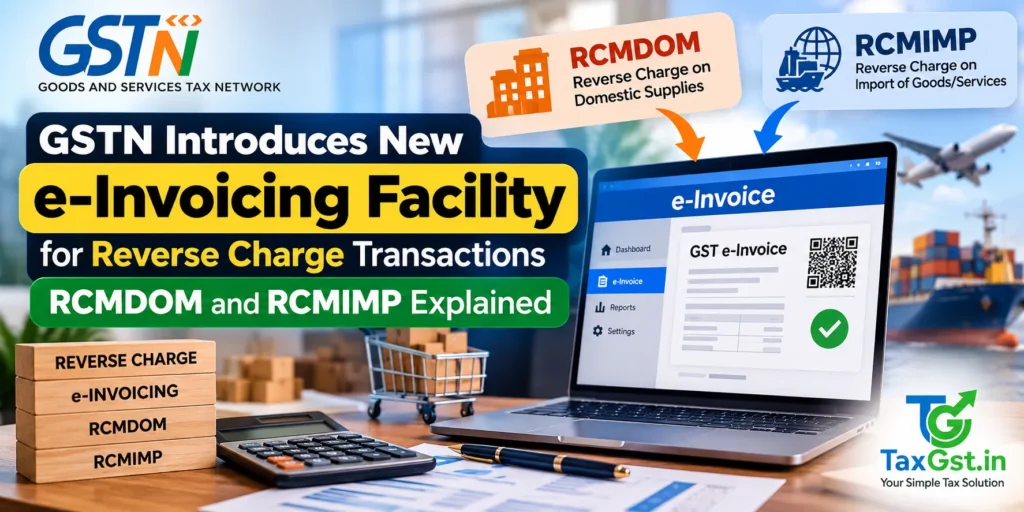
GSTN, vide Advisory No. 678 dated 16th October 2026, has introduced two new supply types — RCMDOM (Reverse Charge Mechanism on Domestic) and RCMIMP (Reverse Charge Mechanism on Import of Services) — within the e-Invoice framework to enable registered taxpayers with an Aggregate Annual Turnover (AATO) of ₹5 crore and above to generate Invoice Reference Numbers (IRNs) for recipient-generated self-invoices. Recommended by the GST Council in its 57th meeting, this facility allows eligible recipients to report self-invoices issued under section 31(3)(f) for specified domestic supplies received from unregistered persons under RCM and for import of services from suppliers located outside India across any of the six authorised Invoice Registration Portals (IRPs).
Also Read-ITAT Cancels 200% Penalty on Non-Filer: The Rs 12.9 Lakh Jaipur Case
Quick Summary
- GSTN Advisory No. 678 (dated 16th October 2026) enhances the e-Invoice system with two new supply types: RCMDOM for specified domestic supplies received from unregistered persons under RCM, and RCMIMP for import of services under RCM.
- The facility applies to registered taxpayers with an Aggregate Annual Turnover (AATO) of ₹5 crore and above (the existing e-invoicing threshold under Notification No. 10/2023–Central Tax), subject to forthcoming statutory notifications governing the final scope and effective date.
- The sandbox environments of all six authorised IRPs and the NIC e-Invoice API Developer Portal are live for testing; the mandatory production rollout date will be notified separately.
- For RCMDOM and RCMIMP transactions, the registered recipient reports the self-invoice on the IRP, with the IRN hash logic generated using the recipient’s GSTIN and the supplier marked as an Unregistered Person (URP).
- This update closes a long-standing compliance gap where B2B RCM invoices issued by registered suppliers under section 9(3) were covered by e-invoicing, but recipient-generated self-invoices under section 31(3)(f) and import of services were outside the IRP framework.
What Are RCMDOM and RCMIMP Supply Types?
RCMDOM (Reverse Charge Mechanism on Domestic) refers to recipient-generated self-invoices for specified domestic supplies of goods or services received from unregistered persons, where the registered recipient is liable to pay GST under the reverse charge mechanism. Under section 31(3)(f) of the CGST Act, 2017, a registered person liable to pay tax under section 9(3) or section 9(4) must issue a self-invoice upon receiving taxable supplies from an unregistered supplier. RCMDOM enables eligible recipients to report these self-invoices on the e-Invoice portal and obtain a valid IRN.
RCMIMP (Reverse Charge Mechanism on Import of Services) covers recipient-generated self-invoices for the import of services from suppliers located outside India, where the registered recipient in India is liable to pay IGST under reverse charge pursuant to section 5(3) of the IGST Act, 2017. Because overseas service providers are located outside India and unregistered under domestic GST, the obligation to raise a self-invoice and discharge GST rests on the Indian recipient. RCMIMP brings cross-border service imports — such as cloud hosting, software licences, and foreign consultancy — directly onto the IRP validation network.
Why Has GSTN Introduced These New e-Invoice Supply Types?
Prior to this enhancement, the e-Invoice architecture only permitted registered suppliers to generate IRNs. While RCM supplies made by registered suppliers under section 9(3) were already reported by the supplier on the IRP, inward supplies received from unregistered domestic vendors or overseas service providers required the recipient to generate a self-invoice under section 31(3)(f) — a workflow the IRP previously did not support.
Following the recommendations of the 57th GST Council meeting, GSTN introduced RCMDOM and RCMIMP to digitise recipient-generated self-invoices at source. This streamlines invoice-level tracking, automates population into the recipient’s GSTR-2B, Invoice Management System (IMS), and Table 3.1(d) of GSTR-3B, and curbs under-reporting of reverse charge liabilities. The facility is currently active for sandbox testing across all six authorised IRPs — NIC IRP-1, NIC IRP-2, Cygnet IRP-3, Clear IRP-4, EY IRP-5, and IRIS IRP-6 — with the production effective date to be announced in due course.
Who Is Required to Report Self-Invoices Under RCMDOM and RCMIMP?
The self-invoice reporting facility is intended for registered taxpayers whose Aggregate Annual Turnover (AATO) in any preceding financial year from FY 2017-18 onwards equals or exceeds ₹5 crore (the current e-invoicing mandate threshold under Notification No. 10/2023–Central Tax). However, GSTN Advisory No. 678 clarifies that the binding scope, applicability, and mandatory effective date will be governed by the relevant statutory notifications to be issued by the Government.
Once notified in production, covered taxpayers must report two distinct categories of inward supplies:
- Under RCMDOM: Specified domestic supplies received from unregistered persons where the recipient pays GST under section 9(3) (such as purchases of metal scrap, raw cotton, cashew nuts, or legal, security, or GTA services from unregistered providers) or section 9(4) (such as notified procurements by real estate promoters from unregistered suppliers).
- Under RCMIMP: Import of services from suppliers located outside India attracting IGST under reverse charge.
| Parameter | B2B E-Invoice (Existing) | RCMDOM | RCMIMP |
|---|---|---|---|
| Who reports on IRP | Registered supplier | Registered recipient (self-invoice) | Registered recipient (self-invoice) |
| Supply type code | B2B | RCMDOM | RCMIMP |
| Nature of transaction | Outward supply to registered person | Specified inward domestic supply from unregistered person (URP) | Import of services from supplier located outside India (URP) |
| Statutory basis | Section 31(1)/(2) — Forward charge or Sec 9(3) by registered supplier | Section 31(3)(f) read with Section 9(3) or Section 9(4) of CGST Act | Section 31(3)(f) of CGST Act read with Section 5(3) of IGST Act |
| GSTIN used in IRN Hash | Supplier GSTIN | Recipient GSTIN | Recipient GSTIN |
| E-Way Bill generation | Applicable (for goods above threshold) | Applicable (where movement of goods is involved) | Not applicable (services only) |
| Intended AATO threshold | ₹5 crore and above | ₹5 crore and above | ₹5 crore and above |
Practical Illustration: Suppose a registered manufacturing company with an Aggregate Annual Turnover of ₹7 crore in FY 2025-26 procures metal scrap (or raw cotton) worth ₹1,20,000 from an unregistered dealer after the production rollout of RCM e-invoicing. Since the supply attracts reverse charge and the supplier is unregistered, the manufacturer issues a self-invoice under section 31(3)(f) of the CGST Act, selects supply type code RCMDOM on an authorised IRP, and generates an IRN. In the same month, the manufacturer imports technical consultancy services worth ₹2,00,000 from an engineering firm in Germany and reports the self-invoice under supply type code RCMIMP to obtain an IRN. The manufacturer discharges the RCM tax liability on both transactions in Table 3.1(d) of GSTR-3B via the electronic cash ledger and claims eligible Input Tax Credit in Table 4(A)(2)/(3) of the same GSTR-3B return.
Illustrative example only; actual compliance dates depend on the production rollout notification.
How Does the Self-Invoice Reporting Process Work for RCMDOM and RCMIMP?
The reporting workflow for RCM self-invoices mirrors the standard e-Invoice schema, with key technical modifications specified in the NIC IRP-1 release notes dated 16th October 2026:
- Recipient as Reporting Party: The registered recipient prepares the self-invoice on their billing or ERP system in accordance with section 31(3)(f) of the CGST Act read with Rule 46 of the CGST Rules, 2017.
- IRN Hash Generation Logic: Unlike regular B2B invoices where the supplier’s GSTIN is used to compute the 64-character IRN hash, the IRP generates the IRN for RCMDOM and RCMIMP using the recipient’s GSTIN, financial year, document type, and recipient’s self-invoice document number.
- Supplier Marked as URP: In the supplier details block of the e-Invoice JSON payload, the supplier is designated as an Unregistered Person (
URP). - Specific Rules for RCMIMP: The
RCMIMPsupply type is strictly restricted to service HSN/SAC codes (import of services), the supplier’s country code must be outside India, POS (Place of Supply) is the recipient’s state, and E-Way Bill generation is disabled.
Taxpayers, GST Suvidha Providers (GSPs), Application Service Providers (ASPs), and ERP vendors can test these JSON payloads across the sandbox portals of all six authorised IRPs (einvoice1.gst.gov.in through einvoice6.gst.gov.in) as well as the NIC e-Invoice API Developer Portal (https://einv-apisandbox.nic.in/).
What Are the Eligibility Conditions and Deadlines for RCM Self-Invoice Reporting?
The RCMDOM and RCMIMP reporting framework is targeted at registered taxpayers with an AATO of ₹5 crore and above in any preceding financial year from 2017-18 onwards. Once e-invoicing is triggered for a PAN based on historical turnover, the obligation continues in subsequent financial years as long as the GST registration remains active, even if turnover later dips below ₹5 crore.
Additionally, under existing GSTN advisories effective 1st April 2025, taxpayers with an AATO of ₹10 crore and above are subject to a 30-day reporting window from the invoice date for generating IRNs. Under Rule 47A of the CGST Rules, 2017 (effective 1st November 2024), a registered recipient liable to issue a self-invoice under section 31(3)(f) must issue the self-invoice within 30 days from the date of receipt of the supply of goods or services from the unregistered supplier. Taxpayers should monitor the forthcoming NIC IRP-1 detailed release notes and production notifications on https://einvoice.gst.gov.in to verify how the IRP validation aligns the self-invoice date with the 30-day reporting window.
Exempted categories of taxpayers — such as Special Economic Zone (SEZ) units, banking companies, financial institutions including NBFCs, insurance companies, Goods Transport Agencies (GTAs), passenger transport service providers, multiplex cinema admissions, Input Service Distributors (ISDs), and composition taxpayers — remain outside the e-invoicing mandate unless specifically notified otherwise.
What Are the Key Differences Between RCM Self-Invoices and Regular B2B E-Invoices?
The primary difference lies in the reporting direction and return flow. In a regular B2B e-invoice (including B2B RCM where the supplier is registered), the supplier generates the IRN and the record flows into the supplier’s GSTR-1. In contrast, for RCMDOM and RCMIMP, the recipient generates the IRN for an inward supply, and the liability is accounted for in the recipient’s GSTR-3B.
| Compliance Aspect | Regular B2B E-Invoice | RCMDOM / RCMIMP Self-Invoice |
|---|---|---|
| Reporting party on IRP | Registered supplier | Registered recipient |
| GST liability discharge | By supplier via electronic cash or credit ledger (for forward charge) | By recipient via electronic cash ledger only — ITC cannot be used to pay RCM tax |
| Return reporting & auto-population | Flows to Supplier’s GSTR-1 (Table 4A for forward charge; Table 4B for registered supplier RCM) | Reflects in Recipient’s GSTR-2B / IMS; tax discharged in Recipient’s GSTR-3B Table 3.1(d) |
| ITC availment basis | Supplier’s tax invoice reflected in GSTR-2B | Recipient’s self-invoice + payment of RCM tax in cash (Section 16(2)(a) & Rule 36(1)(b)), claimed in GSTR-3B Table 4(A)(2)/(3) |
| Time limit to issue invoice | Before/at time of removal of goods or within 30 days of supply of services (Rule 47) | Within 30 days from the date of receipt of supply of goods or services (Rule 47A) |
| Time of supply trigger | Section 12(2) for goods; Section 13(2) for services | Section 12(3) for goods; Section 13(3) for services |
Practical Illustration: A registered corporate entity with an AATO of ₹6 crore in FY 2025-26 engages an individual advocate (unregistered under GST) for legal representation. Under Notification No. 13/2017–Central Tax (Rate) issued under section 9(3), the corporate recipient is liable to pay GST on reverse charge. Upon receiving the legal services in December 2026, the company issues a self-invoice under section 31(3)(f) within 30 days (as per Rule 47A), selects supply type code RCMDOM, and reports it on the IRP to generate an IRN. The company pays the RCM tax through its electronic cash ledger in Table 3.1(d) of GSTR-3B for December 2026 and claims eligible ITC in Table 4(A)(3) of GSTR-3B.
Illustrative example only; actual compliance dates depend on the production rollout notification.
What Are the Common Pitfalls and Compliance Risks Taxpayers Should Avoid?
1. Confusing Registered Supplier RCM with Unregistered Supplier RCM: If you receive an RCM supply from a registered supplier (for example, a registered GTA or registered security agency), the supplier issues the tax invoice and generates the regular B2B e-invoice (marking “Reverse Charge: Yes”). You must not generate a self-invoice under RCMDOM when the supplier is already registered under GST. RCMDOM is strictly for supplies received from unregistered domestic suppliers.
2. Mixing Up RCMDOM and RCMIMP Codes: RCMDOM applies exclusively to domestic procurements from unregistered suppliers, whereas RCMIMP applies exclusively to cross-border import of services (where the supplier’s country code must be outside India). Reporting a domestic unregistered procurement under RCMIMP or vice versa will trigger IRP schema validation errors or misclassify IGST vs. CGST/SGST liabilities.
3. Missing the 30-Day Self-Invoice Issuance Timeline (Rule 47A): Under Rule 47A of the CGST Rules, 2017, self-invoices under section 31(3)(f) must be issued within 30 days from the date of receipt of goods or services. Furthermore, Circular No. 211/5/2024-GST clarifies that for self-invoices under section 31(3)(f), the time limit to avail ITC under section 16(4) is linked to the financial year in which the recipient issues the self-invoice. Delayed issuance beyond 30 days can attract interest and penalty exposure.
4. Attempting to Offset RCM Liability with ITC: Under section 49(4) of the CGST Act, electronic credit ledger balances can only be used to pay output tax. Reverse charge liability must always be discharged in cash via the electronic cash ledger before claiming ITC.
What Should You Do Next?
- Verify whether your Aggregate Annual Turnover in any financial year from FY 2017-18 onwards meets or exceeds ₹5 crore.
- Segregate your RCM transactions into three buckets: (a) RCM from registered domestic suppliers (no self-invoice needed), (b) RCM from unregistered domestic suppliers (eligible for
RCMDOM), and (c) import of services from foreign vendors (eligible forRCMIMP). - Coordinate with your ERP vendor, billing software provider, or GSP to configure the new supply type codes (
RCMDOMandRCMIMP) and recipient-GSTIN hash generation logic. - Conduct end-to-end API testing in the sandbox environment of any of the six authorised IRPs or the NIC API sandbox portal (
https://einv-apisandbox.nic.in/). - Review the NIC IRP-1 technical release notes and participate in the upcoming GSTN/IRP stakeholder webinar.
- Monitor
https://einvoice.gst.gov.inand CBIC notifications for the official production rollout date—remember that sandbox availability is for testing and preparation, not yet a mandatory live compliance deadline.
Frequently Asked Questions
Is RCMDOM applicable to all purchases from unregistered persons, or only to specific categories?
RCMDOM applies only to specified domestic supplies received from unregistered persons where the registered recipient is liable to pay GST under the reverse charge mechanism (under section 9(3) or section 9(4) of the CGST Act, 2017) and is required to issue a self-invoice under section 31(3)(f). General purchases from unregistered dealers that do not attract RCM are not covered under RCMDOM. The exact scope and effective date will be governed by the relevant Government notifications.
Is e-invoicing for RCMDOM and RCMIMP mandatory right now?
No. As per GSTN Advisory No. 678 dated 16th October 2026, the functionality is currently enabled only in the sandbox environments of all six authorised IRPs for testing and ERP integration. The date of production rollout and commencement of mandatory reporting will be communicated separately.
Can taxpayers with aggregate turnover below ₹5 crore voluntarily report RCMDOM or RCMIMP self-invoices through the IRP?
No. The facility is intended for registered taxpayers meeting the existing e-invoicing eligibility threshold of ₹5 crore and above in any preceding financial year from 2017-18 onwards (as per Notification No. 10/2023–Central Tax), subject to forthcoming statutory notifications.
Will the GST paid on reverse charge for RCMDOM or RCMIMP self-invoices be eligible for Input Tax Credit (ITC)?
Yes. Reverse charge liability must first be paid in cash by debiting the electronic cash ledger (ITC cannot be used to pay RCM liability). Once the tax is paid and a valid self-invoice has been issued under section 31(3)(f), the recipient can claim Input Tax Credit in Table 4(A)(2) or 4(A)(3) of GSTR-3B, subject to standard eligibility conditions under Section 16 and Section 17(5) of the CGST Act.
Where are RCMDOM and RCMIMP self-invoices reported in GST returns?
Unlike outward B2B RCM supplies by registered suppliers (which the supplier reports in Table 4B of GSTR-1), recipient-generated self-invoices under RCMDOM and RCMIMP relate to inward supplies. Once reported on the IRP, they are designed to flow into the recipient’s GSTR-2B / IMS, while the recipient reports and discharges the RCM tax liability in Table 3.1(d) of GSTR-3B and claims eligible ITC in Table 4(A)(2)/(3) of GSTR-3B.
Does the 30-day e-invoicing reporting restriction apply to RCMDOM and RCMIMP self-invoices?
Under Rule 47A of the CGST Rules, 2017, a registered recipient must issue a self-invoice within 30 days from the date of receipt of supply from an unregistered supplier. Additionally, taxpayers with an AATO of ₹10 crore and above are subject to the 30-day IRP reporting window from the invoice date. Taxpayers should check the detailed NIC IRP-1 release notes and production rollout advisory on https://einvoice.gst.gov.in for specific validation rules on RCM self-invoice dates.
Sources
- GST Portal — GSTN Advisory No. 678 dated 16th October 2026 (RCMDOM & RCMIMP)
- GST e-Invoice Portal — Official Updates & IRP Links
- NIC e-Invoice API Developer Sandbox Portal & Release Notes
- GST Council — 57th GST Council Meeting Recommendations
- CBIC — Central Goods and Services Tax Act, 2017 & Rules
Article Information
Published: October 18, 2026
Last Reviewed: October 18, 2026
Category: GST
Regulatory Body: CBIC (Central Board of Indirect Taxes and Customs)
Written by C.K. Gupta, M.Com & Tax Editor at TaxGST.in — 18+ years of experience in Indian taxation (in practice since 2007), helping businesses navigate GST compliance, ITC reconciliation, and return filing across Delhi NCR.
Official Resources
- GST Portal (e-Filing)
- E-Invoice Portal
- NIC E-Invoice API Sandbox
- CBIC Portal (Notifications & Circulars)
- GST Council Updates
- E-Way Bill Portal
Disclaimer: This article is for informational purposes only. For legal advice, consult a qualified tax professional. Always refer to the original notification for authoritative information.
Discover more from TaxGst.in
Subscribe to get the latest posts sent to your email.