 C.K. Gupta
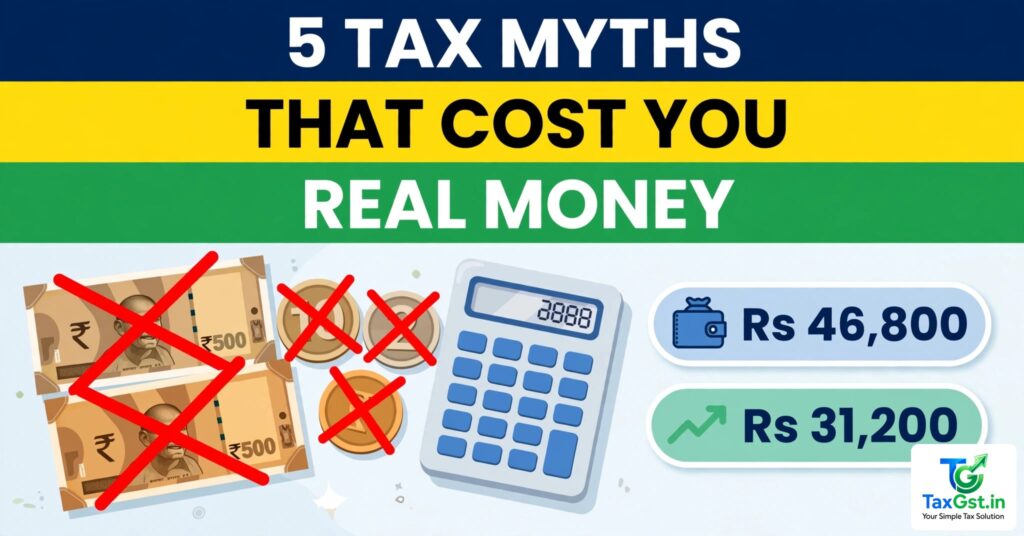
Five beliefs cost Indian taxpayers real money every year: that ₹12 lakh of income means zero tax (the Section 87A rebate does not cover tax on capital gains taxed at special rates); that Section 80C works in the new regime (it doesn’t — only the old regime allows it); that no return is needed if TDS was already deducted (you must file if income exceeds the basic exemption, and unclaimed refunds never come on their own); that GST registration starts only at ₹40 lakh (services start at ₹20 lakh, and inter-state sellers and e-commerce sellers must register at any turnover); and that all gifts are tax-free (gifts above ₹50,000 a year from non-relatives are taxable). Each myth below carries the correct rule and the rupee cost of believing it. Verified November 2026 · TaxGST.in
Meera earns ₹10 lakh salary and made ₹1.5 lakh in short-term capital gains this year. Total income ₹11.5 lakh — under ₹12 lakh — so she assumes she owes no tax at all. She is wrong by ₹31,200, and she will discover it only when the intimation arrives. Her mistake is one of five myths that circulate so widely they feel like rules. Each has a real number attached to it, and each is fixable before 31 March if you catch it now.
For the full income-tax picture, start with the Income Tax hub — slabs, ITR filing and deduction guides, which puts every rule below in context.
Myth 1: “My income is under ₹12 lakh, so I pay zero tax”
The myth: under the new regime, income up to ₹12 lakh is tax-free, so anyone below ₹12 lakh owes nothing.
The reality: the zero-tax outcome comes from the rebate under Section 87A (Section 156 of the Income-tax Act, 2025) — up to ₹60,000 for total income up to ₹12 lakh. But the rebate is not available against tax on income charged at special rates, such as short-term capital gains on equity (Section 111A) or long-term capital gains on equity (Section 112A). Section 112A(6) bars it against LTCG tax outright, and the ITR utility blocks it against STCG too.
What it costs: salary ₹10,00,000 plus STCG of ₹1,50,000 gives total income of ₹11,50,000 — under the ₹12 lakh line. Tax on the salary portion is fully covered by the rebate. But the STCG is taxed at 20%: ₹1,50,000 × 20% = ₹30,000, plus 4% cess = ₹31,200 payable. Believing the myth means no advance tax and no planning — and interest under Sections 234B and 234C on top. Read the Section 87A rebate guide for the full statutory position.
Myth 2: “Section 80C saves tax in the new regime too”
The myth: PPF, ELSS, life insurance premium and tuition fees cut your tax whichever regime you pick.
The reality: Section 80C (Section 123 of the Income-tax Act, 2025) — the ₹1.5 lakh deduction — exists only in the old regime. The new regime, which is the default, allows almost no Chapter VI-A deductions: only the standard deduction of ₹75,000 for salaried taxpayers, the employer’s NPS contribution under Section 80CCD(2), and the Agniveer benefit survive. In the new regime your 80C investments give you zero tax benefit.
What it costs: at the 30% slab, a ₹1.5 lakh deduction is worth ₹45,000 plus 4% cess — ₹46,800 a year — for someone in the old regime. The fix is a regime comparison before the year ends: the guide to deductions you lose in the new regime lists each one with its annual impact.
Myth 3: “TDS was already deducted, so I don’t need to file a return”
The myth: if tax was deducted at source, the department already has its money and there is nothing left to do.
The reality: TDS is a collection mechanism, not a filing exemption. You must file a return if your gross total income exceeds the basic exemption limit — ₹4 lakh under the new regime (₹2.5 lakh under the old regime) for FY 2025-26. And the reverse is just as common: TDS deducted in excess of your actual liability is refunded only when you file a return claiming it.
What it costs: a retiree with ₹3 lakh of FD interest and ₹30,000 TDS deducted owes nil tax — but the ₹30,000 refund arrives only if she files. Every year, crores in small refunds sit unclaimed because people assume TDS means “done”. For AY 2026-27, the belated-return window runs till 31 December 2026. If TDS was deducted but is missing from your records, the guide to TDS missing from 26AS/AIS walks through the fix, and the belated and revised return guide covers both remaining windows.
Myth 4: “GST registration starts only at ₹40 lakh turnover”
The myth: small businesses need not think about GST until they cross ₹40 lakh.
The reality: ₹40 lakh is the threshold for suppliers of goods only (₹20 lakh in special-category states). For services it is ₹20 lakh (₹10 lakh in special-category states). And for some categories there is no threshold at all: inter-state suppliers, sellers of goods through an e-commerce operator, and casual taxable persons must register from the first rupee — Section 24 of the CGST Act makes registration compulsory regardless of turnover.
What it costs: a freelance designer in Pune with ₹8 lakh of annual billing, all to clients in other states, believes she is safely below the limit. She is not — inter-state supply makes registration compulsory, and every invoice raised without GST is a gap that can draw a demand with interest. The penalty for failing to register is the higher of ₹10,000 or the tax evaded. If you are near any threshold, check the GST registration thresholds and documents guide before the next invoice goes out.
Myth 5: “All gifts are tax-free in India”
The myth: India has no gift tax, so any money anyone gives you is yours, tax-free.
The reality: gifts from specified relatives — spouse, siblings, parents, children, and a defined list of others — are fully exempt, whatever the amount. But gifts from anyone else are exempt only up to ₹50,000 in aggregate in a year. Cross that line and the entire amount becomes taxable as income from other sources. The exception: gifts received on the occasion of your marriage are exempt even from non-relatives.
What it costs: a friend transfers ₹2,00,000 to help with a house deposit. It is not a relative, not a marriage gift, and it is above ₹50,000 — so the full ₹2,00,000 is added to your income. At the 30% slab that is ₹60,000 in tax plus cess, or ₹62,400. The same ₹2,00,000 from a parent would have cost nothing. Read the full guide to tax on gifts received for the complete relative list and the clubbing trap for gifts routed through family members.
The 2-minute myth audit
- Income mix: any capital gains at special rates? The 87A rebate will not cover that part.
- Regime: in the new regime, stop counting 80C, 80D and HRA as savings — they only work in the old regime.
- TDS: is tax deducted higher than your real liability? File and claim the refund before 31 December 2026.
- GST threshold: services at ₹20 lakh, goods at ₹40 lakh — and zero threshold for inter-state and e-commerce sellers.
- Gifts: add up everything from non-relatives this year; above ₹50,000, it is taxable.
FAQs
Is income up to ₹12 lakh really tax-free?
Only income taxed at slab rates. The Section 87A rebate (up to ₹60,000) covers slab-rate tax up to ₹12 lakh, but it does not apply to capital gains at special rates — STCG at 20% and LTCG at 12.5% on equity stay payable.
Can I claim 80C in the new regime?
No. Section 80C, 80D, HRA and LTA are old-regime-only. The new regime keeps the ₹75,000 standard deduction and the employer’s NPS contribution.
Must I file ITR if my income is below the taxable limit but TDS was deducted?
Not legally required — but filing is the only way to get the deducted tax refunded. For AY 2026-27, file by 31 December 2026 as a belated return.
Sources
Section 87A (Section 156, Income-tax Act, 2025) — rebate up to ₹60,000 for income up to ₹12 lakh; Section 112A(6) — rebate not admissible against LTCG tax; Section 111A — STCG on equity at 20%. Section 80C (Section 123) — ₹1.5 lakh, old regime only. Section 139(1) — filing above the basic exemption (₹4 lakh new regime / ₹2.5 lakh old regime, FY 2025-26). Section 56(2)(x) — gifts from non-relatives above ₹50,000 a year taxable. Sections 22 and 24, CGST Act, 2017 — registration thresholds (₹40 lakh goods / ₹20 lakh services). Finance Act, 2025 and Finance Act, 2026.
Discover more from TaxGst.in
Subscribe to get the latest posts sent to your email.