 C.K. Gupta
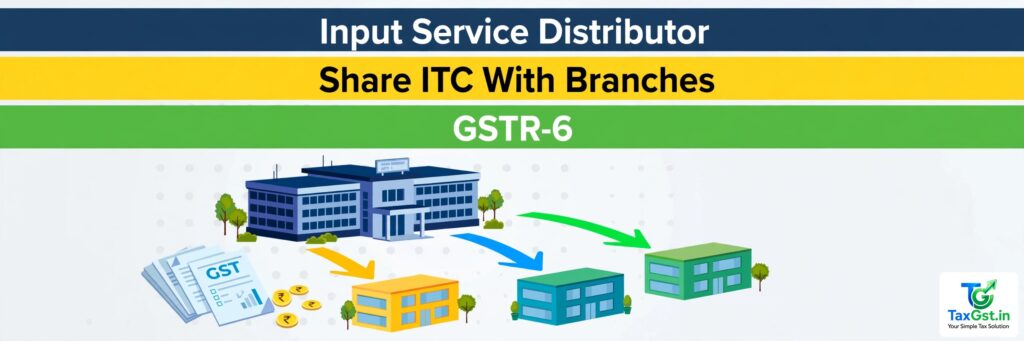
You run finance for a company with offices in Delhi, Mumbai and Bengaluru. The Delhi head office signs one ERP contract, pays one audit fee, buys one insurance policy. The invoices all land in Delhi, with GST on them, but the software is used in all three offices. Whose return claims that credit?
What an ISD actually is
Section 2(61) of the CGST Act defines an ISD as an office that receives tax invoices for input services, including reverse-charge services, for or on behalf of distinct persons under Section 25, and must distribute the credit as Section 20 requires.
A “distinct person” is simply another registration of the same business under the same PAN: your three GSTINs are distinct persons even though they belong to one company. And ISD covers services only: goods and capital goods bought centrally move as supplies between registrations, not through the ISD. For the foundations, the GST hub’s step-by-step guides on registration, returns and ITC cover the basics.
Mandatory since 1 April 2025
The Finance Act, 2024 rewrote Sections 2(61) and 20, effective 1 April 2025 (Notification No. 16/2024-Central Tax, 6 August 2024). The matching Rule 39 changes came via Notification No. 12/2024-Central Tax (10 July 2024), in force from the same date (Notification No. 09/2025-Central Tax, 11 February 2025).
The effect is blunt: if your office receives input-service invoices for distinct persons, Section 20(1) says it shall register as an ISD under Section 24(viii) and shall distribute the credit. There is no turnover threshold, and the old choice between ISD and cross-charging is gone for common third-party services.
How the credit is split
Rule 39 of the CGST Rules sets the mechanics:
- Same month, never more than available. Credit available in a month must be distributed in that month, reported in GSTR-6, and never exceed the credit available. As clarified in October 2026, “available” means the month the ISD ascertains the credit to be prima facie eligible from GSTR-6A, not the month the invoice arrived.
- One branch, one recipient. Credit attributable to a single branch goes only to that branch.
- Shared services go pro rata on turnover. Credit for more than one branch, or all branches, is split in proportion to each branch’s turnover in its State during the relevant period: C1 = (t1 / T) x C. The relevant period is the preceding financial year (or the last quarter with full turnover details if there was none). Unregistered and exempt-supply recipients count in the ratio if the service is attributable to them.
- Eligible and blocked credit stay separate. Credit ineligible under Section 17(5) or otherwise must be distributed separately. Check which credits are blocked under Section 17(5) of the CGST Act before you distribute anything.
Worked example: ₹1,80,000 of IGST across three branches
The Delhi head office receives an ERP subscription and the annual audit, with ₹1,80,000 IGST. Preceding-year turnovers: Delhi ₹50 crore, Mumbai ₹30 crore, Bengaluru ₹20 crore, a 5:3:2 ratio on ₹100 crore aggregate.
| Branch | Preceding-FY turnover | Share | IGST distributed |
|---|---|---|---|
| Delhi | ₹50 crore | 50% | ₹90,000 |
| Mumbai | ₹30 crore | 30% | ₹54,000 |
| Bengaluru | ₹20 crore | 20% | ₹36,000 |
| Total | ₹100 crore | 100% | ₹1,80,000 |
Check it: ₹90,000 + ₹54,000 + ₹36,000 = ₹1,80,000, exactly the credit received. Each branch gets IGST (Rule 39(1)(i)). CGST and SGST, by contrast, go as CGST/SGST to a same-State branch and as IGST to an out-of-State branch. The ISD issues an ISD invoice to each branch, reported in that month’s GSTR-6; a later supplier credit note is apportioned in the same 5:3:2 ratio.
Registration and the monthly routine
Register once. Rule 8(1) requires a separate REG-01 application for ISD registration, in addition to the office’s regular registration on the same PAN. There is no bar on multiple ISD registrations in the same State: each separately registered vertical or place of business receiving such invoices needs its own. Before applying, map every centrally procured service and decide which branches each is attributable to. Registration changed during 2026, so read the 2026 GST registration overhaul and what it changed for new applicants alongside this.
Every month: distribute, then file GSTR-6. Check GSTR-6A, where inward-supply details now flow to the ISD, and record the month you ascertain each invoice’s credit to be prima facie eligible: that is the distribution month. Issue an ISD invoice under Rule 54(1) for each distribution, stating it is issued only for distribution of input tax credit, and an ISD credit note if distributed credit is later reduced. File GSTR-6 by the 13th of the following month (Section 39(4)), even in a nil month. Reconcile GSTR-6A against your purchase register before filing: if an invoice is missing, find out why before the month closes, because the common reasons ITC goes missing from GSTR-2B and how to fix each one apply the same way to credits the ISD is waiting on. Eligibility and reversals stay with the branches, which satisfy Sections 16 and 17 and make any reversals.
What changed in October 2026
The 57th GST Council (8 October 2026) recommended a circular clarifying the ISD mechanism. CBIC issued Circular No. 260/06/2026-GST dated 26 October 2026, and Notification No. 05/2026-Central Tax of the same date amended Rules 36, 39, 54(1A) and 60 and Forms GSTR-6 and GSTR-6A from 1 November 2026.
What actually changed: the timing rule now runs from ascertainment. The “common services” restriction on reverse-charge transfers is gone: under Rules 39(1A) and 54(1A), a regular registration with the same PAN and State code as the ISD can transfer reverse-charge credit on services attributable to one or more distinct persons. A Rule 54(1A) transfer document is only a credit-transfer mechanism, not an outward supply: its value is not turnover in the State, and the transferred credit is not “Net ITC” for refunds. The transferor makes no Section 17 reversals and passes the entire amount to the ISD; the recipients do the reversals.
The core is unchanged since April 2025: mandatory registration, the turnover formula and the monthly GSTR-6 cycle. The expensive mistakes remain the same three: spreading a branch-specific service across all branches, distributing later than the ascertainment month, and pooling blocked credit with eligible credit. Wrong distribution attracts a penalty on the ISD under Section 122(1)(ix), ₹10,000 or the tax evaded or ITC irregularly distributed, whichever is higher, and excess credit is recovered from the recipients with interest under Section 21. Keep the attribution sheet, GSTR-6A workings and ascertainment dates on file. The ISD cannot create credit that does not exist, so reconciling GSTR-2B with GSTR-3B every month at each branch is what makes the distributed credit usable.
FAQs
Is ISD registration compulsory or optional?
Compulsory since 1 April 2025: under Section 20(1), an office receiving such invoices must register as an ISD and distribute the credit.
Can one company have more than one ISD registration?
Yes. Circular No. 260/06/2026-GST (26 October 2026) confirms there is no bar on multiple ISD registrations in the same State.
By when must GSTR-6 be filed?
By the 13th of the following month (Section 39(4)). A nil return is filed when there is nothing to distribute.
Who is responsible if distributed credit turns out to be ineligible?
The recipients. The branches must satisfy Sections 16 and 17 and make any reversals. But if the distribution itself contravenes Section 20, the ISD faces the Section 122(1)(ix) penalty, and excess credit is recovered from the recipients under Section 21.
Sources
- CGST Act, 2017, Sections 2(61), 20, 21, 24(viii), 39(4), 122(1)(ix) — CBIC Tax Information Portal. (Section 20 substituted w.e.f. 1 April 2025.)
- CGST Rules, 2017, Rules 8(1), 39, 54(1)/(1A), 65 — CBIC Tax Information Portal.
- Notifications No. 16/2024-Central Tax (6 Aug 2024), No. 12/2024-Central Tax (10 Jul 2024) and No. 09/2025-Central Tax (11 Feb 2025) — CBIC.
- Circular No. 260/06/2026-GST, 26 Oct 2026, under s.168(1), per the 57th GST Council meeting of 8 Oct 2026 — CBIC, GST Policy Wing.
- Notification No. 05/2026-Central Tax, 26 Oct 2026, CGST (Amendment) Rules, 2026, effective 1 Nov 2026 — CBIC.
Discover more from TaxGst.in
Subscribe to get the latest posts sent to your email.