 C.K. Gupta
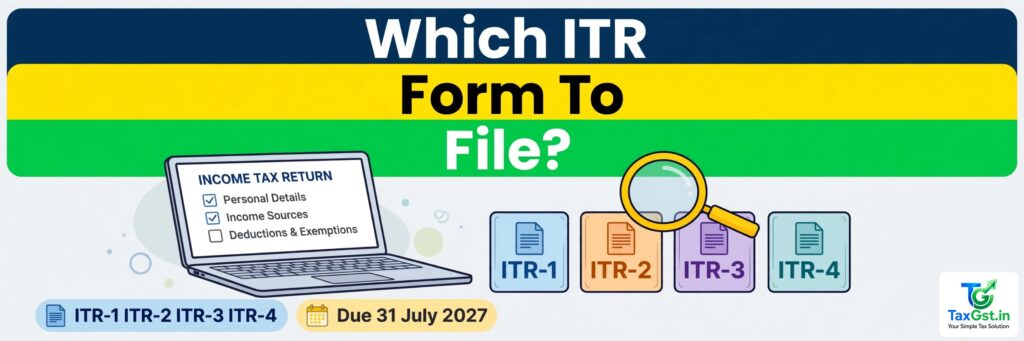
You filed ITR-1 because your salary is your only income and the form took ten minutes. Then in March you sold some shares and made ₹80,000. You file ITR-1 again, because nothing else changed. Three months later a defective-return notice arrives, and the return you thought was done has to be filed again — this time in the right form, with the capital gains schedule, before the deadline. The mistake was not the shares. It was the form. There are four ITR forms that cover almost every individual, and the choice is made by your income sources, not by your convenience. Here is how to pick the right one for tax year 2026-27.
ITR-1 (Sahaj): the simple-salary form
ITR-1 is for a resident individual whose total income is ₹50 lakh or less, and whose income comes only from salary, one house property, and other sources such as bank interest — plus agricultural income up to ₹5,000. That is the whole list. You cannot use ITR-1 if you have any capital gains at all, any foreign income or foreign assets, any income from more than one house property, a directorship in an unlisted company, unlisted equity shares, or income that has to be reported under the new foreign-asset disclosure rules. A single share sale, a single mutual-fund redemption, or a single ESOP in a foreign company pushes you out of ITR-1. The what is ITR guide explains the seven ITR forms and who must file at all, and the income tax hub carries the filing deadlines and the return-filing checklist for the year.
ITR-2: capital gains, foreign income, and everything above ₹50 lakh
ITR-2 is the form for individuals and HUFs who do not have business or profession income, but whose income is not simple enough for ITR-1. Use it if you have capital gains of any kind, foreign income or foreign assets, income from more than one house property, total income above ₹50 lakh, cryptocurrency or virtual digital assets, or agricultural income above ₹5,000. This is also the form for anyone disclosing foreign assets under the FAST-DS window, which closes on 31 December 2026 — foreign bank accounts, ESOPs and RSUs all belong in the foreign-asset schedule of ITR-2 or ITR-3, never in ITR-1. The commonest ITR-2 filers are salaried people who also invest: salary plus a share sale, salary plus a mutual-fund redemption, salary plus rent from a second house. If that is you, ITR-2 is your form even if your salary is modest. The salary plus side income guide shows how the AIS picks up capital gains and dividends, and why the form matters — the AIS reports the gain, and if your return has no schedule for it, the mismatch is automatic.
ITR-3 and ITR-4: business, profession, and presumptive tax
ITR-3 is for individuals and HUFs with income from business or profession. Freelancers, consultants, F&O traders, doctors, lawyers, architects, and anyone running a business file ITR-3 — unless they opt for presumptive taxation, in which case ITR-4 applies. The dividing line is the scheme, not the work: a freelancer who maintains books and claims actual expenses files ITR-3; the same freelancer who declares income at 50% of gross receipts under Section 44ADA files ITR-4. ITR-4 (Sugam) covers presumptive taxation under Section 44AD (small businesses, 6% or 8% of turnover), Section 44ADA (professionals, 50% of receipts) and Section 44AE (goods carriage), with total income up to ₹50 lakh and no capital gains, foreign income, or more than one house property. Here is the catch: the moment a presumptive taxpayer has a capital gain — selling a mutual fund, for instance — ITR-4 is closed to them and they must file ITR-3. The Section 87A rebate guide is worth reading alongside this one, because the rebate does not apply to capital gains taxed at special rates, whatever form you file.
| Your situation | Form |
|---|---|
| Salary only, one house, income up to ₹50 lakh | ITR-1 |
| Salary plus capital gains, or foreign income/assets | ITR-2 |
| Salary plus more than one house, or income above ₹50 lakh | ITR-2 |
| Freelance, consultancy, F&O, or any business income | ITR-3 |
| Presumptive taxation (44AD / 44ADA / 44AE), no capital gains | ITR-4 |
| Presumptive taxpayer who also sold shares or funds | ITR-3 |
| Company, LLP, firm, trust, or AOP | ITR-5, ITR-6, or ITR-7 |
What happens if you pick the wrong form
Filing in the wrong form does not just mean a correction — the return can be treated as defective, and you will get a notice asking you to file a revised return in the correct form within the time allowed. The defective return notice guide explains the six common defects and the fix for each, and a wrong form is one of them. The practical damage is the delay: a defective return is not processed, so your refund waits, and if the correction crosses the deadline for revised returns, the return may not be accepted at all. The usual deadline for tax year 2026-27 is 31 July 2027 for individuals who do not need an audit. Before you file, run through three questions: did I sell anything this year, do I hold anything foreign, and did I earn anything outside salary? One yes to the first two means ITR-2 or ITR-3. One yes to the third, with business income, means ITR-3 or ITR-4. Run the numbers for your situation on the income tax calculator once you know which form applies.
Frequently asked questions
Can I file ITR-1 if I sold shares this year?
No. Any capital gain, however small, disqualifies you from ITR-1. A single share sale or mutual-fund redemption means ITR-2 if you have no business income, or ITR-3 if you do.
Which ITR form is for freelancers?
ITR-3 if you maintain books and claim actual expenses, or ITR-4 if you opt for presumptive taxation under Section 44ADA and have no capital gains or foreign income. A freelancer with capital gains must file ITR-3 even under the presumptive scheme.
Do I need ITR-2 if my income is above ₹50 lakh?
Yes, if you are an individual or HUF without business income. ITR-1 is limited to total income of ₹50 lakh or less. Above that, ITR-2 applies even if your income is only salary and interest.
Which form do I use for foreign income or foreign assets?
ITR-2 if you have no business income, or ITR-3 if you do. ITR-1 and ITR-4 both bar foreign income and foreign assets entirely, including ESOPs and RSUs in foreign companies.
What is the last date to file ITR for tax year 2026-27?
The usual deadline is 31 July 2027 for individuals who do not require an audit. The CBDT can extend it, as it has in past years, so check the current notification before the deadline.
Sources
- Central Board of Direct Taxes, ITR form notifications — ITR-1 (Sahaj) for resident individuals with total income up to ₹50 lakh from salary, one house property and other sources; ITR-2 for individuals and HUFs with capital gains, foreign income or assets, more than one house property, or income above ₹50 lakh; ITR-3 for business or profession income; ITR-4 (Sugam) for presumptive taxation under Sections 44AD, 44ADA and 44AE.
- Income-tax Act, 2025 — presumptive taxation provisions carried forward as Sections 44AD, 44ADA and 44AE equivalents; foreign-asset disclosure under the FAST-DS window notified by the CBDT, open 16 August to 31 December 2026.
- Income Tax Department, e-filing portal guidance — a return filed in the wrong ITR form is treated as a defective return and must be corrected by filing a revised return in the correct form within the time allowed.
Discover more from TaxGst.in
Subscribe to get the latest posts sent to your email.