 C.K. Gupta
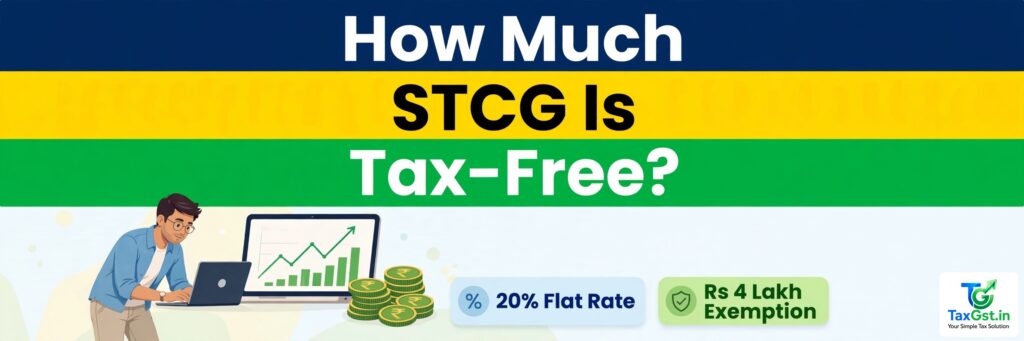
You sold shares you bought eight months ago and made ₹1,50,000. Your friend says short-term gains are tax-free up to ₹1.25 lakh. Your broker’s tax statement says otherwise. Both of them are half right, and the half that is wrong is the expensive one. The ₹1.25 lakh exemption belongs to long-term gains, not short-term ones. Short-term gains on listed equity are taxed at a flat 20%, with no exemption at all — except for one quiet rule that can still make a small gain completely tax-free. Here is exactly how much STCG is tax-free, in four situations.
The headline rate: 20%, no exemption
Short-term capital gains on listed equity shares, equity-oriented mutual funds and units of business trusts — held for 12 months or less, with securities transaction tax paid — are taxed at 20% under Section 196 of the Income-tax Act, 2025 (the old Section 111A of the 1961 Act). The rate has been 20% since 23 July 2024, when the Finance (No. 2) Act, 2024 raised it from 15%, and the Income-tax Act, 2025 kept the rate and only changed the section number. Unlike long-term gains under Section 198 (old Section 112A), which are taxed at 12.5% only on the amount above ₹1.25 lakh a year, short-term gains have no annual exemption threshold. A ₹10,000 gain and a ₹10,00,000 gain are both taxed at 20% on the full amount. The income tax hub carries the full capital-gains rate table, and the mutual fund taxation guide shows how the same 20% and 12.5% rates apply to equity fund units.
The rule that makes small STCG tax-free: the basic exemption set-off
Here is the part almost nobody knows. A resident individual or HUF can set off STCG under Section 196 against any part of the basic exemption limit that their other income has not used up. In the new regime the basic exemption is ₹4 lakh. So the question is never “how much STCG is tax-free?” in the abstract — it is “how much of your ₹4 lakh exemption is still unused?”
Take Meena, 68, a retiree with a pension of ₹3 lakh and STCG of ₹1 lakh from selling shares. After the ₹75,000 standard deduction on her pension, her taxable income is ₹3,25,000 — below the ₹4 lakh basic exemption. Her STCG is entirely tax-free, because her total income never crosses the exemption limit. Now take a salaried person with taxable salary of ₹6 lakh and STCG of ₹2 lakh. The salary alone has already used up the whole ₹4 lakh exemption, so the full ₹2 lakh of STCG is taxed at 20%: ₹40,000, plus 4% cess, or ₹41,600. And the middle case: other income of ₹1 lakh and STCG of ₹5 lakh. The unused exemption is ₹3 lakh, so only ₹2 lakh of the gain is taxed — ₹40,000 plus cess. The gain is never taxed on the part that fits inside your unused exemption. Two limits on this rule: it applies only to resident individuals and HUFs, not to NRIs or companies, and it applies only to STCG taxed at the special 20% rate and to long-term gains — not to income taxed at slab rates, which uses the exemption in the ordinary way.
The rebate trap: ₹12 lakh income, still ₹20,800 tax
This is the expensive misunderstanding. The Section 156 rebate — up to ₹60,000 where total income is ₹12 lakh or less in the new regime — does not apply to income taxed at special rates. The Finance Act, 2025 and a CBDT clarification of February 2026 both make this clear: the rebate covers only income taxed at slab rates. Work it through. A salaried person has taxable salary of ₹9 lakh and STCG of ₹1 lakh, so total income is ₹10 lakh — comfortably inside the rebate limit. Slab tax on the ₹9 lakh salary is ₹30,000 (5% on ₹4 lakh, 10% on ₹1 lakh), and the rebate wipes it out completely. But the ₹1 lakh of STCG is still taxed at 20%: ₹20,000, plus 4% cess, or ₹20,800 payable. Total income under ₹12 lakh, rebate claimed in full, and still a tax bill of ₹20,800. The Section 87A rebate guide explains this exclusion in full, with the marginal-relief rules for income just above ₹12 lakh. The tax myths roundup lists this as one of the costliest myths doing the rounds — “zero tax up to ₹12 lakh” is true only for slab-rate income.
Not all STCG is 20%: the slab-rate kind
Only listed equity with STT paid gets the 20% special rate. Everything else is taxed at your slab rate, and for that kind of STCG the basic exemption and the rebate both work normally. Debt mutual fund units bought on or after 1 April 2023 are always treated as short-term, whatever the holding period, under Section 76 (old Section 50AA), and taxed at slab rates. Unlisted shares, property sold within 24 months, gold sold within 24 months, and units of specified debt funds all fall in this bucket too. So a ₹2 lakh short-term gain on a debt fund for someone with total income of ₹9 lakh is taxed at 10%, not 20% — and the rebate can wipe that out entirely if total income stays within ₹12 lakh. Which is why the asset matters as much as the amount: the same ₹2 lakh gain costs ₹41,600 as equity STCG for a ₹6 lakh earner, and nothing at all as debt-fund STCG for a ₹9 lakh earner inside the rebate limit. Check the holding periods and the rate for your asset in the salary plus side income filing guide, which also explains how the AIS picks up these gains and why unreported STCG is the commonest reason for a mismatch notice.
What to do before 31 March 2027
Three practical moves. First, if your total income for the year is below ₹4 lakh, harvest the gain: sell and rebuy, and the STCG is tax-free because it sits inside your unused exemption. Second, if you are near the ₹12 lakh rebate boundary, remember that STCG does not get the rebate — a ₹1 lakh gain at ₹11.5 lakh of salary still costs ₹20,800. Third, do not confuse the ₹1.25 lakh LTCG exemption with STCG: holding a share for 12 months and one day converts the gain to long-term, taxed at 12.5% only above ₹1.25 lakh a year. A ₹2 lakh gain held 11 months costs ₹41,600; the same gain held 13 months costs ₹9,750 (12.5% on ₹75,000 above the exemption, plus cess). That is a ₹31,850 difference for waiting a few weeks — provided the price holds, which is a market call, not a tax call. Run the numbers for your own portfolio on the income tax calculator before you sell.
Frequently asked questions
Is STCG tax-free up to ₹1.25 lakh?
No. The ₹1.25 lakh annual exemption applies only to long-term capital gains on listed equity under Section 198. Short-term gains under Section 196 are taxed at 20% from the first rupee, except for the part covered by your unused basic exemption limit.
How much STCG can I earn without paying tax?
As much as fits inside your unused basic exemption limit. In the new regime that is ₹4 lakh minus your other taxable income. With no other income, up to ₹4 lakh of STCG is tax-free; with ₹3 lakh of other income, up to ₹1 lakh of STCG is tax-free.
Does the Section 87A rebate apply to STCG?
No, not to STCG taxed at the special 20% rate under Section 196, nor to LTCG under Section 198. The Finance Act, 2025 and the CBDT clarification of February 2026 exclude special-rate income from the rebate. It does apply to STCG taxed at slab rates, such as debt-fund gains.
Can an NRI use the basic exemption against STCG?
No. The set-off of STCG against the unused basic exemption limit is available only to resident individuals and HUFs. An NRI pays 20% on the full STCG under Section 196.
What is the STCG rate on equity shares?
20% under Section 196 of the Income-tax Act, 2025 (old Section 111A), for listed shares and equity-oriented funds held for 12 months or less with STT paid. The rate has applied since 23 July 2024.
Sources
- Finance (No. 2) Act, 2024 — short-term capital gains on listed equity raised from 15% to 20% with effect from 23 July 2024; long-term gains raised from 10% to 12.5% with the annual exemption raised from ₹1 lakh to ₹1.25 lakh.
- Income-tax Act, 2025, Section 196 (tax on short-term capital gains in certain cases, formerly Section 111A of the 1961 Act, 20% rate, with the proviso allowing resident individuals and HUFs to set off the gain against the unused basic exemption limit), Section 198 (long-term gains, formerly Section 112A, 12.5% above ₹1.25 lakh a year), Section 197 (general long-term gains, formerly Section 112), and Section 76 (specified mutual funds deemed always short-term, formerly Section 50AA).
- Finance Act, 2025 and CBDT clarification, February 2026 — the Section 156 rebate does not apply to income taxed at special rates under Sections 196 and 198.
Discover more from TaxGst.in
Subscribe to get the latest posts sent to your email.