 C.K. Gupta
Your father is 68, retired, and his pension is ₹9 lakh a year. He asks whether he gets a special senior-citizen tax slab, and whether he needs to file at all. The honest answer surprises most families: in the new regime his age changes nothing about the slabs, and yet he will probably pay zero tax. The confusion comes from mixing up two different systems — the old regime, where age genuinely matters, and the new regime, where it does not. Get the two mixed up and you either overpay or file the wrong way. Here is the full picture for tax year 2026-27, with the numbers worked out at five income levels.
The new-regime slabs: the same for every age
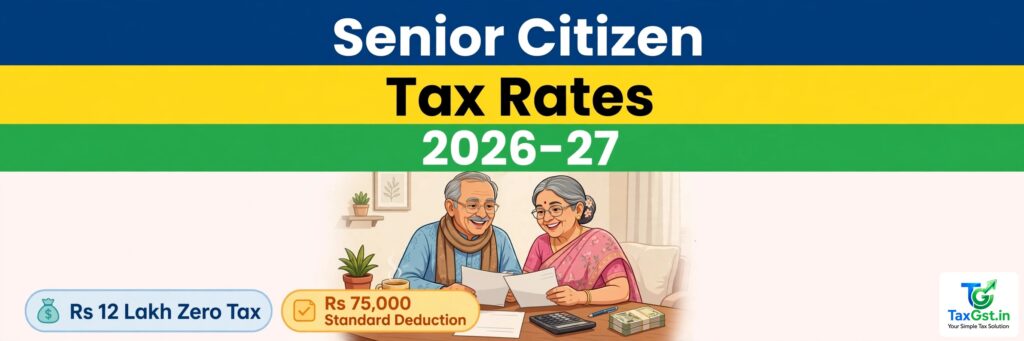
Under the Finance Act, 2025, the new-regime slabs for tax year 2026-27 are the same for a 25-year-old and an 85-year-old: nil up to ₹4 lakh, 5% from ₹4 lakh to ₹8 lakh, 10% from ₹8 lakh to ₹12 lakh, 15% from ₹12 lakh to ₹16 lakh, 20% from ₹16 lakh to ₹20 lakh, 25% from ₹20 lakh to ₹24 lakh, and 30% above ₹24 lakh. Add 4% health and education cess on the tax. There is no senior-citizen slab in this regime at all, and no separate basic exemption for age. What seniors do get, exactly like everyone else, is the ₹75,000 standard deduction on salary and pension income, and the rebate under Section 156 of the Income-tax Act, 2025: up to ₹60,000 of tax wiped out where total income is ₹12 lakh or less. Those two, stacked together, are what make a pension of up to ₹12.75 lakh effectively tax-free. The income tax hub carries the full new-regime slab table and the regime comparison, and the Section 87A rebate guide explains the ₹12 lakh zero-tax limit and the marginal relief that softens the cliff just above it.
Worked examples: pension income in the new regime
Take five pensioners, all aged 65, all in the new regime, and all with no income other than pension. The standard deduction of ₹75,000 comes off first, then the slabs, then the rebate.
| Annual pension | Taxable income | Tax before rebate | Tax payable |
|---|---|---|---|
| ₹8,00,000 | ₹7,25,000 | ₹16,250 | Nil (rebate covers it) |
| ₹12,00,000 | ₹11,25,000 | ₹52,500 | Nil (rebate covers it) |
| ₹13,00,000 | ₹12,25,000 | ₹63,750 | ₹66,300 with cess |
| ₹15,00,000 | ₹14,25,000 | ₹93,750 | ₹97,500 with cess |
| ₹20,00,000 | ₹19,25,000 | ₹1,85,000 | ₹1,92,400 with cess |
Check the ₹13 lakh row, because that is where the rebate cliff sits. Total income of ₹13 lakh is above the ₹12 lakh rebate limit, so no rebate at all. But marginal relief caps the tax at the income above ₹12 lakh, which is ₹1,00,000 — and the computed tax of ₹63,750 is below that cap, so the full ₹63,750 stands. At ₹15 lakh the tax is ₹97,500 including cess, and at ₹20 lakh it is ₹1,92,400. Notice what the table really says: nothing is payable up to ₹12 lakh of pension, and the tax then rises in a straight line. A senior with ₹12 lakh of pension and ₹1 lakh of bank interest is a different story, because interest is taxed at slab rates and the rebate still applies only if total income stays within ₹12 lakh — once it crosses, the whole rebate goes. Run your own numbers on the income tax calculator before deciding anything.
The old regime: where age actually pays
The old regime is where senior and super senior status still carries real money. The basic exemption is ₹3 lakh for a senior citizen (60 to 79) and ₹5 lakh for a super senior citizen (80 and above), against ₹2.5 lakh for everyone else. The old-regime slabs above that are 5% up to ₹5 lakh, 20% from ₹5 lakh to ₹10 lakh, and 30% above ₹10 lakh for a senior; a super senior pays 20% from ₹5 lakh to ₹10 lakh and 30% above. The old-regime rebate under Section 156 is smaller — ₹12,500 where total income is ₹5 lakh or less — and it has no marginal relief. Two deductions exist only here: Section 153 gives seniors a ₹50,000 deduction on interest from savings accounts, fixed deposits and recurring deposits, and the ₹1.5 lakh Section 123 (old 80C) basket still applies. The senior and super senior citizen benefits guide lists every age threshold and benefit in one place, and the 80TTA vs 80TTB comparison shows why the ₹50,000 senior interest deduction beats the ₹10,000 limit for everyone else.
Old vs new at ₹15 lakh pension: a real comparison
Take a 65-year-old with a ₹15 lakh pension who also claims ₹1.5 lakh under Section 123 and ₹50,000 of bank interest under Section 153. In the old regime, taxable income is ₹15,00,000 minus ₹50,000 standard deduction, minus ₹50,000 interest deduction, minus ₹1,50,000 Section 123 — that is ₹12,50,000. Tax on it: 5% on ₹2 lakh (₹3 lakh to ₹5 lakh) is ₹10,000, 20% on ₹5 lakh is ₹1,00,000, and 30% on ₹2.5 lakh is ₹75,000 — a total of ₹1,85,000, or ₹1,92,400 with cess. In the new regime the same pensioner pays ₹97,500, as the table above shows. The new regime wins by ₹94,900 even with ₹2 lakh of deductions claimed. The old regime only starts to win when deductions are much larger — a big home-loan interest claim, heavy medical insurance premiums, or large HRA.
Three things seniors get wrong
First, the TDS threshold on bank interest. Since 1 April 2025, banks deduct TDS on interest only above ₹1,00,000 a year for senior citizens, against ₹50,000 for everyone else. No TDS does not mean no tax — the interest is still taxable, and it still counts towards the ₹12 lakh rebate limit. Second, the 75-plus rule. Section 194P lets a resident aged 75 or above skip filing a return entirely if their only income is pension and interest from the same specified bank, and the bank deducts the tax. It is a filing exemption, not a tax exemption, and it is already covered in the pension taxation guide, which also explains commuted and family pension. Third, the super senior at ₹10 lakh. An 82-year-old with a ₹10 lakh pension pays nothing in the new regime: taxable income after the standard deduction is ₹9,25,000, tax before rebate is ₹32,500, and the rebate wipes it out. In the old regime the same person would pay roughly ₹52,000 even after deductions, because the ₹5 lakh basic exemption does not stretch far enough. Age helps in the old regime, but the new regime’s rebate is usually the bigger gift.
Frequently asked questions
Is there a separate tax slab for senior citizens in the new regime?
No. The new-regime slabs are identical for all ages in tax year 2026-27. Seniors get the same ₹75,000 standard deduction and the same ₹60,000 rebate up to ₹12 lakh of income as everyone else.
At what pension does a senior citizen start paying tax?
In the new regime, a pension up to ₹12.75 lakh pays no tax: ₹75,000 standard deduction brings taxable income to ₹12 lakh, and the Section 156 rebate wipes out the tax. Above that, tax starts at 15% on the income over ₹12 lakh.
What is the basic exemption for senior citizens in the old regime?
₹3 lakh for senior citizens aged 60 to 79, and ₹5 lakh for super senior citizens aged 80 and above. These apply only in the old regime.
Can a senior citizen claim the ₹50,000 interest deduction in the new regime?
No. Section 153 (old 80TTB) is an old-regime-only deduction. In the new regime, bank interest is fully taxable at slab rates, though the rebate can still wipe out the total tax if income stays within ₹12 lakh.
Does a 75-year-old have to file a return?
Not necessarily. Under Section 194P, a resident aged 75 or above whose only income is pension and interest from the same specified bank can let the bank deduct the tax and skip filing. If there is any other income, the return is still required.
Sources
- Finance Act, 2025 — new-regime slabs for tax year 2026-27 (nil to ₹4 lakh, 5% to ₹8 lakh, 10% to ₹12 lakh, 15% to ₹16 lakh, 20% to ₹20 lakh, 25% to ₹24 lakh, 30% above), standard deduction ₹75,000 for salaried persons and pensioners, and the ₹1,00,000 TDS threshold on bank interest for senior citizens.
- Income-tax Act, 2025, Section 156 (rebate up to ₹60,000 where total income does not exceed ₹12 lakh in the new regime; ₹12,500 up to ₹5 lakh in the old regime), Section 153 (old Section 80TTB: ₹50,000 interest deduction for senior citizens, old regime only), Section 123 (old Section 80C: ₹1.5 lakh aggregate deduction), and Section 194P (filing exemption for specified senior citizens aged 75 and above).
- Finance Act rate schedule for the old regime — basic exemption ₹3 lakh for senior citizens aged 60 to 79 and ₹5 lakh for super senior citizens aged 80 and above; old-regime slabs 5% to ₹5 lakh, 20% to ₹10 lakh, 30% above.
Discover more from TaxGst.in
Subscribe to get the latest posts sent to your email.