 C.K. Gupta
Your business hires a contractor to renovate the office for ₹2,40,000. You pay the full amount, no TDS, because the invoice looked simple and nobody flagged it. Months later the assessing officer asks why no tax was deducted, and the interest and penalty on the missed TDS are now your problem, not the contractor’s. This is the most common TDS mistake small businesses make, and it is entirely avoidable. Contractor payments have a clear rule with a clear threshold, and once you know the two numbers, 30,000 and 1,00,000, you will never miss it again.
The rule, in one table
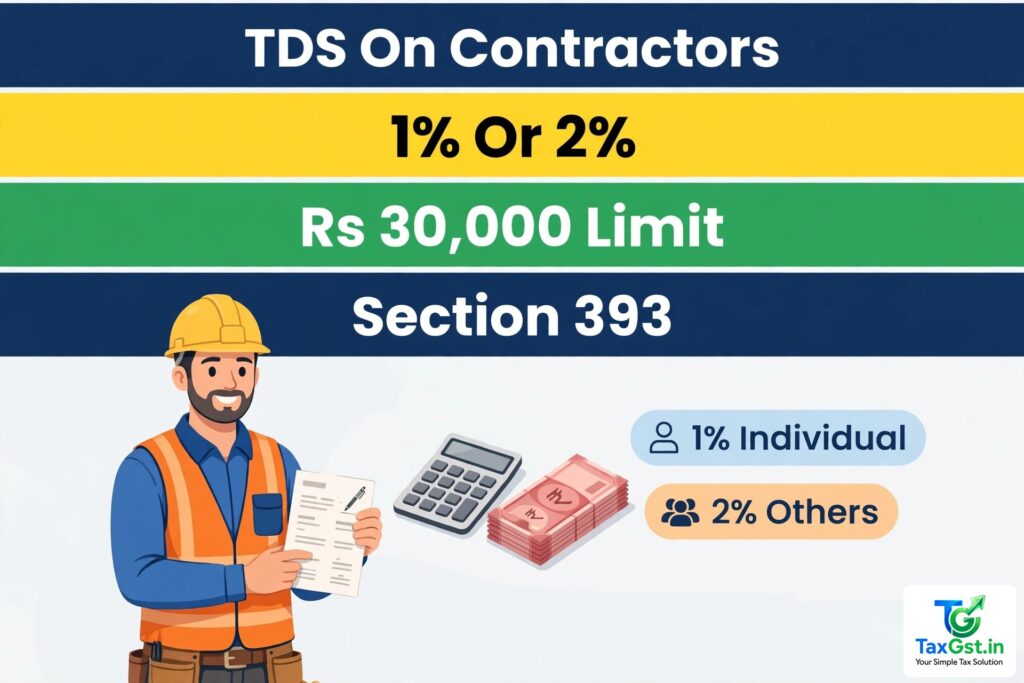
From 1 April 2026, contractor TDS sits in Section 393(1) Table Sl. No. 6(i) of the Income-tax Act, 2025, which replaced Section 194C of the 1961 Act. The rates and thresholds did not change in the move; only the reference did. For payments or credits up to 31 March 2026, the old Section 194C still governs, so check the date of the credit or payment, not the date of the invoice, when you decide which law applies.
| Contractor type | TDS rate | Payment code (new returns) |
|---|---|---|
| Individual or HUF | 1% | 1023 |
| Company, firm, LLP or any other person | 2% | 1024 |
| Any contractor without PAN | 20% | Same code, higher rate |
The thresholds are the part people get wrong. TDS applies when a single payment or credit exceeds ₹30,000, or when the aggregate of payments to that contractor during the tax year exceeds ₹1,00,000. If both conditions are below the limits, no TDS is due. The moment either limit is crossed, TDS applies to the payment that crosses it, on its full value, and to every payment after it. The TDS hub carries the full Section 393 rate table, including the other payment types that sit alongside contractor payments.
A worked example: the monthly contractor
Take a business that pays an individual contractor ₹25,000 a month for maintenance work. No single payment crosses ₹30,000, so at first glance nothing seems due. But the aggregate crosses ₹1,00,000 with the fifth payment: four payments total ₹1,00,000, and the fifth takes the running total to ₹1,25,000. TDS starts with that fifth payment, at 1% of ₹25,000, which is ₹250. The remaining eight payments of the year, ₹2,00,000 in total, attract TDS of ₹2,000. Total TDS for the year is ₹2,250, and it must be deposited and reported in the quarterly return, Form 140 under the new Act (old Form 26Q). Now change one fact: a single invoice of ₹40,000 to a firm. That crosses the ₹30,000 single-payment limit immediately, so TDS of 2%, or ₹800, is due on that payment alone, even if it is the only payment to that contractor all year. And here is the catch: if the contractor has not given you a PAN, the rate is 20% under Section 397(2) of the 2025 Act, the successor to Section 206AA. On that same ₹40,000 invoice, that is ₹8,000 instead of ₹800. Collect the PAN before the first payment, not after. Run the numbers for your own contractors on the TDS calculator before you pay.
Who must deduct, and who is exempt
Not everyone who pays a contractor must deduct TDS. The obligation falls on specified persons: the Central or State Government, local authorities, companies, firms, trusts, co-operative societies, universities and similar bodies. Individuals and HUFs are covered only if their business turnover exceeded ₹1 crore, or professional receipts exceeded ₹50 lakh, in the preceding financial year. And an individual or HUF paying a contractor purely for personal purposes, say renovating their own home, need not deduct at all. TDS is deducted at the earlier of credit to the contractor’s account or actual payment, so crediting the invoice in your books triggers the obligation even if you pay later.
“Work” is wider than construction. Under the provision it includes advertising, broadcasting and telecasting including production of programmes, carriage of goods or passengers by any mode of transport other than railways, catering, and manufacturing or supplying a product according to the customer’s requirement or specification using material purchased from the customer. Manufacturing using material bought from an independent person is excluded. Note the boundary with professional fees: the Finance Act, 2024 clarified that a payment falling under the professional-fees rule is not treated as work for contractor TDS. A CA’s bill is professional fees, not a contract for work, and the guide on TDS on professional and technical fees covers that side. Commission and brokerage sit in yet another row of the same table, explained in the guide on TDS on commission and brokerage.
The exceptions worth knowing
Three exceptions save real money. First, the transport-operator exception: no TDS if the contractor is a transporter who owns ten or fewer goods carriages in the preceding year and gives you a declaration with their PAN. Get that declaration in writing and keep it with the payment record. Second, the lower-deduction certificate: if a contractor’s total income is low, they can apply for a certificate for deduction at a lower rate or nil rate, and you must follow the certificate. The guide on the lower TDS certificate under Form 128 explains the application. Third, the sibling provision: if the payer is an individual or HUF who is not covered by the contractor rule at all, payments for contract work, professional fees or commission above ₹50 lakh in a year attract 2% TDS under the next row of the table, Section 393(1) Table Sl. No. 6(ii), the successor to old Section 194M. That is the rule that catches the high-value home renovation paid by a salaried person. The contractor issues the TDS certificate through Form 131, the new Form 16A, as explained in the Form 131 guide.
What goes wrong, and the fix
The four classic errors are: paying without checking the aggregate threshold, so small monthly payments quietly cross ₹1,00,000; deducting at 1% for a firm or 2% for an individual, because the rate follows the payee, not the payer; forgetting the 20% no-PAN rate; and deducting but never depositing or never filing the quarterly return, which leaves the credit out of the contractor’s Form 26AS and invites a notice both ways. The fix is a one-page routine: maintain a contractor-wise running total for the year, collect PAN before the first payment, deduct at the earlier of credit or payment, deposit by the 7th of the following month, file Form 140 quarterly, and issue the certificate. If TDS was deducted but is missing from your own 26AS or AIS as a deductee, the guide on TDS deducted but missing from 26AS walks through the correction path. Interest on late deduction runs at 1% a month, and late deposit at 1.5% a month, so a missed ₹2,250 deduction becomes a larger problem with every month you wait.
Frequently asked questions
Do I deduct TDS if I pay a contractor ₹25,000 every month?
Yes, once the year’s total crosses ₹1,00,000, which happens with the fifth payment. TDS starts from that payment, at 1% for an individual or HUF contractor and 2% for others, even though no single payment exceeds ₹30,000.
What if the contractor does not give a PAN?
TDS is deducted at 20% under Section 397(2) of the Income-tax Act, 2025, instead of 1% or 2%. Collect the PAN before the first payment.
Does TDS apply to a home renovation I pay for personally?
No, if you are an individual or HUF paying exclusively for personal purposes and you are not covered by the turnover test, no TDS applies under the contractor rule. But if your total payments for such work exceed ₹50 lakh in a year, the separate 2% rule under Section 393(1) Table Sl. No. 6(ii) may apply.
Is a transporter exempt from contractor TDS?
Yes, if the transporter owns ten or fewer goods carriages in the preceding year and furnishes a declaration with their PAN. Without the declaration, normal TDS applies.
Which form do I file for contractor TDS?
The quarterly TDS return in Form 140 under the Income-tax Act, 2025, which replaced Form 26Q. The contractor’s certificate is issued through Form 131, which replaced Form 16A.
Sources
- Income-tax Act, 2025, Section 393(1) Table Sl. No. 6(i) (contractor payments, formerly Section 194C of the Income-tax Act, 1961), Section 393(1) Table Sl. No. 6(ii) (successor to Section 194M), Section 395(1) (lower deduction certificate, Form 128, formerly Section 197 and Form 13), and Section 397(2) (20% rate without PAN, formerly Section 206AA); rates 1% for individual/HUF and 2% for others, thresholds ₹30,000 single payment and ₹1,00,000 aggregate.
- Income Tax Department transition guidance, 2026 — Section 194C applies to credits or payments up to 31 March 2026; Section 393(1) Table Sl. No. 6(i) applies from 1 April 2026; new payment codes 1023 (individual/HUF contractor) and 1024 (other contractor).
- TaxGuru, “Section 194C: TDS on Payments to Contractors and Sub-contractors” and “What is TDS Section 194C?” (verified November 2026) — rate table, thresholds, transport-operator exception, and the Finance (No. 2) Act, 2024 clarification that Section 194J payments are not work under Section 194C.
Discover more from TaxGst.in
Subscribe to get the latest posts sent to your email.