 C.K. Gupta
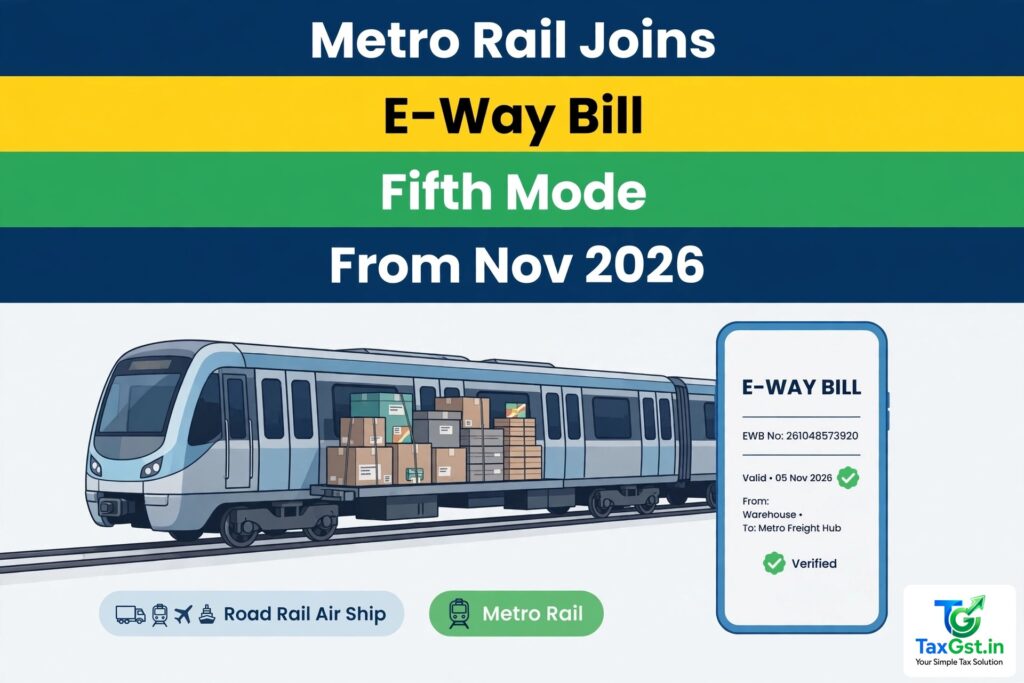
Until this month, the e-way bill portal recognised four ways to move goods: road, rail, air and ship. A business moving cargo on the Delhi Metro had no correct option to pick, because the portal’s “rail” mode was built for Indian Railways, not for a metro system. Delhi Metro’s plan to run depot-to-depot cargo through its Urban Freight Services hit exactly that wall. On 20 November 2026, GSTN fixed it. Metro Rail is now the fifth mode of transport in the e-way bill system, and here is what changes for you, what stays the same, and the two things to get right before you use it.
What GSTN actually announced
The Goods and Services Tax Network issued an advisory on 20 November 2026 adding Metro Rail as a mode of transport for e-way bills. The change follows a government notification dated 26 October 2026, which came after the GST Council recommended it at its meeting last month. The e-way bill system now has five modes: Road, Rail, Air, Ship and Metro Rail. For web users, the facility is live now, for generating e-way bills and updating transport details, and it also covers vehicle updates and the generation and re-generation of consolidated e-way bills. API users are in a different position: the facility is available in the sandbox environment for testing, and GSTN has said the production rollout for APIs will be announced separately. If your billing or logistics software talks to the portal through APIs, keep using the web portal for metro movements until that announcement lands. The GST hub’s e-way bill guides cover the rest of the system this change sits inside.
Why metro needed its own mode
The reason is legal, not technical. The expression “railways” is not defined in the GST rules, and metro rail systems, including the Delhi Metro Rail Corporation, are legally distinct from Indian Railways. The e-way bill portal was designed around Indian Railways, so it did not adequately cater to goods moving through a metro network, and DMRC faced operational difficulty running its planned depot-to-depot cargo pilot. Adding “Metro Rail” as an express mode removes that ambiguity. Other cities with metro networks benefit the same way: any metro system moving goods as middle-mile connectivity can now be recorded correctly instead of being squeezed into a rail entry that does not fit.
How to use it: two steps, one new field
Generating an e-way bill for metro movement works like any other mode, with one difference. Select Metro Rail as the mode of transport, and enter the transport document number, which is now mandatory for this mode. That number is the one detail to watch. As Rajat Mohan, Managing Partner at AMRG Global, pointed out, the amendment also extends to Metro Rail operators the bar on delivering goods unless the requisite e-way bill is produced at the time of delivery, and the mandatory transport document number still needs clarity on which metro-issued documents count and in what format. Until GSTN issues standardised documentation guidelines, keep the metro-issued transport document, the invoice and the e-way bill number together for every consignment, and confirm the document number format with the metro operator before the first movement. The same discipline applies when a bill expires mid-journey: the guide on what to do when an e-way bill expires in transit covers the first-eight-hours response that limits penalty exposure.
What has NOT changed
This is a new mode, not a new exemption, and that distinction is the whole story for most businesses. Under Rule 138 of the CGST Rules, 2017, every registered person moving goods of consignment value above ₹50,000, whether inter-state or intra-state, must generate an e-way bill, and that threshold still applies to metro movements. States may set a lower threshold for intra-state movement, and that power is untouched too. The existing exemptions continue as they are. The validity period rules, the rules for consolidated e-way bills, and the penalty provisions for moving goods without a bill are all unchanged. If your goods were already exempt, they stay exempt. If they needed a bill by road, they need one by metro. Nothing in this advisory lets anyone skip the bill. And note the calendar: e-way bill numbers themselves are changing soon, from 12 digits to 14, from 1 January 2027, as explained in the guide on the e-way bill number change, so your systems team has two updates to track, not one.
Who this actually helps right now
Today, the direct beneficiaries are narrow: metro operators running cargo pilots, and businesses using metro networks for middle-mile movement inside a city. For everyone else, the practical value is readiness. If your logistics plan ever touches a metro corridor, the mode now exists, and the web portal already accepts it. The wider lesson is the direction of travel. GSTN is closing small operational gaps one at a time, and each one removes a reason for a consignment to be detained or a bill to be rejected. The same pattern showed up in the registration reforms of 1 November 2026, covered in the guide on GST registration limits and the process, where standardised documents and online validation replaced manual back-and-forth. Check your transporters’ e-way bill practice once this quarter: confirm they select the right mode for every movement, because a wrong mode is a wrong bill, and a wrong bill is a detention risk at the checkpoint.
Frequently asked questions
Can I generate a metro e-way bill through my accounting software’s API today?
Not in production. The Metro Rail mode is live for web users on the portal, while API users are in a sandbox for testing. Use the web portal for metro movements until GSTN announces the live API rollout.
Is the ₹50,000 threshold different for metro movement?
No. The consignment-value threshold of ₹50,000 under Rule 138 applies the same way, and states may still set a lower threshold for intra-state movement. The advisory adds a mode, not an exemption.
What is the transport document number I must enter?
It is the document number issued by the metro operator for the consignment, and it is mandatory when Metro Rail is selected as the mode. GSTN has not yet standardised which metro-issued documents qualify, so confirm the format with the operator before your first movement.
Does this mean I can move goods by metro without an e-way bill below ₹50,000?
Yes, the same as any other mode. Below the threshold, no e-way bill is required, unless your state has notified a lower intra-state threshold. The mode does not change the threshold.
Can a metro operator deliver goods without seeing the e-way bill?
No. The rule amendment extends to Metro Rail operators the bar on delivering goods unless the requisite e-way bill is produced at the time of delivery, the same as for other modes.
Sources
- GSTN advisory, 20 November 2026 — Metro Rail added as a mode of transport in the e-way bill system; available to web users for generation and transport-detail updates; API users in sandbox, production rollout to be announced separately.
- Government notification dated 26 October 2026, following the GST Council’s recommendation — Metro Rail added to the modes of transport under the e-way bill framework.
- CGST Rules, 2017, Rule 138 — e-way bill mandatory for movement of goods of consignment value above ₹50,000; The Hindu BusinessLine, 21 November 2026 — DMRC depot-to-depot cargo pilot and the legal distinction between metro rail and Indian Railways; Business Standard, 21 November 2026.
Discover more from TaxGst.in
Subscribe to get the latest posts sent to your email.