C.K. Gupta
In short
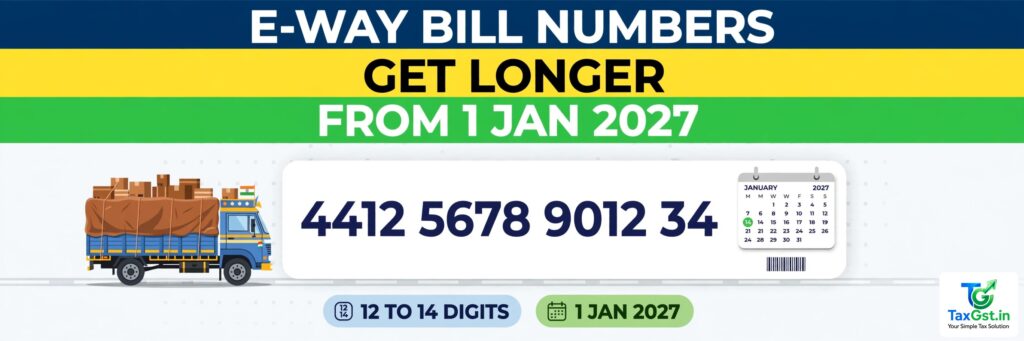
From 1 January 2027, e-way bill numbers get longer: 12 digits become 14, and consolidated e-way bill numbers move from 10 to 11 digits. The change comes from a GSTN advisory dated 4 November 2026 — the existing numbering capacity is running out as e-way bill volumes grow. Nothing else changes: the same bills, the same validity, the same portal. But ERP systems, transporters’ software and any hard-coded 12-digit validation must be updated before the new year. Verified November 2026 · TaxGST.in
A transporter in Ludhiana runs 400 trucks a day. His billing software has a field for the e-way bill number — 12 characters, fixed length, validated on entry. On 1 January 2027, the first bill of the day will come back with 14 digits, and his system will either reject it or truncate it. That is the whole story of this change: a quiet numbering update with a hard cutover date, and the only people who will feel it are the ones who did not update their systems in time. For the wider GST picture, start with the complete GST compliance guides on the GST hub.
What exactly changes on 1 January 2027
GSTN issued an advisory on 4 November 2026 — “Revision in E-Way Bill and Consolidated E-Way Bill Numbering Formats w.e.f. 1 January 2027” — announcing two changes:
- E-way bill number: 12 digits → 14 digits. Every new e-way bill generated on or after 1 January 2027 will carry a 14-digit number.
- Consolidated e-way bill number: 10 digits → 11 digits. The consolidated bill — the single document that covers multiple consignments moving in one vehicle — gets one extra digit.
The reason is unglamorous and entirely practical: the volume of e-way bills generated has grown to the point where the existing numbering capacity is expected to be exhausted. GSTN is adding digits now, before the system runs out of numbers, rather than after. Existing e-way bills keep their old numbers — nothing already issued is re-numbered, and no bill becomes invalid because of the change.
What does NOT change
It is worth saying plainly, because numbering changes invite rumours: the e-way bill rules themselves are untouched. The ₹50,000 threshold for generating a bill, the validity periods (one day per 200 km, broadly), the Part A/Part B structure, the transporter and recipient responsibilities, and the penalties for moving goods without a bill all stay exactly as they are. If your e-way bill expired while goods were in transit, our guide to an expired e-way bill in transit still applies word for word — the penalty exposure and the first-8-hours fix are unchanged.
The change is also separate from the enforcement relief in CBIC Instruction No. 02/2026-GST dated 30 October 2026, which directs field formations to stop vehicles only on specific intelligence authorised by an officer of at least Joint Commissioner rank. That instruction is about how checks are done; the numbering change is about how bills are identified. Both land in the same quarter, and both matter to transporters — read the CBIC instruction explained — no GST arrests, and no show-cause notice below ₹10,000 alongside this piece.
Who must act before 1 January 2027
Businesses with their own billing or ERP systems: check every place an e-way bill number is stored or validated. The usual traps are a database column defined as CHAR(12) or VARCHAR(12), a front-end validation rule that rejects anything longer than 12 characters, and an API integration that passes the number as a fixed-width field. All three will fail silently or loudly on 1 January. Update the field length to at least 14 digits for e-way bills and 11 for consolidated bills, and test with a dummy 14-digit value before the cutover.
Transporters and logistics companies: the consolidated e-way bill is your document — it is the one that moves from 10 to 11 digits. If your trip-sheet software prints or scans consolidated bill numbers, update it too, and brief drivers that a longer number on the printout is correct, not a system error.
Businesses using the GST portal directly or a GSP (GST Suvidha Provider): the portal and most large GSPs will handle the change themselves. Confirm with your GSP in December that their 1 January release covers the new formats — do not assume it.
Accountants and return preparers: e-way bill numbers appear in reconciliation workings and in GSTR-1/GSTR-3B support files. A spreadsheet column formatted as a number will drop leading zeroes; a 14-digit number is also long enough that Excel may display it in scientific notation. Store bill numbers as text, not numbers — this was good practice at 12 digits and becomes essential at 14.
A December checklist
- Find every 12-digit assumption. Search your billing code, your ERP configuration and your spreadsheets for e-way bill fields with a 12-character limit.
- Widen the fields. E-way bill to 14 digits, consolidated e-way bill to 11. Leave headroom — do not hard-code 14 as the new maximum if you can avoid it.
- Test with a 14-digit dummy number in a test environment before 1 January, including printing, scanning and API submission.
- Tell your transporters and customers that longer numbers from 1 January are expected, so nobody rejects a valid bill as a fake.
- Diarise the date. The change takes effect on 1 January 2027 — a public holiday, when your IT support may be thin. Do the update in December, not on the day. All November and December deadlines sit in December 2026’s tax changes and deadlines roundup, and the compliance calendar hub carries the full due-date calendar.
One related date to keep in mind: from 1 January 2027, buyers who must issue e-invoices will also have to report inward supplies taxed under reverse charge from unregistered persons — a separate change under Notification No. 4/2026–Central Tax. If your business buys scrap, waste or used oil from unregistered sellers, read the e-invoicing guide — who is covered at ₹5 crore turnover and the IRN mistakes that silently void an invoice before the year ends.
FAQs
Will my existing e-way bills stop working on 1 January 2027?
No. Bills already generated keep their 12-digit numbers and remain valid for their normal validity period. Only bills generated on or after 1 January 2027 carry 14-digit numbers.
Does the e-way bill threshold or validity change?
No. The ₹50,000 generation threshold, the validity rules and the Part A/Part B requirements are all unchanged. This is a numbering-format change only.
Why is GSTN changing the format at all?
Volume. GSTN’s advisory states that the existing numbering capacity is expected to be exhausted because of the number of e-way bills being generated. Adding digits now avoids running out of numbers mid-year.
Do I need to do anything if I generate e-way bills only on the GST portal?
Almost nothing — the portal will generate 14-digit numbers automatically. The one thing to check is any offline record you keep: spreadsheets, your own registers or accounting software where you paste bill numbers. Store them as text, not numbers, so leading zeroes survive.
What about the consolidated e-way bill?
It moves from 10 digits to 11 digits on the same date, 1 January 2027. If your software handles consolidated bills — mainly transporters consolidating multiple consignments into one vehicle — update that field as well.
Sources
GSTN Advisory: “Revision in E-Way Bill and Consolidated E-Way Bill Numbering Formats w.e.f. 1 January 2027”, dated 4 November 2026 (GSTN) — e-way bill number 12 digits to 14 digits; consolidated e-way bill number 10 digits to 11 digits, effective 1 January 2027. CBIC Instruction No. 02/2026-GST, dated 30 October 2026 — limits on vehicle interception and e-way bill checks, cited for the related enforcement context. Notification No. 4/2026–Central Tax, dated 26 October 2026 (CBIC) — e-invoicing for reverse-charge inward supplies from 1 January 2027, cited for the related 1 January change.
Discover more from TaxGst.in
Subscribe to get the latest posts sent to your email.