
 C.K. Gupta
In short
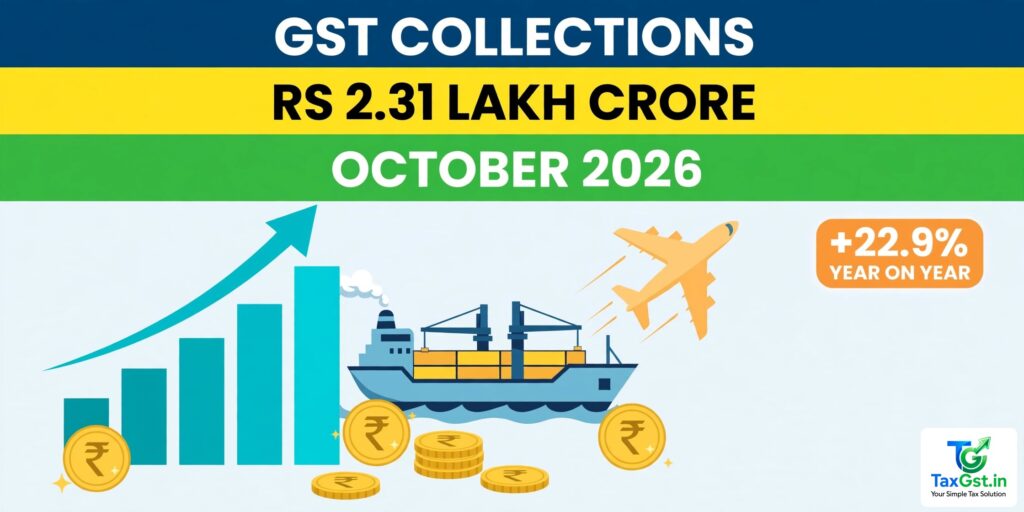
India collected ₹2,31,290 crore in gross GST in October 2026 — up 22.9% on last year and the second-highest monthly collection since GST began in July 2017. Imports did the heavy lifting, rising 42.2%, while domestic collections grew 15.8%. The striking part: this came after the GST rate cuts — lower rates have not shrunk the tax pot. Verified November 2026 · TaxGST.in
When the GST Council cut rates in September 2025 — collapsing four slabs into two, 5% and 18% — the obvious question was whether collections would fall. October 2026 has answered it, loudly. Gross GST collections hit ₹2.31 lakh crore, the second-best month in the tax’s nine-year history, and the growth came from both sides of the economy: Indians spending more at home, and importing far more from abroad.
Here’s what the numbers actually say, what drove them, and what they mean for your business.
The October numbers, in one table
As per the Finance Ministry’s provisional GST collection release of 1 November 2026:
| Component | October 2026 | Change vs October 2025 |
|---|---|---|
| Gross GST collections | ₹2,31,290 crore | +22.9% (vs ₹1,88,125 crore) |
| Domestic GST | ₹1,59,044 crore | +15.8% |
| GST on imports | ₹72,246 crore | +42.2% |
| Refunds paid out | ₹27,934 crore | +6.5% |
| Net GST revenue | ₹2,03,356 crore | +25.6% |
| April–October 2026-27 gross | ₹14.78 lakh crore | +13.2% (vs ₹13.05 lakh crore) |
Two things stand out. First, imports supplied nearly one rupee in every three collected — ₹72,246 crore of the ₹2.31 lakh crore. Second, net revenue grew faster than gross revenue (25.6% vs 22.9%), because refunds grew only 6.5% — the government kept more of what it collected. Maharashtra recorded the highest state collection for the month at ₹35,150 crore, followed by Karnataka and Gujarat.
Why collections rose after a rate cut
The obvious reading — “lower rates, more spending” — is only half the story. Three forces are at work:
- Festive demand. October covered the Diwali season, when consumption peaks. Lower rates on everyday goods meant the same rupee bought more, and more of it.
- An import surge. Import GST jumped 42.2% — far faster than domestic collections. That points to strong demand for imported goods, gold and electronics in the festive quarter, and it is the single biggest contributor to the headline growth.
- A wider base, not just higher rates. The 57th GST Council’s November 2026 reforms — easier registration for small e-commerce sellers, faster refunds — are designed to pull more businesses into the system. Our GST reforms rolling out from 1 November 2026 explains the package. Collections rising after a rate cut is the classic sign that the base is widening faster than rates are falling.
One caution, flagged in the official reporting itself: last October’s headline figure was reported on a different basis, so the 22.9% should be read against the matched base in the current release rather than against old headlines. The direction is unambiguous; the exact percentage is a little less precise than it looks.
What it means for your business
Big national numbers feel abstract. They matter to you in three concrete ways:
1. Refunds are flowing, but slowly. Refunds rose just 6.5% while collections jumped 22.9%. If you are owed a refund — especially an inverted-duty refund — the system is paying out, but the gap between collections and refunds is widening. The good news: the refund rules themselves got much better on 1 November. Our guide to the new inverted-duty refund formula shows how input-service credit now counts — worth reading before your next claim.
2. Scrutiny follows the money. When collections surge, the department’s data analytics get sharper, not duller. Mismatches between GSTR-1 and GSTR-3B remain the biggest notice trigger — our GST notice survival guide sets out the weekly routine that keeps you out of trouble.
3. Don’t read a rate cut as a tax holiday. Lower rates plus higher collections means the department is collecting more from more people, not less from you. If your turnover crossed a threshold this festive season, check whether you need to register — our GST hub has the registration thresholds and the compulsory-registration cases where no threshold applies at all.
The longer view: seven months of FY 2026-27
For April–October 2026-27, gross collections reached ₹14.78 lakh crore, up 13.2% on ₹13.05 lakh crore in the same period last year. That is a steadier number than October’s 22.9% — the festive month is an outlier, and the seven-month figure is the better guide to the underlying trend.
If the second half holds anywhere near this pace, FY 2026-27 will end well above last year’s total, despite the rate cuts. That has a direct policy consequence: with revenues healthy, the Council has room to keep simplifying — the return-form revamp and the inverted-duty refund expansion are both funded by this buoyancy, not threatened by it. And for businesses, it means the compliance direction is one-way: simpler forms, faster refunds, but also better data matching. If you pay GST, our step-by-step PMT-06 challan guide covers the payment side, including what to do when a payment doesn’t reflect on the portal.
FAQs
How much GST was collected in October 2026?
₹2,31,290 crore gross — up 22.9% year-on-year, and the second-highest monthly collection since GST launched in July 2017.
Why did GST collections rise after the rate cuts?
Festive demand, a 42.2% surge in import GST, and a widening tax base. Lower rates encouraged more spending, and more businesses are now inside the system.
Which state collected the most GST in October 2026?
Maharashtra, at ₹35,150 crore, followed by Karnataka and Gujarat.
What is the difference between gross and net GST collections?
Gross is the total collected; net subtracts the refunds paid back to taxpayers. In October 2026, gross was ₹2,31,290 crore, refunds were ₹27,934 crore, and net revenue was ₹2,03,356 crore.
Does higher GST collection mean higher tax rates are coming back?
No signal of that. The 57th GST Council kept rates unchanged in October 2026 and focused on simplification — easier registration, faster refunds and return-form reform.
Sources
Finance Ministry provisional GST collection release, 1 November 2026, reporting October 2026 gross collections of ₹2,31,290 crore — as reported by All India Radio on 2 November 2026 and the Press Information Bureau. Domestic and import splits, refund and net-revenue figures, and the April–October cumulative of ₹14.78 lakh crore are from the same release. Rate-cut context: the 56th GST Council’s rate rationalisation (four slabs to 5% and 18%, plus a 40% demerit rate) effective 22 September 2025, and the 57th GST Council meeting of 8 October 2026. For the November compliance dates behind these collections, see our compliance calendar hub.
Discover more from TaxGst.in
Subscribe to get the latest posts sent to your email.