C.K. Gupta
In short
The GST overhaul approved at the 57th GST Council meeting starts rolling out in phases from 1 November 2026: simplified registration for e-commerce sellers, a streamlined registration process and faster refunds come first. The bigger legal changes — removal of arrest powers, prosecution threshold up from ₹1 crore to ₹5 crore, and no show-cause notice below ₹10,000 — need Act amendments and take effect from 1 April 2027. If your returns have GSTR-1 vs GSTR-3B mismatches, fix them now: the new return system is being built specifically to end them.
Verified October 2026 · TaxGST.in
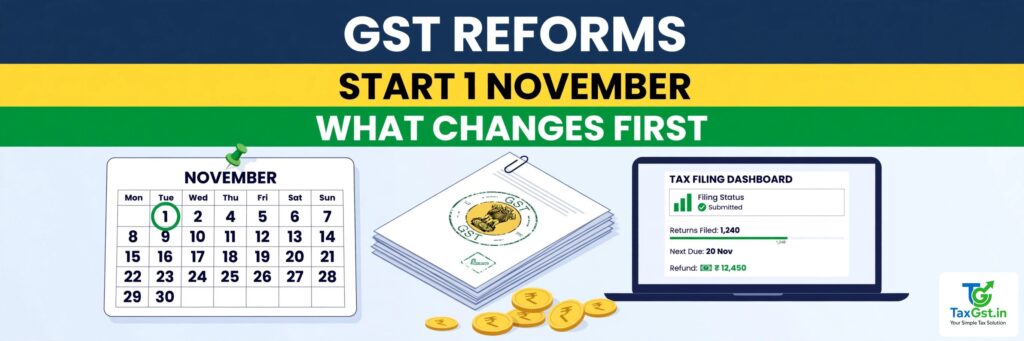
If you sell goods or services under GST, two dates matter more than any headline right now: 1 November 2026 and 1 April 2027. On the first, the government starts switching on the process reforms it approved at the 57th GST Council meeting. On the second, the law itself changes. Knowing which reform belongs to which date decides whether you should act this month or simply plan for next year.
This is the companion to our GST hub coverage of the Council meeting — this piece is the timeline and the to-do list. Our detailed breakdown of every reform the Council approved is in the 57th GST Council meeting explainer.
What actually starts on 1 November 2026
Sanjay Mangal, Member (GST) of the Central Board of Indirect Taxes and Customs (CBIC), told reporters on 22 October 2026 that wherever Act amendments are not required, the reforms will be implemented “as soon as possible”, tentatively from 1 November 2026. Phase 1 focuses on three things:
- Simplified registration for e-commerce sellers. If you sell through marketplaces and found GST registration paperwork disproportionate to your size, this is the fix you’ve been waiting for.
- A streamlined registration process for everyone else. Fewer back-and-forth queries, faster approvals — the details will be in the CBIC circulars the Law department has already vetted.
- Faster refunds. The Council approved 90% provisional refunds within 3 working days and cut the refund acknowledgement window from 15 days to 10 days. Phase 1 puts the machinery for this in place.
Here’s the catch: these are process changes, meaning they don’t need Parliament or state assemblies to amend the law. That’s exactly why they can start next month.
What waits until 1 April 2027 — and why
The headline-grabbing reforms all need amendments to the CGST and SGST Acts, so the Council has targeted 1 April 2027 for them. According to the CBIC’s statements reported on 22 October 2026, the law-change list includes:
| Reform | What changes |
|---|---|
| Arrest powers | Removed from the GST law |
| Prosecution threshold | Raised from ₹1 crore to ₹5 crore of tax evaded |
| Show-cause notices | Minimum threshold of ₹10,000 — no notices below it |
| General penalty | Cut from ₹25,000 to ₹10,000 |
| E-way bill provisions | Being modified (details in the forthcoming circulars) |
The return-filing overhaul also lands on 1 April 2027: the Council has approved a new mechanism to correct tax liability and input tax credit inside the return system itself, backed by statutory force for the Invoice Management System (IMS), a new electronic statement of reverse-charge tax paid and ITC claimed (proposed Rule 86D), and a rule tying the liability in GSTR-3B to what is declared in GSTR-1, GSTR-1A and the IFF.
In practice, this is the single biggest compliance shift since GST launched. If your accountant still “adjusts” GSTR-3B by hand every month to match your books, that habit has an expiry date.
Why the government is obsessed with mismatches
At the Assocham National Conclave on GST on 22 October 2026, Gaurav Singh, Commissioner (GST Policy Wing), CBIC, put a number on the problem: nearly 80% of GST notices are issued because of mismatches between what businesses declare in different returns.
Here’s how the trap works today. A business can edit its GSTR-3B — the monthly summary return where tax is paid — so the figures there drift away from the invoice-level detail in GSTR-1. The system flags the difference, and a notice follows. Singh said the department studied why businesses edit 3B in the first place, then redesigned GSTR-1 and improved the IMS so the need to edit 3B “does not arise”. No edits, no mismatch, no notice.
That is also why the Finance Ministry is putting the draft GSTR-1/1A/IFF forms on myGov.in from 1 November for public comments until 30 November — it wants industry to stress-test the new forms before they go live. If you file GST returns for a living, submitting comments in that window is the cheapest compliance insurance you’ll ever buy.
Your action checklist: October to December 2026
- Reconcile GSTR-1 vs GSTR-3B for the last 6 months. Any gap you can explain today is a notice you won’t receive tomorrow. Start with the months where 3B was edited after GSTR-1 was filed.
- Check your refund pipeline. With 90% provisional refunds in 3 working days coming, pending refund claims deserve a review now — see our GST refund revamp guide for the deficiency-memo (RFD-03) playbook.
- E-commerce sellers: get your registration documents in order. Simplified registration still means registration — keep your PAN, Aadhaar, bank details and principal-place-of-business proof ready.
- Comment on the draft forms (1–30 November). Watch myGov.in from 1 November. If a field in the new GSTR-1 doesn’t fit how your business actually invoices, say so while the forms are still drafts.
- Review your past late fees and interest. If you’ve paid GSTR-3B late fees this year, run the numbers on our GST late fee calculator and the worked examples in our late fee and interest guide — the late-fee relief for businesses up to ₹5 crore turnover (filing 3B by month-end) is part of the same reform package.
FAQs
Do I need to do anything on 1 November 2026?
No filing changes on that date. 1 November is when the government starts the phased rollout (registration simplification, refund speed-up) and opens the draft return forms for public comment. Watch for CBIC circulars — the notifications have been vetted by the Law department and are expected in the public domain.
Will the ₹10,000 minimum notice threshold apply to old notices?
No. It applies prospectively from 1 April 2027, once the Act amendments take effect. Pending proceedings continue under the current law.
I’m a small business with ₹40 lakh turnover. What helps me most?
Three things: the ₹10,000 notice threshold (small demands simply won’t be raised), the general penalty cut to ₹10,000, and the late-fee relief for GSTR-3B filed by month-end. Plus faster refunds if you claim any.
What happens to the 80% mismatch notices after April 2027?
The intent is that they largely disappear: with IMS giving statutory backing, Rule 86D’s electronic statement, and 3B tied to GSTR-1/1A/IFF, the system will block the mismatch at the filing stage instead of chasing it with a notice later. Whether it works in practice is exactly what the November consultation is meant to test.
Sources
- 57th Meeting of the GST Council — press release dated 8 October 2026, issued by the GST Council (PIB), New Delhi.
- Statement by Sanjay Mangal, Member (GST), Central Board of Indirect Taxes and Customs, on the phased rollout from 1 November 2026 and the 1 April 2027 target for Act-amendment measures — reported by moneycontrol.com on 22 October 2026.
- Statement by Gaurav Singh, Commissioner (GST Policy Wing), CBIC, at Assocham’s National Conclave on GST on 22 October 2026 (80% of notices from mismatches; draft forms on myGov.in 1–30 November; audit-streamlining remarks) — reported by The Indian Express, The Hindu and The Hindu BusinessLine on 22 October 2026.
Discover more from TaxGst.in
Subscribe to get the latest posts sent to your email.