C.K. Gupta
In short
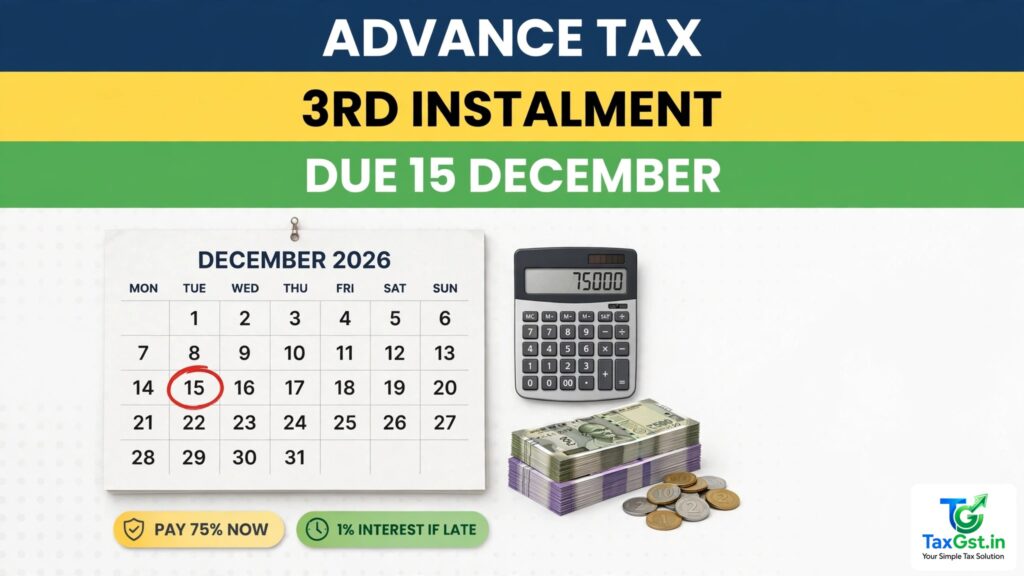
The third advance-tax instalment is due on Tuesday, 15 December 2026. By that date you must have paid 75% of your total tax for the year — miss it and interest of 1% a month applies on the shortfall for three months. Salaried taxpayers whose employer deducts full TDS usually owe nothing; freelancers, traders and anyone with side income must do the maths now. Verified November 2026 · TaxGST.in
Every December the same thing happens: the third advance-tax instalment quietly comes due, and thousands of freelancers, traders and professionals discover — usually in March — that they have been paying interest for months without realising it. This year the date is Tuesday, 15 December 2026, and the rule is simple: by then, 75% of your total tax for the year must be paid. If you run the numbers now, the fix is a five-minute payment. If you leave it, the interest keeps ticking. For the full month’s picture, see our December 2026 tax deadlines roundup.
Who has to pay advance tax at all?
Advance tax applies when your total tax liability for the year, after TDS, is ₹10,000 or more. That threshold is the first filter — if your TDS already covers your liability, you owe nothing in advance tax.
In practice, that means:
- Salaried employees with only salary income: usually nothing to pay. Your employer’s TDS is designed to cover the whole liability. You only owe advance tax if you have significant side income — rent, interest, capital gains, freelance work — that your employer does not know about.
- Freelancers and professionals: almost always liable, because no one deducts tax at source on most of your income, or deducts it at only 10% while your slab rate is 20% or 30%.
- Traders and investors: liable on business income and capital gains, though gains get a special concession explained below.
- Senior citizens (60+) with no business income: exempt from advance tax entirely. The exemption does not apply if you have business or professional income.
- Presumptive taxpayers (Sections 44AD/44ADA): you pay your whole advance tax in a single instalment by 15 March — the quarterly schedule does not apply to you.
The instalment schedule
Advance tax is paid in four instalments, each a cumulative percentage of your total estimated tax for the year:
| Due date | Cumulative tax to be paid |
|---|---|
| 15 June 2026 | 15% |
| 15 September 2026 | 45% |
| 15 December 2026 | 75% |
| 15 March 2027 | 100% |
The key word is cumulative. The December instalment is not 30% of your tax — it is the point at which 75% of the year’s total must have been paid, counting what you already paid in June and September.
A worked example: the freelancer
Meera is a freelance designer. Her estimated income for FY 2026-27 is ₹18 lakh, and her total tax liability — after the new-regime slabs and rebate — works out to ₹2,10,000. She has no TDS on most of her income, so the full ₹2,10,000 is payable as advance tax.
- By 15 June: 15% = ₹31,500. She paid ₹32,000.
- By 15 September: 45% = ₹94,500. She paid another ₹63,000, taking her total to ₹95,000.
- By 15 December: 75% = ₹1,57,500. She must pay at least ₹62,500 more (₹1,57,500 minus ₹95,000 already paid).
Now suppose Meera pays nothing in December and only catches up in March. Her shortfall at 15 December is ₹62,500. Interest under the deferment-interest provisions (earlier Section 234C of the 1961 Act) is 1% per month for three months on the shortfall: ₹62,500 × 1% × 3 = ₹1,875. Entirely avoidable — and it stacks on top of any further interest if she also falls short in March. Our earlier advance-tax interest explainer works through both interest provisions with more examples.
The two interest charges, in plain English
There are two separate interest provisions, and people confuse them constantly:
- Interest for deferment (earlier Section 234C): 1% per month on the shortfall for each instalment you missed or underpaid — three months’ interest for a December shortfall, one month for a March shortfall. This is the charge most people actually pay.
- Interest for short payment overall (earlier Section 234B): 1% per month if your total advance tax for the year is less than 90% of your assessed tax. This runs from 1 April of the assessment year until the tax is paid, so it can be much larger than the 234C charge.
Both are charged on top of the tax itself — they are interest, not penalty, and there is no waiver for “I forgot”. The only real escape is to pay on time.
Three situations that catch people out
1. Capital gains late in the year. If you sell shares or property in December, you cannot be expected to have predicted the gain in June. The law recognises this: if the shortfall is only because of capital gains, no deferment interest applies — provided you pay the tax on the gain in the next instalment after it arises. Sell in December, pay by 15 March, and there is no interest on that part.
2. Salary plus side income. Rohan earns ₹14 lakh salary with full TDS, and also earns ₹6 lakh from weekend consulting, on which clients deduct 10% TDS. His total tax is about ₹3,00,000; TDS covers roughly ₹1,90,000. The gap of ₹1,10,000 is advance tax — and because his salary TDS looks complete, he never thinks to check. By 15 December he should have paid 75% of it, i.e. ₹82,500, minus whatever he paid in June and September.
3. Income that jumps in the second half. Advance tax is based on your estimated total income for the year. If your income rises sharply after September — a big project, a bonus, a property sale — your 75% target rises with it. Re-estimate in early December rather than relying on the June estimate.
How to pay in five minutes
- Estimate your total income for FY 2026-27 (April 2026 to March 2027), including salary, business, rent, interest and capital gains.
- Work out your total tax on the advance-tax calculator — or use the income-tax calculator for a quick slab check.
- Subtract the TDS already deducted (and expected by March) from the total. That is your advance-tax liability.
- Multiply by 75% and subtract what you paid in June and September. That is your December payment.
- Pay through the e-pay tax facility on the income-tax portal, choosing advance tax as the payment type. Keep the challan receipt — it is your proof if the payment does not reflect in your AIS.
If your estimate changes later, you can revise it — the March instalment is your chance to true up to 100%. Paying a little extra in December is harmless: excess advance tax is refunded with interest after you file.
FAQs
I am salaried and my employer deducts TDS. Do I need to pay advance tax?
Only if your total tax exceeds your TDS by ₹10,000 or more — typically because of rent, interest, capital gains or freelance income your employer does not know about. Check your Form 26AS and AIS against your actual income; the gap is your advance-tax liability.
What happens if I miss the 15 December deadline?
You pay 1% a month on the shortfall for three months under the deferment-interest provisions. Pay as soon as you realise — the interest is calculated on the shortfall, so a late payment still stops further months from accruing on the amount you pay.
Can I pay advance tax after 15 March?
Yes, but it stops being “advance” tax — it becomes self-assessment tax, and the overall short-payment interest keeps running until you pay. File and pay before 31 July 2027 (the ITR deadline) to limit the damage.
Do senior citizens have to pay advance tax?
No, if you are 60 or older and have no business or professional income, you are exempt from advance tax entirely. You pay your tax when you file your return.
Is there a penalty for not paying advance tax, or only interest?
Only interest — there is no separate penalty for non-payment of advance tax. But the interest can be substantial if the shortfall is large and runs for many months, and it is not waivable.
Sources
Advance-tax instalment schedule (15%/45%/75%/100%) and interest provisions under the Income-tax Act, 2025 (earlier Sections 208, 211, 234B and 234C of the Income-tax Act, 1961); senior-citizen exemption and presumptive-tax single-instalment rule under the same framework; CBDT Circular No. 07/2026, dated 28 September 2026, extending ITR and audit-report due dates for AY 2026-27. For the full compliance calendar, see the compliance calendar hub on TaxGST.in, and for the income-tax guidance hub, the complete income-tax guide hub.
Discover more from TaxGst.in
Subscribe to get the latest posts sent to your email.