C.K. Gupta
In short
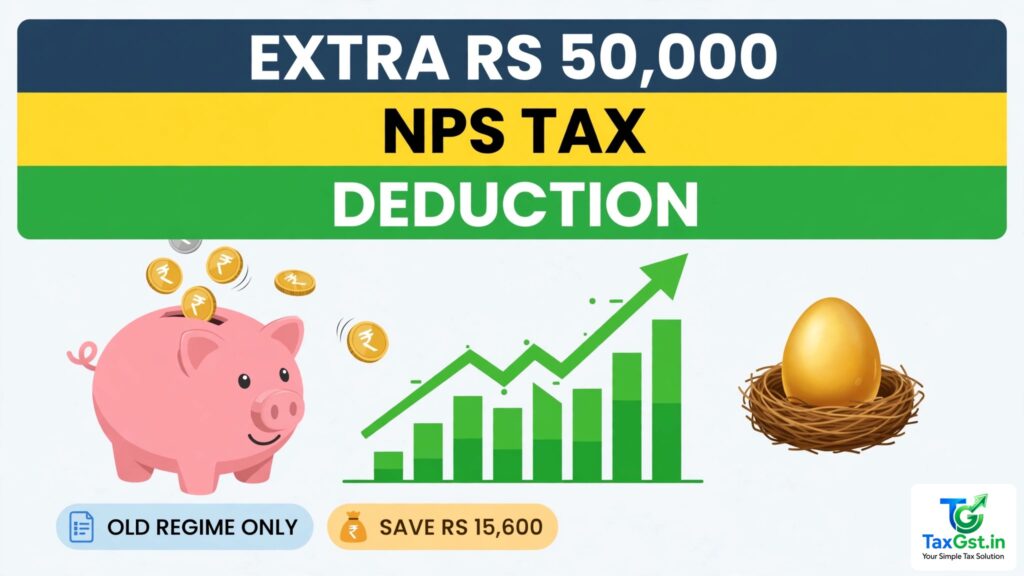
An extra ₹50,000 NPS contribution can save you up to ₹15,600 in tax — but only if you file under the old regime. The deduction sits entirely outside the ₹1.5 lakh Section 80C limit, taking your total NPS-linked deduction to ₹2 lakh, and it is the single most overlooked tax break for salaried Indians who have already maxed out 80C. Verified November 2026 · TaxGST.in
Every December the same conversation happens in offices across India: “Have you used your full 80C?” Someone mentions PPF, someone else mentions ELSS, and the ₹1.5 lakh limit is treated as the finish line. It is not. There is a further ₹50,000 deduction sitting outside 80C entirely — for contributions to the National Pension System — and a large number of salaried taxpayers who have already filled 80C never claim it. The catch, and it is a real one, is that this deduction only works under the old tax regime. If you are on the new regime, it is worth nothing — though your employer’s NPS contribution still is. Here is the full picture, with the numbers worked out. If you are still deciding between regimes, run both on the income-tax calculator before you commit.
The three NPS deductions — and which one is the extra ₹50,000
NPS contributions get three separate deductions. Confusing them is the most common mistake in this whole area:
| Deduction | What it covers | Limit | Old regime | New regime |
|---|---|---|---|---|
| Your own contribution — Section 124, Income-tax Act, 2025 (earlier Section 80CCD(1)) | Your Tier-I contribution, within the 80C basket | Part of the ₹1.5 lakh 80C cap | Yes | No |
| Extra voluntary contribution — Section 124 (earlier Section 80CCD(1B)) | Your additional Tier-I contribution | ₹50,000, over and above 80C | Yes | No |
| Employer’s contribution — Section 124 (earlier Section 80CCD(2)) | What your employer puts into your NPS | Up to 14% of salary (basic + DA) | Yes (14% govt, 10% private) | Yes — 14% for all employers |
Two things jump out. First, the extra ₹50,000 is genuinely additional: it does not eat into your ₹1.5 lakh 80C limit, so a taxpayer who has already maxed 80C with EPF, PPF and ELSS can still claim it. Second, the new regime keeps only the employer-contribution deduction. Your own NPS contribution — including the extra ₹50,000 — buys you nothing under the new regime. That is the single most important fact in this article, so read the regime warning below before you contribute a rupee for tax reasons.
Worked example: what ₹50,000 actually saves
Take Anil, 38, salaried, taxable income ₹18 lakh after the standard deduction, filing under the old regime. His 80C basket is already full: EPF ₹1,10,000 plus PPF ₹40,000 = ₹1,50,000. He puts an additional ₹50,000 into his NPS Tier-I account.
- Without NPS: taxable income ₹16,50,000 (after 80C).
- With the extra ₹50,000: taxable income ₹16,00,000.
- Tax saved: ₹50,000 × 31.2% (30% slab + 4% cess) = ₹15,600.
At the 20% slab, the same ₹50,000 saves ₹10,400. At the 5% slab, it saves ₹2,600 — barely worth the lock-in, which is why this deduction matters most once you are in the 20% or 30% bracket.
Now add the employer side. If Anil’s employer contributes 10% of his basic salary to NPS — say ₹60,000 a year — that ₹60,000 is also deductible, and it does not count against either the 80C limit or the ₹50,000. Anil’s total NPS-linked deduction can reach ₹2,60,000 (₹1,50,000 of 80C including his own NPS contribution, plus ₹50,000 extra, plus ₹60,000 employer). If you want the exact figures for your salary, work them out on the NPS calculator.
The regime warning — read this before you invest
Here is the catch, stated plainly: the extra ₹50,000 deduction exists only in the old regime. Under the new regime (Section 202 of the Income-tax Act, 2025, earlier Section 115BAC), the only NPS deduction that survives is the employer’s contribution. Your own contribution gets no deduction at all.
That creates a trap. NPS is still a reasonable retirement product on its own merits — low-cost, market-linked, with a tax-free lump sum at exit — but if your only reason for contributing is the tax deduction, you must be in the old regime, and the old regime must actually beat the new regime on your total numbers. For many taxpayers earning under ₹12 lakh, the new regime’s nil-tax threshold (up to ₹12 lakh, or ₹12.75 lakh for salaried taxpayers after the standard deduction) makes the new regime the winner even without a single deduction. Run both regimes before you move money.
And a second caution: NPS money is locked in until age 60. Partial withdrawals are allowed after three years — up to 25% of your own contributions, only for specified purposes such as a child’s education, a house purchase or medical treatment — but this is not a flexible savings account. Do not park emergency money here for a tax break.
What happens to the money at 60?
This is where NPS compares well with other retirement products, and it is worth knowing before you commit:
- Up to 60% of the corpus can be withdrawn as a lump sum, tax-free.
- The remaining 40% must buy an annuity — a monthly pension. The pension itself is taxed as income in the year you receive it.
- If you exit before 60, the rules are stricter: 80% must go into an annuity and only 20% comes out as a lump sum.
Compare that with PPF (fully tax-free at maturity, but no extra ₹50,000 deduction) and EPF (tax-free after five years of continuous service). Our NPS exit guide works through the lump-sum-versus-annuity choice with examples, and the ELSS vs PPF vs NSC vs tax-saver FD comparison shows how the 80C options stack up against each other.
Two newer wrinkles worth knowing
NPS Vatsalya counts too. From assessment year 2026-27, contributions a parent or guardian makes to the NPS Vatsalya account of a minor child also qualify for the ₹50,000 deduction under the same provision (inserted by the Finance Act, 2025).
Keeping the account alive is cheap. A Tier-I account needs a minimum contribution of ₹1,000 a year to stay active, and contributions can be made online through your NPS login or the eNPS portal. The ₹50,000 for this financial year must be contributed by 31 March 2027 to count for FY 2026-27 — do not leave it to the last week, because payment failures in the final days are common and there is no extension.
Who should claim it — and who should not
- Claim it if: you are in the old regime, your 80C is already full, you are in the 20% or 30% slab, and you can leave the money untouched until 60.
- Skip it if: you are in the new regime (no deduction at all), you are in the 5% slab (the saving is too small for the lock-in), or you might need the money before 60.
- Ask your employer first if: your company does not yet contribute to NPS — getting the employer contribution switched on is worth more than the ₹50,000, because it is deductible in both regimes, up to 14% of salary.
For a quick year-end check of everything else you might be missing, run through the 15-minute year-end tax health check — it covers the proofs your employer will ask for in December.
FAQs
Is the ₹50,000 NPS deduction available in the new regime?
No. The extra ₹50,000 under Section 124 of the Income-tax Act, 2025 (earlier Section 80CCD(1B)) is available only under the old regime. In the new regime, only your employer’s NPS contribution is deductible, up to 14% of your salary.
Does the ₹50,000 count inside the ₹1.5 lakh 80C limit?
No — that is the whole point. It sits over and above 80C. With 80C full and the extra ₹50,000, your total deduction on your own contributions reaches ₹2 lakh, before any employer contribution.
Tier-I or Tier-II — which one gets the deduction?
Only Tier-I. Tier-II is a voluntary savings account with no tax deduction on contribution and no lock-in — useful as a flexible investment, not as a tax saver.
Can I claim the deduction for NPS Vatsalya contributions for my child?
Yes, from AY 2026-27. Contributions by a parent or guardian to a minor child’s NPS Vatsalya account qualify under the same ₹50,000 provision.
Is the NPS maturity amount taxable?
Up to 60% of the corpus withdrawn as a lump sum at 60 is tax-free. The 40% that buys an annuity is not taxed at purchase, but the monthly pension you receive from it is taxed as income.
Sources
Section 124 of the Income-tax Act, 2025 (earlier Section 80CCD(1B)) — additional deduction of ₹50,000 for NPS Tier-I contributions, over and above the ₹1.5 lakh limit; Section 123 (earlier Section 80C); employer’s contribution under Section 124 (earlier Section 80CCD(2)) up to 14% of salary, deductible under the new regime per Section 202 (earlier Section 115BAC); NPS Vatsalya inclusion by the Finance Act, 2025, from AY 2026-27; exit and annuity rules per the Pension Fund Regulatory and Development Authority (PFRDA). For the full tax-saving guidance hub, see the deductions and tax-saving hub on TaxGST.in.
Discover more from TaxGst.in
Subscribe to get the latest posts sent to your email.