
 C.K. Gupta
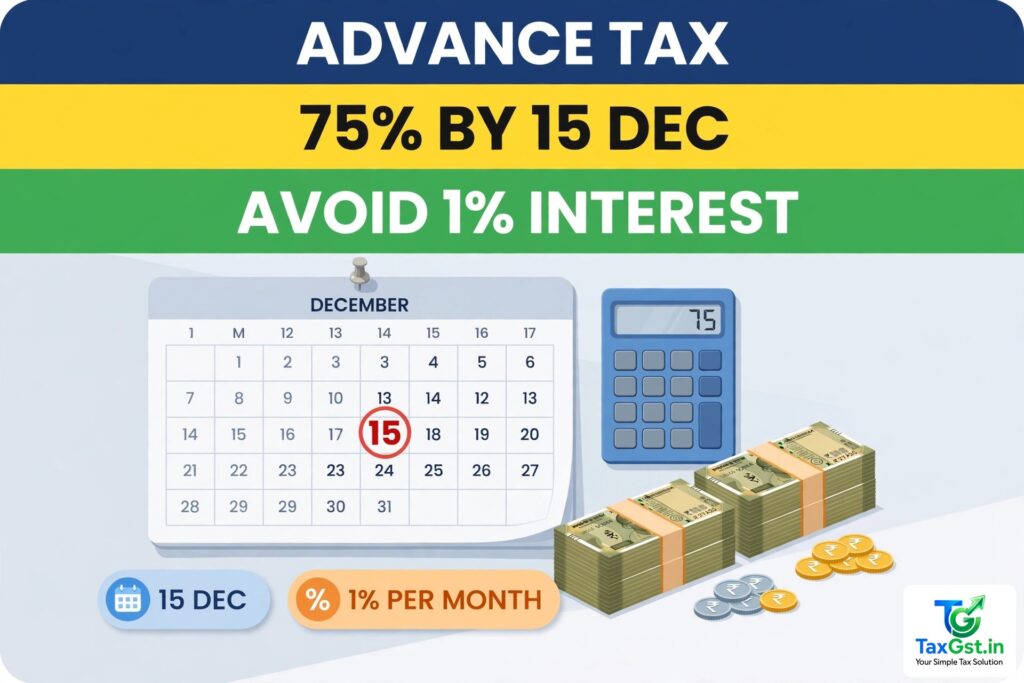
If your total tax liability for the year is ₹10,000 or more, you must pay it in four instalments — 15% by 15 June, 45% by 15 September, 75% by 15 December and 100% by 15 March. Miss an instalment and interest applies at 1% per month on the shortfall. The next deadline, the third instalment, falls on 15 December 2026 — and the December instalment is where most salaried people with side income get caught. Verified November 2026 · TaxGST.in
Meet the classic advance-tax victim: a salaried employee who also earns freelance income on the side. Her employer deducts TDS on her salary perfectly. But nobody deducts tax on her freelance receipts — or deducts only 10% while her slab is 30%. March arrives, she files her return, and discovers a tax bill of ₹80,000 plus interest for not having paid it in advance. The interest is the insult on top of the injury, and it was entirely avoidable.
Advance tax is simply pay-as-you-earn for income that escapes TDS. If your total tax bill for the year, after TDS, is ₹10,000 or more, you are expected to pay it yourself in instalments through the year. This guide gives you the instalment table, the interest maths with real figures, and the December checklist — and if you earn salary plus side income, pair it with the salary-plus-side-income filing guide on the Income Tax hub, which shows how the AIS catches exactly this gap. Keep the year’s other deadlines in view too via the compliance calendar’s full due-date list.
The four instalments
| Due date | Cumulative payment required | Instalment share |
|---|---|---|
| 15 June | 15% of total advance tax | 15% |
| 15 September | 45% of total advance tax | 30% |
| 15 December | 75% of total advance tax | 30% |
| 15 March | 100% of total advance tax | 25% |
A worked example. Suppose your estimated total tax for the year is ₹2,00,000 after TDS. Your instalments are: ₹30,000 by 15 June; a further ₹60,000 by 15 September (cumulative ₹90,000); a further ₹60,000 by 15 December (cumulative ₹1,50,000); and the final ₹50,000 by 15 March. If you pay nothing until March, you have not just deferred payment — you have triggered interest on every missed instalment.
Who must pay — and who is exempt
- Liability test: advance tax applies only when your net tax payable (total tax minus TDS/TCS) is ₹10,000 or more. Below that, no advance tax is due.
- Salaried-only taxpayers usually owe nothing extra — employer TDS covers the salary. The obligation bites on freelancers, traders, landlords, professionals and anyone with capital gains or side income.
- Senior citizens aged 60 or above who have no income from business or profession are exempt from advance tax altogether — they can pay the whole amount at filing time without interest.
- Presumptive-taxpayers (Sections 44AD/44ADA cases) pay their entire advance tax in a single instalment by 15 March.
The interest: how 1% a month actually works
Two interest rules apply, carried into the Income-tax Act, 2025 from the old Act’s Sections 234B and 234C:
- Short payment overall (old Section 234B): if the advance tax you paid is less than 90% of your total assessed tax, interest runs at 1% per month (or part of a month) on the shortfall, from 1 April of the assessment year until the date you actually pay. Example: assessed tax ₹2,00,000, advance tax paid ₹1,50,000 — shortfall ₹50,000, and at 1% a month for, say, 4 months, that is ₹2,000.
- Deferred instalments (old Section 234C): interest at 1% per month applies to each instalment shortfall — for 3 months on a shortfall in the June, September or December instalments, and for 1 month on the March instalment shortfall. Example: you skipped the 15 December instalment of ₹60,000 entirely — interest is 1% × 3 months × ₹60,000 = ₹1,800, even if you pay in full by 15 March.
Here’s the catch: the interest is computed on the shortfall at each date, not on your final bill. Paying everything in March fixes the tax but not the interest. In practice, the December instalment is the one that hurts most people, because by December your year’s income is nearly known — there is no excuse left for guessing low.
Your 15 December checklist
- Re-estimate the full year now. Add up salary, freelance receipts, rent, interest and capital gains realised so far, plus what you expect by 31 March.
- Subtract TDS already deducted (check Form 26AS/AIS) and advance tax already paid.
- Apply 75% to the net figure — that is your cumulative target by 15 December. Pay the difference between that and what you have already paid.
- Pay online through the Income Tax Department’s e-pay tax service and keep the challan acknowledgement — it is your proof if the credit ever goes missing.
- Diarise 15 March for the final 25% — and remember that capital gains arising late in the year get a concession: tax on gains arising after 15 December can be paid with the March instalment without deferment interest.
If your estimate turns out wrong, you can revise it at the next instalment — advance tax is paid on estimates, and the system expects estimates to move. What it penalises is silence: paying nothing when you plainly owed something. If a demand or mismatch follows anyway, the demand-notice guide explains the agree, pay or dispute choice, and the mid-year tax-moves checklist covers the deductions still open before March.
FAQs
Do I need to pay advance tax if my employer deducts TDS?
Only on income beyond your salary. If TDS covers your full liability and the balance is under ₹10,000, no advance tax is due.
What if my income is unpredictable — can I be penalised for a wrong estimate?
Interest applies to shortfalls, but you may revise your estimate at each instalment. A genuine underestimate paid late still attracts interest; a deliberate zero when income was obvious costs the most.
Are senior citizens really exempt?
Resident senior citizens (60+) with no business or profession income need not pay advance tax — they settle the full amount when filing. The exemption does not apply if they have business income.
What happens if I pay advance tax but my final liability is lower?
The excess comes back as a refund with interest, once your return is processed — which is another reason to file and e-verify promptly.
Is there a form for paying advance tax?
Pay through the e-pay tax service on the Income Tax portal (select the advance-tax minor head) and preserve the challan counterfoil; no separate return form is involved.
Sources
Income Tax Department — advance tax instalment schedule (15 June 15%, 15 September 45%, 15 December 75%, 15 March 100%), ₹10,000 liability threshold, and senior-citizen exemption for those without business income, per the advance-tax provisions of the Income-tax Act, 2025 (carried forward from Sections 208–211 of the Income-tax Act, 1961). Interest rules at 1% per month for short payment and deferred instalments, per the interest provisions carried forward from Sections 234B and 234C of the 1961 Act. Presumptive-tax single-instalment rule (15 March) per Sections 44AD/44ADA framework. December 2026 instalment date per the statutory schedule; late-capital-gains concession per the deferment-interest proviso.
Discover more from TaxGst.in
Subscribe to get the latest posts sent to your email.