C.K. Gupta
In short
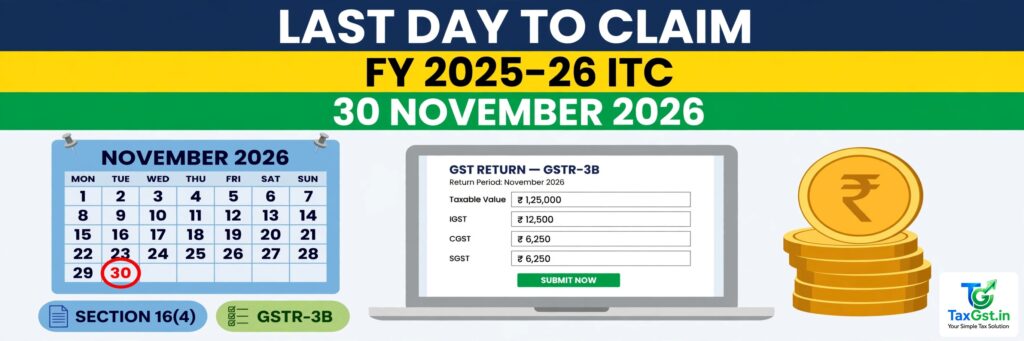
Input tax credit on any FY 2025-26 invoice or debit note must be claimed in a GSTR-3B filed on or before 30 November 2026 — or on the date you file the annual return (GSTR-9) for FY 2025-26, whichever is earlier. That is the hard cut-off in Section 16(4) of the CGST Act: unclaimed credit lapses permanently, with no relief mechanism after it. In practice, monthly filers must claim the last of it in the October 2026 GSTR-3B (due 20 November) — the November 3B is filed on 20 December, three weeks too late. Check your 2B now, chase every missing invoice, and do not file GSTR-9 early. Verified November 2026 · TaxGST.in
A trader in Surat found a ₹1,80,000 purchase invoice from March 2026 in his email last week. His supplier had uploaded it late, so it only appeared in his GSTR-2B in August. He assumed he could claim it whenever he liked — the purchase was genuine and the tax was paid. He cannot: under Section 16(4), the credit dies on 30 November 2026, or on his GSTR-9 filing date if earlier. This is the one GST deadline in the year with no extension, no condonation and no second chance. For the full calendar, keep the compliance calendar hub open while you read.
What Section 16(4) actually says
Section 16(4) of the CGST Act, 2017 bars a registered person from taking input tax credit on an invoice or debit note after the thirtieth day of November following the end of the financial year it pertains to, or after furnishing the relevant annual return, whichever is earlier. For FY 2025-26, that means 30 November 2026, unless your GSTR-9 goes in first.
Three things catch people out. First, “taking” credit means claiming it in a GSTR-3B: recording an invoice in your books, or seeing it in 2B, is not a claim — the claim happens only when the credit is reported in a 3B furnished on or before the cut-off. Second, debit notes follow the year of the debit note, not the original invoice: a debit note dated April 2026 against a FY 2025-26 invoice belongs to FY 2026-27, with its own cut-off of 30 November 2027. Third, the deadline does not make a credit valid on its own — every other condition in Section 16(2) still applies, including Section 16(2)(aa): the supplier must have reported the invoice in GSTR-1 so it appears in your 2B, and blocked credits under Section 17(5) stay blocked regardless of date. For the wider framework, see the GST hub — rates, registration and returns in one place.
Which return carries the last FY 2025-26 claim?
The cut-off is a filing deadline, not a return-period label — but the calendar decides what is possible:
| Filer type | Last GSTR-3B that can carry FY 2025-26 ITC | Normal due date |
|---|---|---|
| Monthly filer | October 2026 GSTR-3B | 20 November 2026 |
| QRMP filer (quarterly) | July–September 2026 GSTR-3B | 22 or 24 October 2026, depending on the state |
For monthly filers, the October 2026 GSTR-3B is effectively the last chance — the November 3B is due on 20 December, three weeks past the cut-off. For QRMP filers the July–September quarter return was due in late October; if unfiled, it can still carry FY 2025-26 credit if filed late but on or before 30 November 2026. The same applies to a monthly filer’s October 3B: filed late on 28 November, it can still carry the credit — filed on 2 December, it cannot. If your 3B is already late, our worked guide to GSTR-3B late fees and interest shows what the delay costs.
The GSTR-9 trap: filing early closes the window sooner
GSTR-9 for FY 2025-26 is due on 31 December 2026, and the forms were enabled on the portal in October 2026. Filing it early is the quietest way to lose credit: the moment GSTR-9 is furnished, the Section 16(4) window closes, even if 30 November has not arrived. Do not file GSTR-9 until you have claimed every FY 2025-26 invoice.
One relief: Notification No. 15/2025-Central Tax dated 17 September 2025 exempts taxpayers with turnover up to ₹2 crore from filing GSTR-9 from FY 2024-25 onwards — for them, 30 November is the only cut-off.
Four things to check before 20 November
1. Reconcile GSTR-2B against your purchase register, invoice by invoice. 2B is a static statement, available by the 14th of the following month. Anything in your books but missing from 2B is credit you cannot claim — chase the supplier to file GSTR-1. Our guide to the 7 real reasons ITC goes missing from GSTR-2B walks through each cause and its fix.
2. Check the 180-day rule before it bites twice. Under Rule 37, if you have not paid a supplier within 180 days of the invoice date, you must reverse the credit — and if the Section 16(4) cut-off arrives before you pay, the credit lapses permanently. The Rule 37 reversal guide explains the reclaim route for the day the supplier is paid.
3. Check Rule 37A. If a supplier has not filed its GSTR-3B for the relevant period by 30 September after the financial year ends, you must reverse the credit by 30 November, or pay it later with interest — a separate reversal from Rule 37, sharing the same deadline.
4. Watch Table 4 of your GSTR-3B. GSTN now auto-populates Table 4A from your 2B and issues DRC-01C intimations automatically when your 3B claim exceeds the 2B figure beyond the Rule 88D tolerance. Keep the invoice, payment proof and supplier’s GSTR-1 record together — that is the file you will need to answer it. If a notice does arrive, the protection checklist for genuine buyers facing fake-ITC notices covers the documents and payment trail that keep you safe.
Worked example: what is at stake
Take a monthly filer with ₹12,00,000 of FY 2025-26 ITC still unclaimed in mid-November — ₹7,00,000 in the October 2B, ₹5,00,000 in late-uploaded supplier invoices. Claim it all in the October 2026 GSTR-3B, filed on or before 30 November, and the full amount is hers. File that 3B on 2 December instead and the ₹12,00,000 is time-barred — tax she will pay in cash on November sales with no credit to set against it. File GSTR-9 on 25 November and the same result follows. The late fee on a delayed 3B is capped and small; the lost credit is not.
One last note: at its 57th meeting on 8 October 2026, the GST Council recommended aligning the time limits in Sections 37 and 39 with the ITC deadline under Section 16(4). That is a recommendation, not law — it is not yet in force, so the deadline for FY 2025-26 remains 30 November 2026. Do not plan on an extension that has not been notified.
FAQs
What is the last date to claim ITC for FY 2025-26?
30 November 2026, under Section 16(4) of the CGST Act — or the date you file the annual return (GSTR-9) for FY 2025-26, whichever is earlier. Credits not claimed by that date lapse permanently.
I am a monthly filer. Which GSTR-3B should carry my remaining FY 2025-26 ITC?
The October 2026 GSTR-3B, due 20 November 2026 — the November 3B is due 20 December, after the cut-off. A late-filed October 3B still works if filed on or before 30 November 2026.
Does filing GSTR-9 early affect the ITC deadline?
Yes — furnishing GSTR-9 closes the Section 16(4) window on that date, even before 30 November. Do not file GSTR-9 for FY 2025-26 until every FY 2025-26 invoice has been claimed. Taxpayers with turnover up to ₹2 crore are exempt from GSTR-9.
My supplier uploaded a March 2026 invoice only in August 2026. Can I still claim it?
Yes, if it appears in your 2B and you claim it in a 3B filed on or before 30 November 2026 (and before your GSTR-9, if earlier). The supplier’s late upload does not extend the cut-off — it only shortens the time you have left.
Sources
Section 16(4) and Section 16(2)(aa) of the Central Goods and Services Tax Act, 2017; CBIC Notification No. 15/2025-Central Tax, dated 17 September 2025 (GSTR-9 exemption up to ₹2 crore turnover); CBIC Circular No. 237/31/2024-GST (text of Sections 16(4) to 16(6)); Rule 36(4), Rule 37 and Rule 37A of the CGST Rules, 2017; 57th GST Council press release, 8 October 2026.
Discover more from TaxGst.in
Subscribe to get the latest posts sent to your email.