 C.K. Gupta
In short
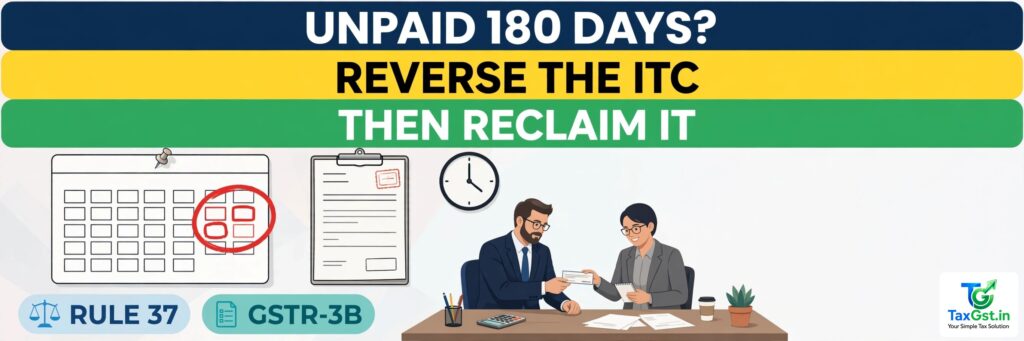
If you claimed input tax credit on a purchase but have not paid your supplier the invoice value plus GST within 180 days of the invoice date, you must reverse that credit — proportionate to the unpaid amount, with interest if the credit was used — in the GSTR-3B for the tax period immediately after the 180 days expire, under Rule 37 of the CGST Rules read with the second proviso to Section 16(2) of the CGST Act. The reversal is temporary: pay the supplier and you can claim the credit again. It does not apply to reverse-charge supplies.
Verified October 2026 · TaxGST.in
A Pune packaging supplier gave a regular buyer 210 days’ credit — generous terms, good relationship, and a GST trap neither of them saw. The buyer claimed ₹90,000 of ITC on a ₹5,00,000-plus-GST invoice, paid nothing for seven months, and then got a mismatch notice: the credit had to be reversed, with interest, in a return he had already filed. That is Rule 37, and it bites precisely the businesses that think of ITC as theirs the moment the goods arrive.
ITC discipline is the thread running through most GST trouble. If your credit is missing for a different reason, start with the seven reasons ITC goes missing from GSTR-2B; if you have already received a demand, the DRC-01 reply guide covers the 30-day response. For the wider filing picture, see the complete GST guide hub.
The rule in one paragraph
Section 16(2) of the CGST Act lets you claim ITC when you hold a tax invoice, have received the goods or services, and the supplier has paid the tax to the government. Its second proviso adds a condition most buyers forget: if you fail to pay the supplier the value of the supply plus the tax within 180 days of the invoice date, an amount equal to the ITC availed must be added back to your output tax liability, with interest. Rule 37 of the CGST Rules (in its current form, substituted by Notification No. 26/2022–Central Tax dated 26 December 2022) prescribes how: reverse the credit proportionate to the amount not paid, in the GSTR-3B for the tax period immediately following the expiry of the 180 days.
Three points do most of the work: the clock runs from the invoice date, not delivery or your payment due date; the reversal is proportionate to the unpaid part; and the rule does not apply to reverse-charge supplies, where you pay the tax anyway.
A worked example: half paid, half reversed
Take an invoice dated 5 April 2026: goods worth ₹5,00,000 plus 18% GST of ₹90,000, total ₹5,90,000. You claim the full ₹90,000 ITC in April’s GSTR-3B. By 2 October 2026 — 180 days after 5 April — you have paid only ₹2,95,000, exactly half the invoice.
- Unpaid portion: ₹2,95,000, which carries half the GST: ₹45,000.
- Reversal due: ₹45,000, in the GSTR-3B for October 2026 — the tax period immediately following expiry of the 180 days.
- Interest: under Section 50 read with Rule 88B(3), interest at 18% per annum applies only if the credit was actually utilised, and runs from the date you availed the ITC to the date you reverse it. If the ₹45,000 sat utilised for two months, the interest is roughly ₹45,000 × 18% × 2/12 = ₹1,350. Small next to the principal — but it is the part businesses forget to compute, and officers do not.
- When you finally pay the remaining ₹2,95,000, you re-avail the ₹45,000 in the GSTR-3B for the month of payment. The credit was deferred, not destroyed.
Here’s the catch: if you pay the supplier on day 181, the reversal is still due for that intervening period. Paying late does not retroactively erase the reversal — it creates the re-availment. File the reversal, then file the re-claim; skipping the first step because you “paid eventually” is how the mismatch notice arrives.
Where to report it in GSTR-3B
Report the reversal in the ITC reversal section of GSTR-3B (Table 4B) for the period immediately after the 180 days expire, and report the re-availment in the ITC-available section of the return for the month you pay. Keep an ageing list of unpaid supplier invoices with their 180-day dates, and reconcile it against GSTR-2B before every 3B filing. An invoice approaching 150 days unpaid should trigger a decision — pay it, part-pay it, or diary the reversal.
Rule 37 is not Rule 37A — do not confuse them
Two neighbouring rules get mixed up constantly, and the fix for each is different:
- Rule 37 (this article): you have not paid your supplier. Fix: pay, then re-avail.
- Rule 37A: your supplier uploaded the invoice but did not file their GSTR-3B and pay the tax. Fix: the supplier files and pays; you re-avail once they do. Chasing your own payment diary will not help here.
- Rules 42 and 43: common credit used partly for exempt or personal purposes, reversed by turnover or capital-goods ratios. That reversal is generally permanent for the exempt proportion — a usage problem, not a payment problem.
- Section 17(5) blocked credits: motor vehicles, food, personal consumption and similar categories are blocked from day one. No payment timing fixes a blocked credit.
The traps around the edges
Part-payments count — proportionately. After the 2022 amendment, Rule 37 expressly covers whole or partial non-payment. A 60%-paid invoice needs a 40% reversal, not an all-or-nothing one. Keep the invoice-wise payment split in your books; a single “supplier balance” figure will not survive scrutiny.
Credit notes change the base. If the supplier issued a credit note reducing the invoice value, compute the reversal on the reduced value.
The annual deadline still looms. Separately, Section 16(4) bars ITC for a financial year after 30 November following that year (or the annual return date, whichever is earlier). That deadline is why 30 November 2026 is the last date for FY 2025-26 ITC claims. If your 180-day reversal and re-availment straddle that cut-off, check with your CA whether the re-availment is still open — do not assume a re-claim is automatically available in a later year.
Interest only bites on utilised credit. If the reversed ITC sat unused in your credit ledger, Rule 88B(3) means no interest is payable — but the reversal itself is still mandatory.
Your monthly Rule 37 routine
- List every supplier invoice unpaid at 150 days, with its 180-day expiry date.
- For each, decide: pay in full, part-pay (and compute the proportionate reversal), or diary the full reversal.
- Reverse in the GSTR-3B for the period immediately after expiry — not the month you notice it, and not “next quarter”.
- When payment is finally made, re-avail in that month’s 3B and keep the payment proof stapled to the original reversal entry.
- Once a quarter, cross-check the ageing list against 2B: any invoice your supplier has not yet reported is a Rule 37A question, not a Rule 37 one.
For a business running on extended credit, that payment diary is worth more than any year-end reconciliation.
FAQs
I paid the supplier on day 190. Do I still reverse?
Yes — reverse in the return for the period immediately after day 180, then re-avail in the return for the month you paid. Late payment creates a re-claim, not an exemption from reversal.
Is interest always payable on a Rule 37 reversal?
No. Under Rule 88B(3), interest at 18% per annum applies only to the extent the ITC was utilised, for the period from availment to reversal. Unutilised credit reversed attracts no interest — but the reversal itself is still mandatory.
Does Rule 37 apply to reverse-charge purchases?
No. Supplies on which tax is payable on reverse charge basis are expressly excluded from the second proviso to Section 16(2).
Sources
Section 16(2), second proviso, and Section 50 of the Central Goods and Services Tax Act, 2017; Rule 37 of the CGST Rules, 2017, as substituted by Notification No. 26/2022–Central Tax, dated 26 December 2022 (Central Board of Indirect Taxes and Customs); Rule 88B(3) of the CGST Rules on interest for ITC wrongly availed and utilised (CBIC); Section 16(4) of the CGST Act on the time limit for availing ITC (CGST Act). Late-fee and interest mechanics for the return itself are covered in our GSTR-3B late fee and interest worked examples.
Discover more from TaxGst.in
Subscribe to get the latest posts sent to your email.