 C.K. Gupta
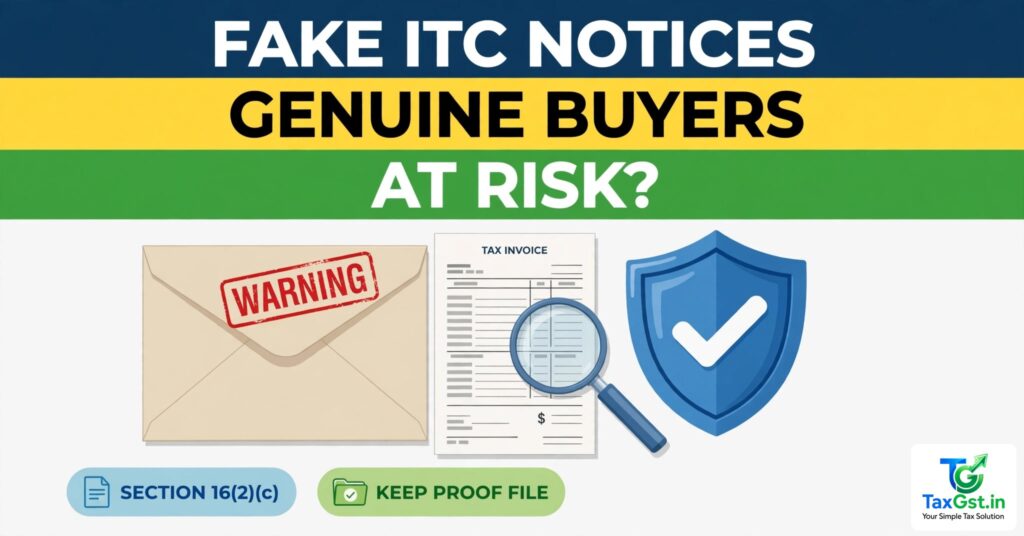
Genuine buyers are receiving GST demands for input tax credit their suppliers never deposited — and until now the law has mostly sided with the department. Under Sections 16(2)(aa) and 16(2)(c) of the CGST Act, your credit depends on the supplier filing GSTR-1 and actually paying the tax. The 57th GST Council (8 October 2026) has set up a Committee of Officers to examine protection for a buyer who holds a proper invoice, received the goods and paid in full — but that is a study, not law yet. Until the law changes, your only protection is a document trail that proves you did everything right. Verified November 2026 · TaxGST.in
Picture this. You buy raw material worth ₹20 lakh, pay the full amount plus ₹3.6 lakh GST by bank transfer, receive the goods, and claim the ₹3.6 lakh as input tax credit. A year later a GST notice arrives: your supplier never deposited that tax with the government, so your credit is denied — plus interest at 18% and a penalty. You did nothing wrong. Your supplier vanished. And the department still wants the money from you. This is the fake-ITC trap, and it is landing on genuine buyers across India right now.
If a notice has already arrived, start with the DRC-01 demand notice reply guide for the reply mechanics and timelines. This article is about the trap itself — why it catches honest buyers, what the GST Council is doing about it, and the checklist that keeps you out of it.
Why an honest buyer loses credit: the two conditions
Input tax credit is not yours just because you paid GST. Section 16(2) of the CGST Act, 2017 puts two conditions on it that depend entirely on your supplier. First, under Section 16(2)(aa), the invoice must appear in your GSTR-2B — which happens only if the supplier reports it in GSTR-1. Second, under Section 16(2)(c), the tax charged on the supply must actually have been paid to the government by the supplier. If either fails, the department can deny your credit and raise a demand against you, usually through a notice in Form DRC-01 under Section 74 or 74A.
The department’s logic is straightforward: credit is a pass-through of tax the government received, so if nobody paid it, there is nothing to pass through. The buyer’s logic is equally straightforward: you cannot audit your supplier’s bank account before every purchase. Courts have pushed back — several High Courts have read down or limited such reversals where the buyer acted in good faith, and the CBIC has challenged those readings before the Supreme Court. But litigation takes years, and the demand sits on your books meanwhile. That is why the Council’s move matters.
What the 57th GST Council actually decided
At its 57th meeting on 8 October 2026, the GST Council did not change the law. What it did was constitute a Committee of Officers to examine protection for a genuine buyer who holds a proper invoice, has received the goods or services, and has paid the supplier in full. The committee has three months to complete its study, after which the matter returns to the Council. The Finance Minister announced the move in the post-meeting press briefing, and the Council’s own material notes the committee will examine the operation of Section 16(2)(c) — the “supplier must have paid the tax” condition — and recommend a framework.
Be clear about what this is and is not. It is not a blanket buyer-protection rule, and it is not in force. No amendment has been notified, and no date has been fixed. As the Council’s recommendations themselves record, the proposal is a study — and the honest advice is to keep every vendor check in place until something conclusive is notified. If you are planning purchases on the assumption that the committee will save your credit, stop: that is exactly the mistake the Council’s own commentary warns against.
The worked example: what a demand actually costs
Take the opening example. You claimed ₹3.6 lakh of credit on a ₹20 lakh purchase. The supplier files nothing and pays nothing. The department’s demand is the ₹3.6 lakh of credit, plus interest at 18% a year from the date you claimed it, plus penalty — which can reach 10% of the tax under Section 74A in cases without fraud, and far more where fraud is alleged. A ₹3.6 lakh credit can easily become a ₹4.5 lakh demand within a year, before legal costs. And if your credit is blocked under Rule 86A while the matter is pending, your working capital takes a second hit: the blocked amount sits frozen in your electronic credit ledger.
Here is the catch most buyers miss: the problem is usually discovered late. Suppliers who intend to vanish file GSTR-1 for a few months — so your 2B looks fine at first — and stop only after they have collected enough. By the time the department’s data analytics flag the chain, you may have a year of purchases from the same supplier. That is why a one-time check at onboarding is not enough; the checks below need to be monthly.
Your protection checklist — the documents that save you
No checklist guarantees the department will not issue a notice. But in practice, buyers who can show this file win replies and appeals far more often than buyers who cannot. Keep it supplier-wise, not in one big folder:
- Verify the GSTIN before the first order: check on the GST portal that the supplier’s registration is active, and note the date you checked. A cancelled or suspended GSTIN on the day of supply is the first red flag.
- Pay by bank, never in cash: every payment must be traceable — bank transfer, UPI or cheque — for the full invoice value including tax. Cash payments destroy your “paid in full” argument.
- Keep the goods trail: purchase order, supplier invoice, e-way bill, transporter’s lorry receipt or delivery challan, and your goods receipt note with the receiver’s signature. The department’s first question is always: did the goods actually move?
- Reconcile GSTR-2B every month: claim only what appears in 2B. If an invoice is missing, chase the supplier the same month — do not wait for the annual return. For the mechanics, see the guide to ITC missing from GSTR-2B, which lists the seven real reasons and the fix for each.
- Watch for the mismatch notice: if your 3B claim exceeds 2B by the prescribed margin, Rule 88D triggers a DRC-01C intimation. Treat it as an early warning, not spam.
- Monitor supplier filing behaviour: a supplier who files GSTR-1 late for two months running, or whose 2B entries suddenly stop, is a supplier to pause. Your exposure grows with every new order.
- Hold a small retention where the contract allows: for large or new suppliers, a payment term that holds back part of the value until the invoice reflects in 2B is legitimate commercial protection.
- Keep the 180-day rule in mind: if you have not paid the supplier within 180 days of the invoice, the credit must be reversed under Section 16(2) — and you can reclaim it the day you pay, as the Rule 37 reversal guide explains.
If the notice has already come
Do not ignore it. GST notices are served on the portal only, and a missed reply leads to an ex-parte order that is far harder to undo than to prevent. Reply within the time stated in the notice, attaching the full document file above — invoice, payment proof, e-way bill, delivery proof and the 2B screenshot showing the invoice was reported. State plainly that you are a bona fide purchaser who received the goods and paid in full, and cite the Council’s committee as context, not as law. If an order goes against you, appeal to the Appellate Authority within three months of the order under Section 107. And read the GST notice survival guide for the weekly portal-check routine that stops notices from being missed in the first place.
One more thing worth doing this month: reconcile your FY 2025-26 credit before the 30 November 2026 cut-off under Section 16(4). The November 2026 tax due dates calendar lists every deadline in the cluster, including the GSTR-9 annual return due 31 December 2026. Credit you have not claimed by the earlier of 30 November or your annual-return filing date is lost for good.
FAQs
Can the department deny my ITC if my supplier did not pay GST?
Yes, as the law stands today — Section 16(2)(c) makes credit conditional on the supplier paying the tax. High Courts have limited this in good-faith cases, but there is no blanket protection yet.
What did the 57th GST Council decide for genuine buyers?
It constituted a Committee of Officers to study protection for a buyer with a proper invoice, goods received and full payment. The committee reports in three months. Nothing has become law yet.
Does a GSTR-2B entry prove my supplier paid the tax?
No. 2B proves the supplier reported the invoice in GSTR-1. It does not prove the tax was deposited — that is the gap Section 16(2)(c) leaves open.
What documents prove I am a genuine buyer?
Tax invoice, bank payment proof for the full amount, e-way bill and transport documents, goods receipt note, and the 2B entry. Together they prove invoice, receipt and payment — the three facts the Council’s committee is built around.
How long do I have to appeal a GST demand order?
Three months from the date the order is communicated, to the Appellate Authority under Section 107 of the CGST Act.
Sources
57th GST Council meeting press briefing and recommendations, 8 October 2026 (Committee of Officers to examine genuine-buyer ITC protection; three-month study period). Section 16(2)(aa) and 16(2)(c), CGST Act, 2017 (ITC conditions). Rule 86A and Rule 88D, CGST Rules, 2017 (blocking of credit; DRC-01C mismatch intimation). Section 74A and Section 107, CGST Act, 2017 (demand; appeal within three months).
Discover more from TaxGst.in
Subscribe to get the latest posts sent to your email.