 C.K. Gupta
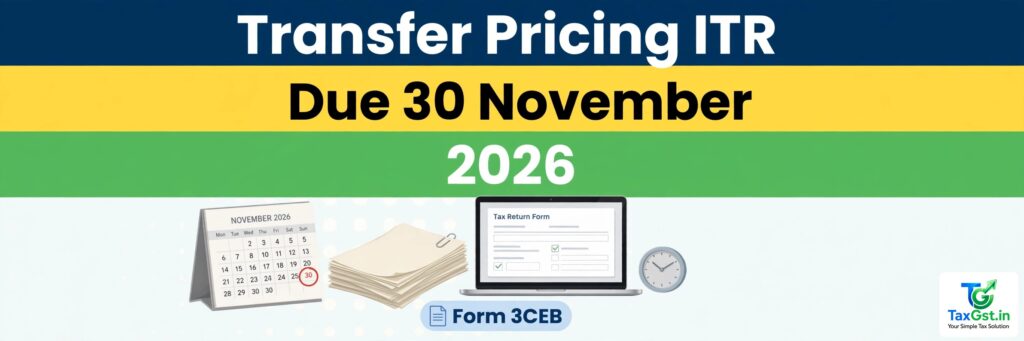
Your CFO walks in with good news: the audit-case ITR deadline was extended to 21 November, so the return is filed and the pressure is off. Then someone asks the awkward question. Did the Indian subsidiary pay its foreign parent for software support this year? If yes, that relief does not apply to you. Your deadline is a different date: 30 November 2026.
Why 30 November, not 21 November
Section 139(1), Explanation 2, sorts assessees into rows, each with its own date. Ordinary audit cases are serial number 2: return due 31 October 2026. Section 92E cases are serial number 3: 30 November.
CBDT Circular No. 07/2026, dated 28 September 2026, moved only serial number 2: the audit-case return to 21 November 2026, the tax audit report to 21 October 2026. It names serial number 2 and nobody else. The 30 November date for Section 92E cases was never touched, nor the 31 October date for Form 3CEB.
Here is the catch. A company that is audited and has a Section 92E obligation belongs in the 30 November row, not the 21 November row. The audit extension neither pulls you forward nor pushes you back. For the full account of the extension, read the full story of the ITR deadline extension to 21 November 2026, and for the wider map of this year’s return dates, see the Income Tax hub with every AY 2026-27 deadline in one place.
Are you a transfer-pricing case?
You are in the 30 November row if, during FY 2025-26, you entered into an international transaction with an associated enterprise, or a specified domestic transaction. In practice that covers most Indian subsidiaries of foreign groups and export-focused IT and services firms billing group entities.
Two traps. First, international transactions have no minimum value: one Rs 5 lakh royalty to your foreign parent still triggers Form 3CEB. Second, specified domestic transactions count only if the listed transactions, such as inter-unit transfers under Section 80-IA, exceed Rs 20 crore in aggregate. A plain related-party payment is not an SDT on its own; the old Section 40A(2)(b) clause was removed years ago.
If you are unsure, ask your chartered accountant one question: “Did we have a Section 92E reporting obligation for FY 2025-26?” The answer decides your deadline, and getting it wrong in either direction costs money.
The 30 November checklist
| Item | Form | Due date | Status now |
|---|---|---|---|
| Accountant’s report | Form 3CEB, Sec 92E | 31 Oct 2026 | Already due — file now if missed |
| TP documentation | Sec 92D, Rule 10D | 31 Oct 2026 | Must exist by now; keep 8 years |
| Income-tax return | ITR-6 / ITR-5 | 30 Nov 2026 | Due in 4 days |
| Master File | Form 3CEAA, Rule 10DA | 30 Nov 2026 | Due with the return |
| Country-by-Country Report | Form 3CEAD, Sec 286 | 31 Mar 2027 | Largest groups only |
Form 3CEB was due on 31 October, a month before the return. If it is still not filed, file it now; a late report beats a missing one. The Master File is the one most teams miss. Part A of Form 3CEAA must be filed by every constituent entity of an international group, whatever its size. Part B applies only where group consolidated revenue exceeds Rs 500 crore and international transactions exceed Rs 50 crore, or intangible-property transactions exceed Rs 10 crore. Test revenue on consolidated group figures, not the Indian entity’s turnover.
One small mercy on documentation: if aggregate international transactions did not exceed Rs 1 crore, Rule 10D does not require the full local-file set, though you must still show the income was computed at arm’s length.
What it costs to miss 30 November
Missing the date does not lock you out: a belated return under Section 139(4) is open until 31 December 2026. But the costs stack up, and one is permanent.
First, the late fee: a flat Rs 5,000 under Section 234F once the Section 139(1) date passes, capped at Rs 1,000 if total income is up to Rs 5 lakh. Flat, not daily: one day late costs the same as thirty.
Second, interest. Section 234A charges simple interest at 1.5% per month, or part of a month, on unpaid tax from the day after the due date. Take a company with Rs 10 lakh of unpaid tax that files on 15 December. The period from 1 to 15 December is part of a month, so it counts as a full month: 1.5% of Rs 10,00,000 is Rs 15,000. Add the Rs 5,000 late fee and the delay has cost Rs 20,000. Work out your own numbers on the income-tax calculator to estimate what a late filing will cost you, and pay the balance tax now, even before the return is ready, to stop the interest clock.
Third, and worst, the losses. Under Section 80 read with Section 139(3), business and capital losses carry forward only if the return of loss is filed by the original due date. File belatedly and they are gone for good. House-property losses and unabsorbed depreciation survive, but for a company with a business loss, 30 November is the line between keeping it and losing it.
Then there are the transfer-pricing penalties, separate from the late-filing costs:
| Default | Section | Penalty |
|---|---|---|
| No Form 3CEB furnished | 271BA | Rs 1,00,000 flat |
| TP documentation not kept, or incorrect information | 271AA(1) | 2% of each transaction’s value |
| Documents not furnished when asked for | 271G | 2% of transaction value, per failure |
| Master File not furnished | 271AA(2) | Rs 5,00,000 flat |
To see how sharp the 2% penalty is, take a single Rs 3 crore service payment to a foreign parent with no benchmarking study behind it. Two per cent of Rs 3,00,00,000 is Rs 6,00,000, per transaction, before any adjustment to the price itself. Section 273B offers relief where you can prove reasonable cause, but “we thought the deadline was 21 November” is not the kind of cause that usually succeeds.
What to do in the next four days
If Form 3CEB is filed and the return is nearly ready, verify the 3CEB figures match the return, confirm Part A of Form 3CEAA is filed, and pay any balance self-assessment tax today. File before the portal’s last-day rush.
If Form 3CEB is not filed, do not wait for it to be perfect. Get the report furnished now and file the return by 30 November. A late 3CEB risks a Rs 1,00,000 penalty; a late return costs the fee, the interest and the loss carry-forwards as well. If 30 November slips past you, file the belated return before 31 December 2026. After that the belated window closes, and the only route left is an updated return, which cannot carry losses or claim a refund. The third instalment of advance tax also falls due in December, so read the guide to the December advance-tax instalment before you pay it.
What changes next year
AY 2026-27 is governed by the Income-tax Act, 1961. From tax year 2026-27, income from 1 April 2026, the Income-tax Act, 2025 takes over: Section 172 replaces Section 92E, Form 48 replaces Form 3CEB, and the return moves to Section 263. For what the new Act means in practice, see the seven-month business checklist under the Income-tax Act, 2025. And if the new regime’s rebate changes the maths on the return you are filing, the Section 87A rebate guide explains who actually pays no tax up to Rs 12 lakh.
FAQs
Is the transfer-pricing ITR deadline 21 November or 30 November 2026?
30 November 2026. Circular No. 07/2026 extended only the serial number 2 audit cases to 21 November. Section 92E cases were not covered.
Was Form 3CEB also extended?
No. It was due on 31 October 2026. If it is still unfiled, furnish it now; the penalty for not furnishing it is Rs 1,00,000 under Section 271BA.
Does every company in a foreign group need to file the Master File?
Every constituent entity must furnish Part A of Form 3CEAA. Part B applies only above Rs 500 crore group revenue and Rs 50 crore of international transactions (Rs 10 crore for intangibles). Both parts are due by 30 November 2026.
What happens if I file after 30 November?
A belated return under Section 139(4) is open until 31 December 2026: Rs 5,000 late fee (Rs 1,000 if income is up to Rs 5 lakh), 1.5% monthly interest on unpaid tax, and loss of business and capital loss carry-forwards.
Does the Income-tax Act, 2025 apply to this return?
No. This return covers FY 2025-26 income under AY 2026-27 and is governed by the 1961 Act. The 2025 Act applies from tax year 2026-27.
Sources
CBDT Circular No. 07/2026, F. No. 225/128/2026/ITA-II, dated 28 September 2026 (Central Board of Direct Taxes). Income-tax Act, 1961, Sections 92BA, 92D, 92E, 139(1) Explanation 2, 139(3), 139(4), 234A, 234F, 271AA, 271BA, 271G and 80, via the Income Tax Department (incometaxindia.gov.in). Income-tax Rules, 1962, Rules 10D, 10DA and 10E. CBDT press release on Master File rules, 1 November 2017 (Press Information Bureau). Section 139(4) as amended by the Finance Act, 2021.
Discover more from TaxGst.in
Subscribe to get the latest posts sent to your email.