 C.K. Gupta
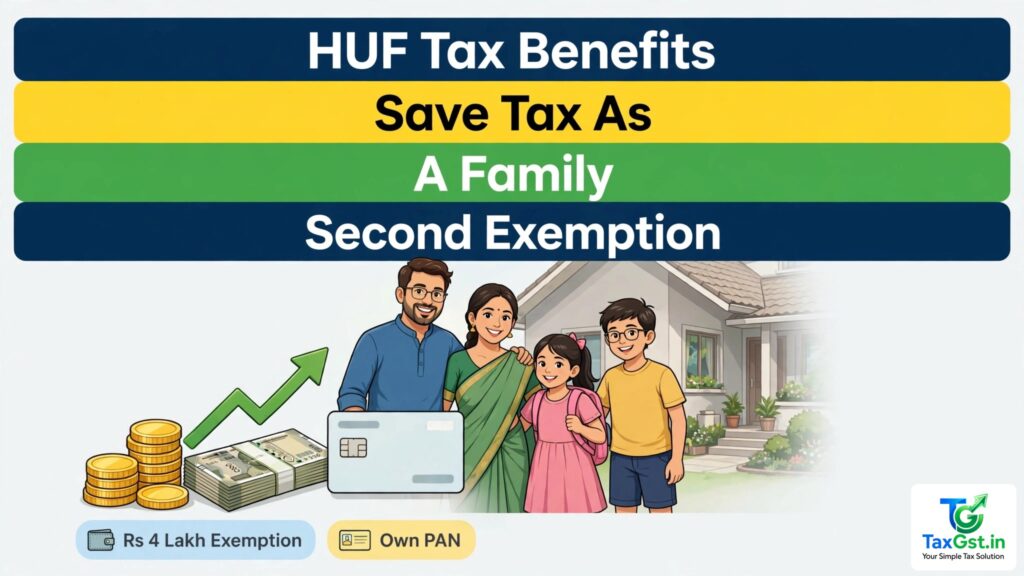
Imagine a family in Delhi. The father earns ₹18 lakh a year in salary and also collects ₹6 lakh a year in rent from a shop the family owns. In his own hands, that rent sits on top of his salary and is taxed at 30% — ₹1,80,000 of tax, plus 4% cess, or ₹1,87,200 in all. Now suppose the shop belongs to the family’s HUF instead. The HUF is a separate person in tax law. It files its own return, on its own PAN, and the ₹6 lakh of rent is taxed in the HUF’s hands, not the father’s. The HUF’s basic exemption in the new regime is ₹4 lakh, so only ₹2 lakh is taxable, at 5% — ₹10,000 of tax, ₹10,400 with cess. The saving is ₹1,76,800 a year, every year, on the same rent from the same shop. That is the whole HUF idea in one example. It is also the idea most often done wrong, because the rules that make it work — and the two traps that undo it — are rarely explained together. Here they are.
What an HUF is, and how one comes into being
An HUF — a Hindu Undivided Family — is a family unit recognised as a separate taxable entity under income tax law. It consists of all persons lineally descended from a common ancestor, together with their wives and unmarried daughters. The head of the family, the karta, manages its affairs, and the members are coparceners with a birthright in the family property. The crucial point, and the first thing people get wrong, is that an HUF arises by operation of Hindu law. It cannot be created simply by signing a document or applying for a PAN. A family becomes an HUF when there is ancestral property, or property thrown into the common hotchpotch, or a business or asset that belongs to the family as a unit — typically on partition of a larger HUF, on receiving ancestral property, or on a gift or will that creates a family corpus. Once it exists, the HUF gets its own PAN (applied for on Form 49A through NSDL or UTIITSL), its own bank account, its own investments, its own property, and its own income-tax return, filed on ITR-2, ITR-3 or ITR-4 depending on the nature of its income. It is taxed at the same slab rates as an individual. The deductions hub carries the full set of deduction guides, and the ITR form guide explains which form an HUF files for which income.
The tax benefits, one by one
The core benefit is income splitting, amplified by a second basic exemption slab. The HUF gets its own basic exemption threshold independently of every member: ₹4 lakh under the default new regime in tax year 2026-27, and ₹2.5 lakh under the old regime. The new-regime slabs are the same as for an individual, and the HUF can choose between the regimes independently of its members. Under the old regime, the HUF can independently claim the deductions its members also claim, each within its own limit: Section 123 (old Section 80C) up to ₹1.5 lakh for life insurance premiums on the lives of members, ELSS, NSC, tax-saving fixed deposits and home-loan principal on HUF property; Section 126 (old Section 80D) for health insurance premiums for members — ₹25,000, or ₹50,000 where the insured member is a senior citizen; Section 80G for donations; and home-loan interest under Section 24(b) where the HUF owns the property. Both the HUF and the karta can claim Section 123, so a family effectively gets two ₹1.5 lakh baskets. The Section 80C complete guide lists all thirteen options in the basket, and the Section 87A rebate guide explains the ₹12 lakh zero-tax limit — which, as the next section shows, does not apply to the HUF at all.
The 87A trap: the HUF gets no rebate
Here is the mistake that ruins most HUF plans. Section 87A — the rebate that makes an individual’s income up to ₹12 lakh effectively tax-free in the new regime — is available only to a resident individual. An HUF is not an individual. The HUF gets the basic exemption but not the rebate, and it gets no marginal relief either. So a family that pushes ₹11 lakh of income into the HUF expecting zero tax will be disappointed: the HUF pays 5% on the ₹4 lakh to ₹8 lakh slice (₹20,000), 10% on the ₹8 lakh to ₹11 lakh slice (₹30,000), and 4% cess on top — ₹52,000 in all. Plan the income-splitting threshold accordingly: push enough income into the HUF to benefit from the lower slabs, but do not rely on the ₹12 lakh nil-tax band that individuals enjoy. The same logic applies in reverse to the old regime, where the HUF’s rebate is the same ₹12,500 up to ₹5 lakh that an individual gets — but again, only within its own return. Two more limits complete the picture. An HUF cannot earn salary, so it cannot claim the standard deduction. And an HUF cannot open a PPF account — that was prohibited under the Public Provident Fund Scheme, 2019 — so do not plan around PPF for the HUF, even though PPF contributions in a member’s name can still sit inside the HUF’s Section 123 claim where the premium or contribution is paid by the HUF.
The clubbing trap: gifted assets come back
The second trap is Section 64(2) of the Income-tax Act, 1961 (carried into the Income-tax Act, 2025). If a member transfers an asset to the HUF without adequate consideration — a gift of a flat, shares, or cash to the family corpus — the income from that asset is clubbed back into the member’s hands. The transfer itself is not the problem; the income it produces is. So a father who gifts his own flat to the HUF and then has the HUF collect the rent has achieved nothing: the rent is taxed in the father’s hands exactly as before. The HUF route works for income from ancestral property, from property the HUF already owns, from a business the HUF runs, and from investments made out of the HUF’s own accumulated income. It does not work as a laundering device for a member’s own assets. The clubbing rules guide explains how the same provision catches income routed through a spouse or a minor child, and the income tax hub carries the wider family-taxation material.
Worked example: old regime versus new regime for the HUF
Take the Delhi family again, with ₹6 lakh of rent in the HUF’s hands and nothing else. In the new regime: taxable income is ₹6,00,000 minus the ₹4,00,000 basic exemption, which is ₹2,00,000; tax at 5% is ₹10,000; with 4% cess, ₹10,400. In the old regime, suppose the HUF also pays ₹1,50,000 into ELSS and life insurance premiums under Section 123, and ₹25,000 of health insurance premium for the karta under Section 126. Taxable income is ₹6,00,000 minus ₹1,75,000 of deductions, which is ₹4,25,000; the basic exemption is ₹2,50,000, so tax is 5% on ₹1,75,000, which is ₹8,750; with cess, ₹9,100. The old regime wins by ₹1,300 in this case — but only because the HUF has ₹1.75 lakh of deductions to claim. With no deductions at all, the new regime wins: ₹10,400 against ₹18,200 in the old regime (5% on ₹3.5 lakh is ₹17,500, plus cess). The lesson is the same as for individuals: run both regimes every year, because the answer flips with the size of the deductions. And remember the due date: a non-audit HUF files by 31 July 2027 for assessment year 2027-28.
Frequently asked questions
Can I create an HUF just by applying for a PAN?
No. An HUF arises by operation of Hindu law — from ancestral property, a partition, or property thrown into the common hotchpotch. The PAN application on Form 49A is a step after the HUF exists, not the step that creates it.
Does an HUF get the ₹12 lakh zero-tax benefit under Section 87A?
No. Section 87A is available only to resident individuals. An HUF gets its own basic exemption — ₹4 lakh in the new regime, ₹2.5 lakh in the old — but it pays tax on income above that, starting at 5%.
Can both my HUF and I claim Section 80C?
Yes, under the old regime, each within its own ₹1.5 lakh limit. The HUF claims it on premiums and investments it pays for; you claim it on yours. The two baskets are independent.
If I gift my flat to the HUF, is the rent taxed in the HUF?
No. Under Section 64(2), income from an asset transferred to the HUF by a member without adequate consideration is clubbed back into the member’s hands. The HUF route works for ancestral property and the HUF’s own income, not for a member’s gifted assets.
Can an HUF open a PPF account?
No. HUFs have been prohibited from opening PPF accounts under the Public Provident Fund Scheme, 2019. Plan the HUF’s Section 123 basket around ELSS, NSC, life insurance and tax-saving deposits instead.
Sources
- Income-tax Act, 1961, Section 2(31) (HUF as a separate person) and Section 64(2) (clubbing of income from assets transferred by a member to the HUF); Income-tax Act, 2025, Section 202 (new regime as the default for HUFs from tax year 2026-27) and Section 156 (Section 87A rebate — resident individuals only).
- Income-tax Act, 2025, Section 123 (old Section 80C: ₹1.5 lakh aggregate deduction), Section 126 (old Section 80D: health insurance premiums ₹25,000, ₹50,000 for senior citizen members), and Section 24(b) (home-loan interest deduction) — all old-regime only for the HUF.
- Public Provident Fund Scheme, 2019 — HUFs prohibited from opening PPF accounts. Form 49A (PAN application for HUF) via NSDL e-Gov / UTIITSL; ITR-2, ITR-3 or ITR-4 for HUF returns depending on the nature of income.
Discover more from TaxGst.in
Subscribe to get the latest posts sent to your email.