 C.K. Gupta
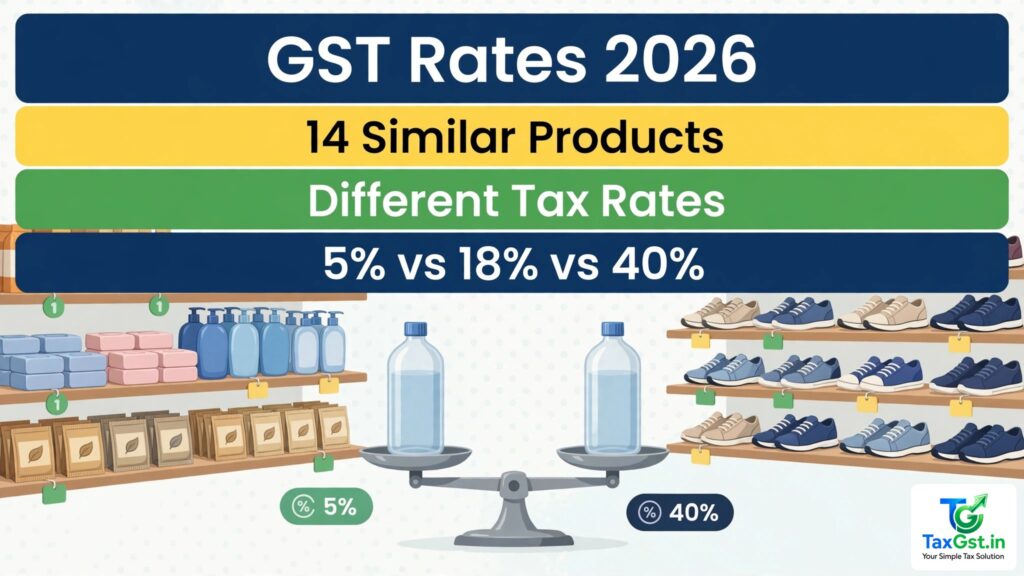
A kirana wholesaler in Indore sold both namkeen and pan masala, both under heading 2106, both in similar pouches, and charged 5% on both for years. The department’s answer was that pan masala is a named tariff item at 40%, and the short payment ran into lakhs with interest. His mistake was the most natural one in GST: assuming that things that look alike are taxed alike. They are not. The goods rate notification still has about 1,200 entries, and the difference between two rates is usually one word in the entry, one threshold, or one exclusion in square brackets. Here are the 14 pairs that catch the most businesses, with the notification entry for each. For the mechanics of HSN codes themselves, the GST rates and HSN codes guide explains the digit structure and the 4-digit versus 6-digit rules, and the GST hub carries every rate and compliance guide in one place.
Drinks: sugar, flavour and fizz change everything
| Product | GST rate | Looks like | GST rate | What decides it |
|---|---|---|---|---|
| Packaged drinking water and plain soda water, no added sugar, sweetener or flavour (2201) | 5% — Sch. I, entry 146 | Water with added sugar, sweetener or flavour (2202 10) | 40% — Sch. III, entry 1 | Any added sugar, sweetener or flavour moves it to 2202 10 |
| Fruit pulp or fruit juice based drinks, not carbonated (2202 99 21, 2202 99 29) | 5% — Sch. I, entry 150 | Carbonated beverages of fruit drink, or carbonated beverages with fruit juice (2202) | 40% — Sch. III, entry 4 | Carbonation. Entry 150 itself excludes the carbonated fruit drinks |
Two details matter here. Beverages containing milk are also 5%, under Schedule I entry 151. And from 1 May 2026, Notification No. 1/2026-Central Tax (Rate) split tariff items 2202 99 20, 2202 99 30 and 2202 99 90 each into two — the descriptions and rates did not change, but the code on your invoice must be the one in force at the time of supply.
Food: processing, packaging and the same code twice
| Product | GST rate | Looks like | GST rate | What decides it |
|---|---|---|---|---|
| Namkeen, bhujia, mixture, chabena (2106 90) | 5% — Sch. I, entry 143 | Pan masala (2106 90 20) | 40% — Sch. III, entry 14 | The named tariff item. Pan masala was 28% plus compensation cess until 31 January 2026 |
| Tea, whether or not flavoured, including green tea (0902) | 5% — Sch. I, entry 34 | Unprocessed green leaves of tea (0902) | Nil — 10/2025-CT(R), entry 58 | Processing. Only unprocessed green leaves are nil |
| Dried chillies and chilli powder (0904) | 5% — Sch. I, entry 36 | Fresh green chillies (0709) | Nil — 10/2025-CT(R), entry 35 | Fresh or chilled vegetables are Chapter 7; dried, crushed or ground capsicum is Chapter 9 |
| Dried pulses, pre-packaged and labelled (0713) | 5% — Sch. I, entry 20 | The same pulses sold loose, or in packs above 25 kg (0713) | Nil — 10/2025-CT(R), entry 39 | Packaging. Same code, two entries |
The pulses row is the one to pin to your wall. The same dal, the same HSN code, is nil when sold loose or in a 50 kg sack and 5% in a retail pack of up to 25 kg that is pre-packaged and labelled. “Pre-packaged and labelled” is a defined condition: a commodity intended for retail sale, of not more than 25 kg or 25 litres, pre-packed under Section 2(l) of the Legal Metrology Act, 2009, and required to carry its declarations. Your item master needs two rate lines for one code. The same pattern runs through the whole food section: fresh chillies are vegetables of Chapter 7, dried chillies are spices of Chapter 9, and the products are close but the entries are not. The November 2026 rate changes guide covers the item-wise changes that took effect on 1 November 2026, including retreaded tractor tyres at 5% and psyllium seeds going exempt.
Personal care: the entry names only three products
| Product | GST rate | Looks like | GST rate | What decides it |
|---|---|---|---|---|
| Toilet soap (other than industrial soap) in bars, cakes or shapes (3401) | 5% — Sch. I, entry 251 | Liquid or cream products for washing the skin, such as face wash and body wash (3401) | 18% — Sch. II, entry 66 | The form. Entry 66 names liquid and cream skin-washing products |
| Hair oil and shampoo (3305) | 5% — Sch. I, entry 245 | Other preparations for use on the hair (3305) | 18% — Sch. II, entry 62 | Only hair oil and shampoo are named. Mehendi paste in cones is also 5%, Sch. I, entry 77 |
| Shaving cream, shaving lotion and aftershave lotion (3307) | 5% — Sch. I, entry 249 | Pre-shave and other shaving preparations not named in entry 249, personal deodorants, bath preparations and depilatories (3307) | 18% — Sch. II, entry 64 | Only the three shaving products named in entry 249 are 5% |
Personal care is where the “named items are closed lists” rule bites hardest. Hair oil and shampoo are 5% because entry 245 names them. A hair serum, a hair mask or a styling gel under the same heading 3305 is 18%, because it is not named. The same is true of shaving: only shaving cream, shaving lotion and aftershave lotion are 5%; a pre-shave oil or a deodorant under heading 3307 is 18%. And the soap entry carries the classic exclusion trap: the 18% entry for liquid skin-washing products excludes toilet soap in bars, cakes, moulded pieces or shapes — read only the first half of the entry and you will charge the wrong rate on a bar of soap. Work it out: a distributor selling ₹50 lakh a year of body wash at 5% instead of 18% has short-paid ₹6.5 lakh of tax, before interest at 18% a year and penalty. Run your own numbers on the GST calculator before you correct the rate.
Vehicles, footwear, clothing — and one service
| Product | GST rate | Looks like | GST rate | What decides it |
|---|---|---|---|---|
| Tractors (8701) | 5% — Sch. I, entry 442 | Road tractors for semi-trailers of engine capacity above 1800 cc (8701) | 18% — Sch. II, entry 531 | Type and engine capacity |
| Motorcycles up to 350 cc (8711) | 18% — Sch. II, entry 546 | Motorcycles above 350 cc (8711) | 40% — Sch. III, entry 8 | Engine capacity. Electric two-wheelers are 5%, Sch. I, entry 441 |
| Footwear of sale value up to ₹2,500 per pair (Chapter 64) | 5% — Sch. I, entry 392 | Footwear above ₹2,500 per pair | 18% — Sch. II, entries 202 to 206 | Sale value of each pair |
| Garments and clothing accessories of sale value up to ₹2,500 per piece (Chapters 61 and 62) | 5% — Sch. I, entries 388 and 389 | The same above ₹2,500 per piece | 18% — Sch. II, entries 197 and 198 | Sale value of each piece |
| Hotel accommodation up to ₹7,500 per unit per day (SAC 9963) | 5% — 11/2017-CT(R), entry 7(i) | Hotel accommodation above ₹7,500 per unit per day | 18% — 11/2017-CT(R), entry 7(vi), with input tax credit | Value of supply per unit per day |
Three rules tie this section together. First, value tests apply item by item: for footwear it is the sale value of each pair, and for garments of each piece, not the total of the invoice. One invoice can carry both 5% and 18% lines under the same heading. Second, the hotel 5% rate is mandatory: Explanation (a) in entry 7(vi) covers item (i), so a hotel cannot choose 18% with credit instead. It comes with a credit condition — no input tax credit on the goods and services used — with one exception from 1 November 2026: credit is allowed on hotel accommodation bought from another supplier of hotel accommodation, but only up to tax at 2.5% central tax (5% in all). The notification’s own illustration: where the other hotel charged ₹900 central tax at 9% on a ₹10,000 room, credit of only ₹250 can be taken. The restaurants and hotels 5% guide works through the same-line credit rule in detail. Third, the rate of the period, not of today: rates and thresholds before 22 September 2025 were different, and pan masala moved from 28% plus compensation cess to 40% only on 1 February 2026. For an older supply, use the entry in force at its time of supply, with Section 14 of the CGST Act deciding where supply, invoice and payment fall on different sides of a change.
Confirming the code in five steps
First, start from the tariff, not from a rate chart: the rate notifications say the rules for the interpretation of the Customs Tariff apply to them, so find the heading from the description of the goods. Second, read the whole entry — the words in any “[other than …]”, any value, size or packaging test, and, for services under Notification 11/2017-Central Tax (Rate), the condition column. Third, apply the test to each item: value per pair or piece, packaging of each pack, engine capacity of each vehicle. Fourth, check the date, and use the entry in force at the time of supply. Fifth, record the notification and entry against the item, so a later reviewer can see why the rate was chosen. The types of GST guide explains which of CGST, SGST, IGST or UTGST applies once the rate is settled. Getting this wrong is not a paperwork issue: tax short-paid because the wrong notification entry was applied is recoverable under Sections 73 or 74 of the CGST Act (Section 74A for 2024-25 onwards), with interest under Section 50 and penalty — and the HSN code also has to appear on tax invoices: under Notification No. 78/2020-Central Tax, at least 4 digits on B2B invoices where aggregate turnover in the preceding financial year is up to ₹5 crore, and 6 digits on all invoices above that. A code copied from a similar product puts a wrong number on every invoice and every GSTR-1, so the error repeats until someone checks the entry.
Frequently asked questions
Are the GST rates 5% and 18% for everything now?
No. Most goods are 5% or 18% since 22 September 2025, but a short list is at 40% — pan masala, flavoured and carbonated drinks, motorcycles above 350 cc — and many essentials are exempt. The rate depends on the exact notification entry, not the slab structure.
My product is sold both loose and in retail packs. Which rate applies?
Both, depending on the pack. The same pulses are nil loose or in packs above 25 kg and 5% pre-packaged and labelled up to 25 kg. Your item master needs two rate lines for one HSN code.
Can a hotel choose 18% GST with input tax credit instead of 5%?
No. The 5% rate for rooms up to ₹7,500 a day is mandatory. From 1 November 2026 the only credit allowed is same-line hotel accommodation credit, capped at 2.5% central tax.
A shoe costs ₹2,500 exactly. Is it 5% or 18%?
5%. The entry covers footwear of sale value up to ₹2,500 per pair. The 18% entries apply above ₹2,500 per pair, tested on each pair, not on the invoice total.
Which notification do I cite for the rate on my invoice?
For goods, Notification No. 9/2025-Central Tax (Rate) for taxable goods and No. 10/2025-Central Tax (Rate) for exempt goods, as amended — with the schedule and entry number recorded against each item. For hotel and restaurant services, Notification No. 11/2017-Central Tax (Rate), as amended by No. 6/2026-Central Tax (Rate) from 1 November 2026.
Sources
- Notification No. 9/2025-Central Tax (Rate) and Notification No. 10/2025-Central Tax (Rate) — the GST 2.0 rate and exemption schedules effective 22 September 2025, as amended, including Notification No. 1/2026-Central Tax (Rate) of 1 May 2026 (tariff-code splits in Schedule I entries 150 and 151 and Schedule III entries 2 and 3) and Notification No. 19/2025-Central Tax (Rate) (pan masala at 40% from 1 February 2026).
- Notification No. 6/2026-Central Tax (Rate), dated 27 October 2026 — hotels, restaurants, railway catering and outdoor catering at 5% with same-line input tax credit from 1 November 2026, with the 2.5% central-tax cap illustrated in the notification.
- Notification No. 78/2020-Central Tax — HSN digit requirements on tax invoices: 4 digits on B2B invoices up to ₹5 crore aggregate turnover in the preceding financial year, 6 digits above that. Rates as in force on 16 November 2026.
Discover more from TaxGst.in
Subscribe to get the latest posts sent to your email.