 C.K. Gupta
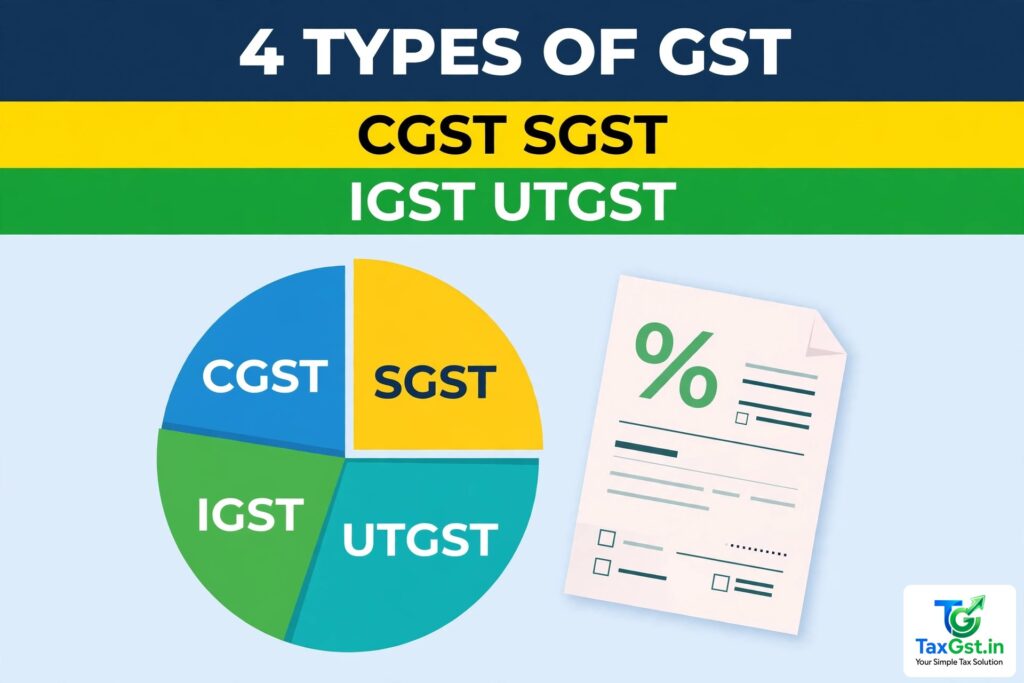
In short
GST in India is not one tax: it is four. CGST goes to the Centre and SGST to the state on sales inside one state; IGST goes to the Centre on sales between states; UTGST replaces SGST in Union Territories without a legislature. On a ₹10,000 sale at 18%, a local sale splits into ₹900 CGST + ₹900 SGST, while an inter-state sale is ₹1,800 IGST – same total, different pockets. The tax you can set off follows the same split, and getting the split wrong is the most common GST invoice error.
Verified November 2026 · TaxGST.in
A Delhi shopkeeper once showed me an invoice for a ₹10,000 sale at 18% GST that charged ₹1,800 as IGST. The buyer was in Delhi too. The total was right, the tax head was wrong – and that one wrong head was enough to make the buyer’s credit claim a problem. The shopkeeper had treated CGST, SGST, IGST and UTGST as four names for the same thing. They are not. This guide explains each one, when it applies, and how to split a bill without that mistake.
For the wider GST picture, see the GST hub and the November 2026 GST changes guide. The missing-ITC guide explains the GSTR-2B problem that often sits behind a wrong split, the registration-fees guide clears up a separate cost myth, and the PMT-06 guide shows how the tax you compute is actually paid.
The one question that decides the tax
Every GST invoice starts with the same question: where is the supply consumed? The answer is called the place of supply, and it decides everything that follows.
If the seller and the buyer are in the same state, the sale is intra-state and the tax splits. If they are in different states, the sale is inter-state and a single tax applies. That is the whole system in one sentence – and most invoice errors come from skipping that sentence.
The four taxes, simply
CGST is the Centre’s tax. SGST is the state’s tax. IGST is the integrated tax for sales between states. UTGST is the Union Territory version of SGST, used where a territory has no legislature of its own.
On an intra-state sale, CGST and SGST are charged together, each at half the rate. On an inter-state sale, IGST is charged at the full rate. On a sale inside a Union Territory without a legislature, CGST and UTGST are charged together, each at half the rate.
Worked example: the same sale, three ways
Take a ₹10,000 item at 18% GST. The total tax is always ₹1,800. What changes is how it is shown:
- Delhi to Delhi (intra-state): CGST ₹900 + SGST ₹900 = ₹1,800
- Delhi to Mumbai (inter-state): IGST ₹1,800
- Chandigarh to Chandigarh (intra-UT): CGST ₹900 + UTGST ₹900 = ₹1,800
The customer pays ₹11,800 in every case. The invoice must still show the right split, because the buyer’s credit depends on it.
Place of supply, in practice
For goods, the place of supply is usually where the goods are delivered. For services, it is usually where the recipient is located. Special rules apply to transport, events, property and a handful of other services, but the basic test covers most everyday sales.
It is almost always intra-state if the goods stay inside the seller’s state. It is inter-state if they move to a buyer in another state.
A shopkeeper selling only in their own state charges CGST + SGST.
The table you can check an invoice against
| Sale type | Tax charged | Example at 18% on ₹10,000 |
|---|---|---|
| Intra-state | CGST + SGST | ₹900 + ₹900 |
| Inter-state | IGST | ₹1,800 |
| Intra-UT (no legislature) | CGST + UTGST | ₹900 + ₹900 |
| Intra-UT (with legislature) | CGST + SGST | ₹900 + ₹900 |
Local sales split 9% + 9%. Inter-state sales charge the full rate as IGST.
UTGST: the one people get wrong
UTGST applies only in Union Territories without a legislature – Chandigarh, Ladakh, and Dadra and Nagar Haveli and Daman and Diu, among others. It replaces SGST in those places.
Delhi, Puducherry and Jammu and Kashmir do have legislatures, so they use SGST, not UTGST. A Delhi-to-Delhi sale is CGST + SGST, never UTGST. A Chandigarh-to-Chandigarh sale is CGST + UTGST.
If your software defaults to UTGST for Delhi, fix the master data. That one setting causes a steady stream of wrong invoices.
Input tax credit: the order you must follow
Input tax credit is the GST you paid on purchases, set off against the GST you collect on sales. The order is fixed:
- IGST credit is used first against IGST, then CGST, then SGST or UTGST.
- CGST credit is used against CGST, then IGST – never against SGST.
- SGST or UTGST credit is used against SGST or UTGST, then IGST – never against CGST.
CGST and SGST credits never cross over to each other. If you have ₹5,000 of CGST credit and ₹5,000 of SGST liability, you cannot net them off. You pay the SGST in cash or with IGST credit, and carry the CGST credit forward.
Before you send an invoice: the checklist
- Check the buyer’s state against the delivery state.
- Match the tax heads to the place of supply, not to the seller’s state alone.
- Check Delhi and Puducherry are set to SGST, not UTGST.
- Check inter-state sales show IGST only, not CGST + SGST.
- Check the total still adds up – a wrong split often hides a wrong total.
- Keep a copy of the invoice with the credit note if you correct it later.
FAQs
Is the total GST the same for local and inter-state sales?
Yes, if the rate is the same. Only the split changes: CGST + SGST (or UTGST) versus a single IGST line.
Can I claim IGST credit against SGST?
Yes, after using it against IGST and CGST first. IGST credit is the most flexible; CGST and SGST credits are restricted.
What if I charged the wrong tax on an invoice?
No – issue a credit note for the wrong invoice and raise a fresh one with the correct tax heads. Do not just adjust the total, because the buyer’s credit depends on the heads.
Does UTGST apply in Delhi?
No. Delhi has a legislature and uses SGST. UTGST applies only in territories without a legislature, for sales inside that territory.
Who gets the IGST money?
The Centre collects IGST and transfers the state share to the destination state, so the consuming state benefits even though only one line appears on the invoice.
Do exports attract IGST?
Exports are zero-rated: no IGST is charged, and the exporter can claim a refund of input tax credit. That is different from an exempt sale, where no credit can be claimed.
Sources
GST Acts: Central GST Act, 2017 · Integrated GST Act, 2017 · Union Territory GST Act, 2017 · CBIC: GST portal and place-of-supply rules · GST Council: rate notifications
Discover more from TaxGst.in
Subscribe to get the latest posts sent to your email.