
 C.K. Gupta
In short
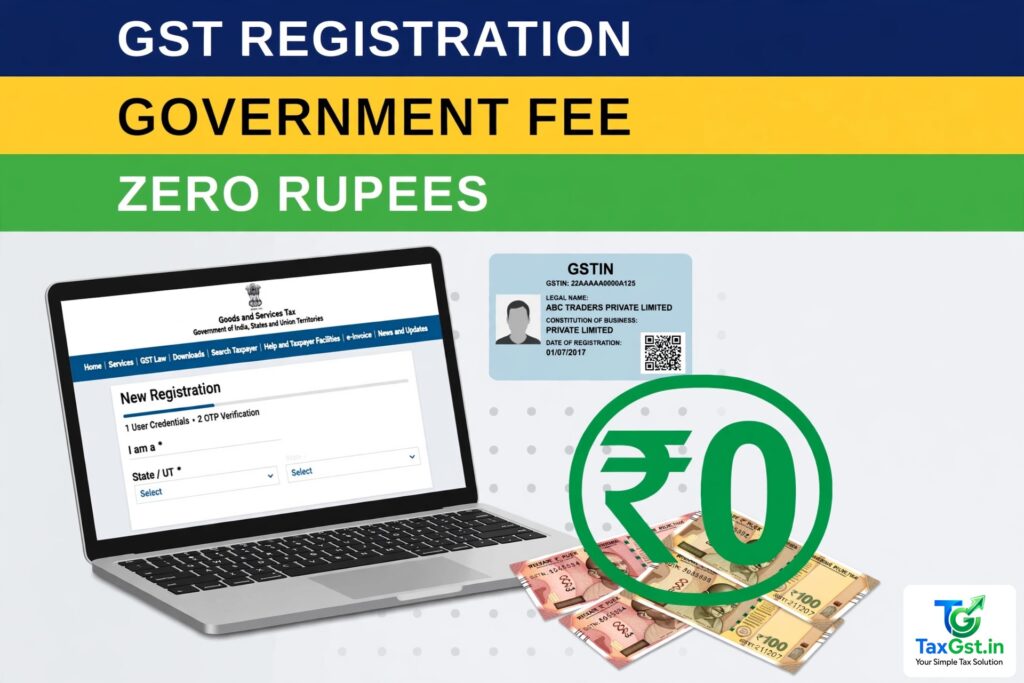
There is no government fee for GST registration in India — applying on the GST portal costs ₹0 for every business type, from a sole proprietor to a private limited company. Every “GST registration fee” you are quoted is a professional service charge for preparing, filing and tracking the application, typically ₹500–₹2,500 for a sole proprietor and higher for companies — plus separate third-party costs such as a digital signature where one is required. Anyone demanding a “government fee” for the registration itself is misdescribing the charge.
Verified November 2026 · TaxGST.in
A kirana-store owner in Indore was quoted ₹4,999 as a “government GST registration fee” on WhatsApp, with a link to pay immediately or “lose the slot”. He nearly paid. The truth took two minutes to check: the GST portal charges nothing to submit a registration application, and there is no slot to lose — applications are processed in turn, and the only thing a payment buys is someone else doing the paperwork. He registered himself the same evening for free. The ₹4,999 was not a fee; it was a sales pitch dressed as a government charge, and it is the most common GST cost confusion in India.
For the registration process itself, see the complete GST hub guides and updates and the GST reforms phase-1 rollout guide from 1 November 2026, which covers the newly standardised registration documents. If you are deciding whether registration is even required, the GST notice portal survival guide explains what happens when compliance goes wrong, and how to pay GST online with a PMT-06 challan covers the first payment after registration. For the service side of registration, TaxGST’s GST consultant services set out what assisted filing includes.
Government fee: nil, for everyone
GST registration is free on the official GST portal (gst.gov.in) for every business type. There is no application fee, no processing fee and no annual government fee simply for holding a registration. The registration itself — form GST REG-01 for a normal taxpayer — is submitted electronically, and the GSTIN (the 15-digit Goods and Services Tax Identification Number) is issued without any government charge. This is not a limited-time waiver or a small-business concession; it is how the system has worked since GST began, and it did not change in 2026.
Registration under Section 22 of the CGST Act becomes mandatory once aggregate turnover crosses the threshold — ₹20 lakh for services and ₹40 lakh for goods in most states — and compulsory in certain cases regardless of turnover, such as inter-state supply and e-commerce selling. But the obligation to register never comes with a government price tag. If a website, agent or message asks you to pay the “government” for the registration, that label is wrong, whatever else the payment may legitimately cover.
What you actually pay for: the professional fee
Most businesses that pay anything for registration are paying for help, not for the registration. A professional fee covers eligibility review, choosing the correct business constitution, matching address proof to documents, selecting HSN/SAC codes, preparing and filing REG-01, and handling any clarification query (REG-03) the officer raises. That help has real value — a wrong constitution, a mismatched address or a missing proof gets the application rejected or stuck in a clarification loop that costs weeks, not rupees.
| Business type | Indicative professional fee range |
|---|---|
| Individual / sole proprietor | ₹500 – ₹2,500 |
| Partnership firm | ₹1,500 – ₹5,000 |
| Limited liability partnership | ₹2,000 – ₹6,000 |
| Private limited company | ₹3,000 – ₹10,000 |
These are market ranges reported by service providers, not a tariff: the fee varies with business structure, documentation, complexity and scope — whether the package includes only filing or also query handling and the first returns. Some providers quote a low headline fee and charge separately for query responses; others bundle filing plus six or twelve months of return filing into one price. Here’s the catch: the cheapest quote is not the cheapest outcome if a rejected application costs you a month of input tax credit. Compare what is included — filing only, or filing plus REG-03 handling plus first-return support — before comparing the number.
The other costs that are not the registration fee
Three separate costs get bundled into “registration charges” quotes and should be priced separately in your head. First, a digital signature certificate (DSC), required for companies and LLPs, bought from a certifying authority at its own price — it is a third-party cost, not a government registration fee, and a proprietor filing with an electronic verification code does not need one at all. Second, stamp duty on a rent agreement, if you need a fresh agreement as address proof — a state charge on the agreement, not on the registration. Third, everything after registration: return filing, accounting and bookkeeping, if outsourced, are recurring professional costs, typically quoted annually — they are not part of registering, and a quote that folds a year’s filing into a “registration fee” is selling you two things under one label. Ask for the split.
The fake-fee scams to recognise
The nil government fee is exactly what makes the scam work: a message that looks official can invent urgency around a charge that does not exist. Red flags: a demand to pay a “government GST fee” by UPI or a payment link outside the GST portal; a deadline or “slot” that will be lost; a fee demanded before any application is shown to you; and a quote that refuses to split government fee from service fee. The real process never asks for payment on the portal for REG-01, and no officer collects a registration fee over WhatsApp, phone or email. If you are unsure about a quote, ask one question — “how much of this is the government fee, and how much is your service charge?” — and walk away from any answer that still claims a government component.
Should you do it yourself or hire help?
Do it yourself if your case is simple: proprietorship, clean address proof matching your documents, one place of business, and standard HSN/SAC codes. The portal’s post-November-2026 document drop-downs make a first filing easier than it used to be. Hire help if your case has edges: a company or LLP structure, multiple places of business, a rented address with a landlord who will not cooperate on proof, a past rejection, or a compulsory-registration case where the category choice affects your whole compliance calendar. In that case, pay for the expertise, not for the registration — and get the scope in writing: filing, query handling, and what happens if the application is rejected.
FAQs
Is GST registration really free?
Yes. The government charges nothing to submit a registration application on gst.gov.in, for any business type. Any charge you pay is for professional help or a separate third-party item such as a DSC.
Why do agents quote ₹1,500 or ₹5,000 then?
That is their service fee for preparing, filing and tracking the application and handling queries — not a government fee. The amount varies with entity type and scope.
Do I need a digital signature to register?
Companies and LLPs need a DSC. Proprietors and partnerships can generally file with electronic verification instead. A DSC is bought from a certifying authority at its own price.
Is there an annual government renewal fee for GST?
No. There is no annual government fee simply for holding a GST registration. Return filing and accounting, if outsourced, are separate recurring professional costs.
Someone asked me to pay a “government fee” on a payment link. What do I do?
Do not pay. The GST portal charges nothing for REG-01 and never collects a registration fee through a payment link, UPI request or message. Report the message and register directly on gst.gov.in or through a verifiable professional.
Sources
CGST Act, 2017, Section 22 (registration thresholds) and the GST registration framework on the official GST portal, gst.gov.in (CBIC/GSTN) — normal registration application in Form GST REG-01 carries no government application or registration fee, and no annual government fee is charged for holding a registration. Market professional-fee ranges as reported by GST service providers in 2026 — sole proprietor ₹500–₹2,500, partnership ₹1,500–₹5,000, LLP ₹2,000–₹6,000, private limited company ₹3,000–₹10,000, varying with structure, documentation and scope; digital signature certificates are separate third-party costs from certifying authorities. 57th GST Council process reforms from 1 November 2026 (GST Council) — standardised registration documents and portal guidance tools for GST REG-01.
Discover more from TaxGst.in
Subscribe to get the latest posts sent to your email.