
 C.K. Gupta
In short
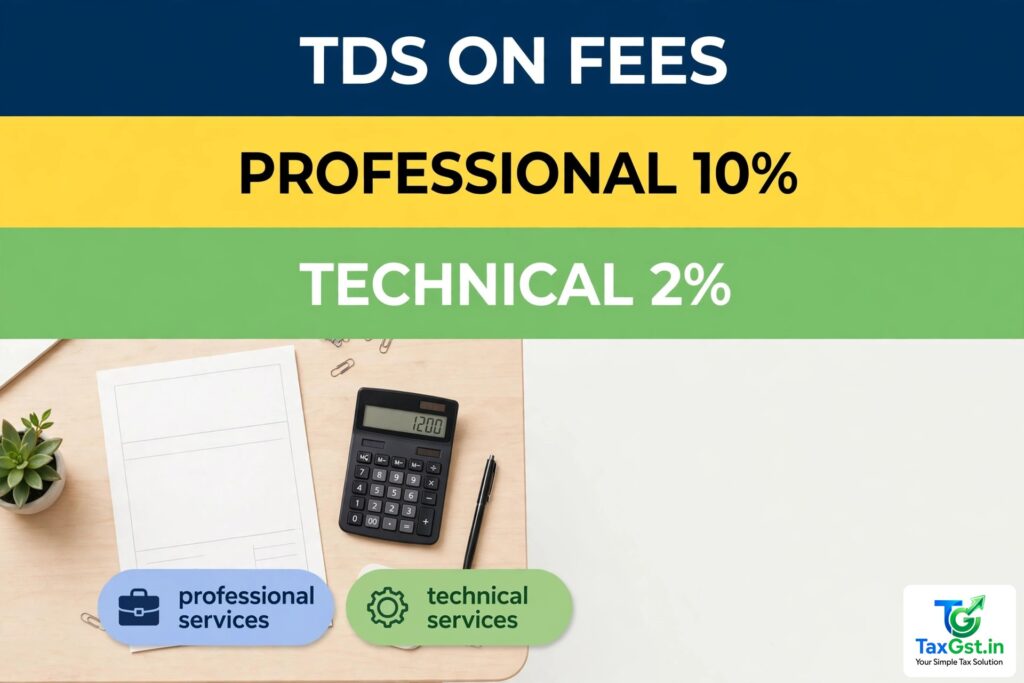
TDS on professional and technical fees is deducted at 10% for professional services and 2% for technical services, once payments to a resident payee in a financial year exceed ₹30,000 for that category — and the threshold is tested separately for each category. Under the Income-tax Act, 2025 the provision sits in the Section 393(1) TDS table (old Section 194J). Director’s remuneration other than salary has no threshold at all, and without the payee’s PAN the rate jumps to 20% under Section 397(2).
Verified November 2026 · TaxGST.in
A startup paid its branding consultant ₹2,40,000 for the year and its software vendor ₹1,80,000 for custom development — and deducted 10% on both. The consultant’s 10% was right; the vendor’s was not. Custom software development, as a technical service rather than a professional service, attracts 2%, so the startup over-deducted ₹14,400, annoyed its vendor, and created a reconciliation mess for both returns. The 10-versus-2 split is the single most expensive classification error in this whole TDS family, and it happens because “professional” and “technical” sound interchangeable in ordinary language. In tax law they are not, and the rate follows the category, not the invoice heading.
For the wider TDS picture, see the TDS hub’s rate and return guides and TDS on commission and brokerage at 2% and its ₹20,000 threshold — the neighbouring table entry deductors confuse with this one. Rent TDS under Section 393 explained covers the rent table, TDS on FD interest and its new thresholds covers the interest table, and how Form 131 replaced Form 16A for TDS certificates explains what the payee now receives as proof.
Who has to deduct, and on what
The provision covers payments to a resident for fees for professional services, fees for technical services, royalty, non-compete fees and remuneration to a director other than salary. Professional services means the notified professions — legal, medical, engineering, architectural, accountancy, technical consultancy, interior decoration, advertising and similar professional work, including film artists and sports persons in the notified list. Technical services means managerial, technical or consultancy services — software development and maintenance, website design, research, photography and editing work, and similar services — excluding salary and excluding amounts already covered by the salary TDS route.
Who must deduct? Any person other than an individual or a Hindu Undivided Family. Individuals and HUFs deduct only if their accounts are subject to tax audit — the same carve-out that runs through most TDS provisions. In practice: companies, firms, LLPs and audited proprietors deduct; a householder hiring an architect for a private home does not, unless that householder’s own accounts are audited. Deduct at the earlier of crediting the sum to the payee’s account or actually paying it — a March credit paid in April is still a March deduction obligation.
The rates and the ₹30,000 threshold
| Category | Rate | Threshold (per year) |
|---|---|---|
| Fees for professional services | 10% | ₹30,000 |
| Fees for technical services (including call centres) | 2% | ₹30,000 |
| Royalty (other than film-related, which is 2%) | 10% | ₹30,000 |
| Non-compete fees | 10% | ₹30,000 |
| Director’s remuneration (not salary) | 10% | No threshold |
| Any of the above, payee without PAN | 20% | — |
Here’s the catch most deductors miss: the ₹30,000 threshold is tested separately for each category, and on the aggregate paid or credited to that payee in the financial year — not per invoice. Pay a consultant ₹20,000 for professional advice and ₹20,000 for technical work in the same year and neither category crosses ₹30,000, so no TDS is due on either — even though the payee received ₹40,000 in total. Pay the same consultant ₹40,000 of professional fees alone and TDS applies to the whole ₹40,000, not just the ₹10,000 above the threshold. Worked examples: professional fees of ₹1,20,000 attract TDS of ₹12,000 at 10%; technical fees of ₹1,20,000 attract ₹2,400 at 2%; the same technical fees paid to a payee who never gave a PAN attract ₹24,000 at 20% under Section 397(2).
One more trap: the rate split dates from 1 April 2020, when the Finance Act 2020 separated technical services at 2% from the previously uniform 10%. Guides and software presets written before that date still quote 10% for everything. If your accounting system deducts 10% on a software invoice, check its rate table before the next payment run — over-deduction is not a favour, it is a refund the payee must wait a year to claim.
Classification: the decisions that actually get disputed
Technical consultancy by a professional is professional services at 10%; the same words on an invoice do not decide it — the nature of the service does. A chartered accountant’s audit fee is professional; a firm’s IT support contract is technical. Royalty needs care too: payment for the use of a copyright, patent or similar right is royalty, while payment for a service that happens to use proprietary tools is usually a technical service. And director’s remuneration is the exception that swallows the threshold: sitting fees and managerial remuneration to a director, other than salary, attract 10% from the first rupee — there is no ₹30,000 shelter at all. A company that pays a director ₹25,000 in sitting fees and deducts nothing has already defaulted.
In practice, keep a one-line classification note on each vendor master: category, rate, threshold tracker. When a vendor’s work straddles both — say, a consultant who both advises (professional) and builds a tool (technical) — split the engagement or the invoices by category and track the thresholds separately. A single blended invoice with a single rate is exactly what an assessing officer will unpick.
After deducting: deposit, return, certificate
Deposit the TDS by the 7th of the following month (30 April for March deductions), file the quarterly non-salary TDS return — Form 140 under the Income-tax Act, 2025 — and issue the payee’s certificate, now in Form 131. The payee claims the credit in their return; it appears in their TIS and AIS, which is why a late or wrong return by the deductor becomes the payee’s problem at filing time. Non-deduction or short deduction also has a direct cost to the deductor: the expense itself can face disallowance — up to 30% of the sum on which tax was not deducted — in the deductor’s own assessment, on top of interest for late deposit. That disallowance risk is why getting the category right matters more than getting the paperwork neat.
Deductor’s checklist
- Classify before you pay: professional 10% or technical 2% — note it on the vendor master, not in your head.
- Track thresholds per payee per category across the whole year, not per invoice.
- Collect the PAN before the first payment; no PAN means 20%.
- Remember director’s remuneration has no threshold — deduct from the first rupee.
- Deduct on credit, not only on payment; a March credit is a March obligation.
- Deposit by the 7th of next month, file Form 140 for the quarter, issue Form 131 to the payee.
- Reconcile quarterly: your return total must match what payees see in their TDS statements.
FAQs
Is TDS on technical services 10% or 2%?
2%, since 1 April 2020. Professional services remain at 10%. The old uniform 10% rate is the most common outdated figure in circulation.
Does the ₹30,000 threshold apply per invoice or per year?
Per payee, per category, per financial year, on the aggregate paid or credited. Several small invoices to the same payee in the same category add up.
Do I deduct TDS on a director’s sitting fees below ₹30,000?
Yes. Director’s remuneration other than salary has no threshold — TDS at 10% applies from the first rupee.
What if the payee gives their PAN after I deducted 20%?
The 20% already deducted stands for those payments; later payments, once the PAN is on record, are deducted at the normal 2% or 10%. The payee recovers any excess through their return.
Sources
Section 194J of the Income-tax Act, 1961, as consolidated in the Section 393(1) TDS table of the Income-tax Act, 2025 (Income Tax Department) — TDS on fees for professional services, fees for technical services, royalty, non-compete fees and director’s remuneration paid to a resident; rates of 10% for professional services and 2% for technical services following the Finance Act 2020 split effective 1 April 2020; aggregate threshold of ₹30,000 per category per financial year, with no threshold for director’s remuneration. No-PAN rate of 20% under Section 397(2) of the Income-tax Act, 2025 (old Section 206AA). Quarterly non-salary TDS return in Form 140 and TDS certificate in Form 131 under the Income-tax Act, 2025 framework. Individual/HUF carve-out: deduction obligation applies only where the individual’s or HUF’s accounts are subject to tax audit, per the 194J framework.
Discover more from TaxGst.in
Subscribe to get the latest posts sent to your email.