 C.K. Gupta
In short
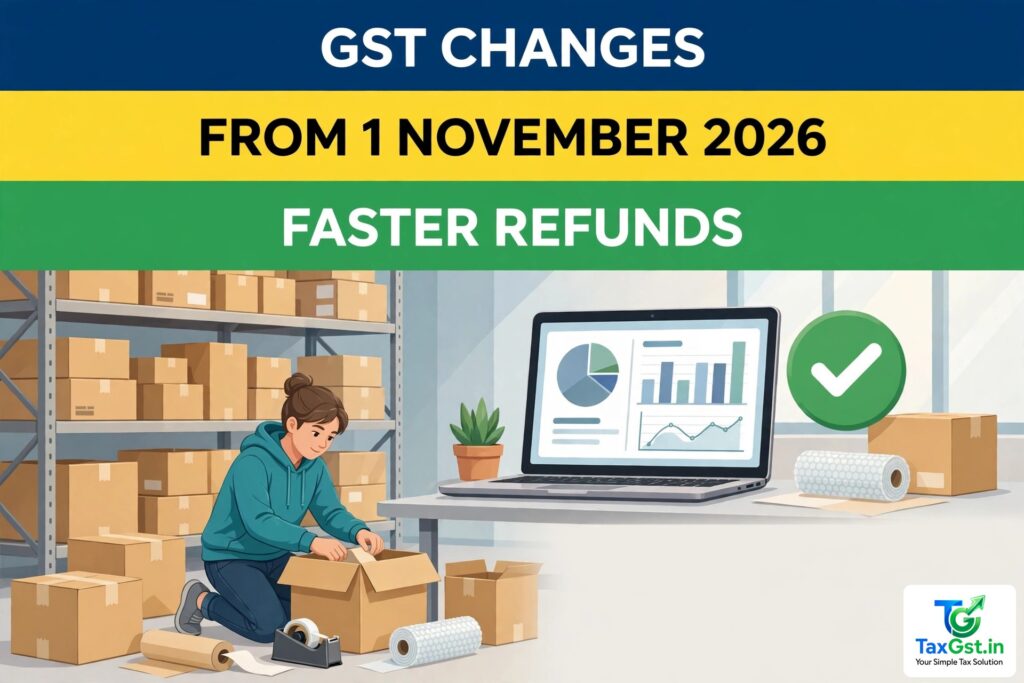
From 1 November 2026, the first phase of the 57th GST Council’s process reforms is live: small e-commerce sellers can use a platform warehouse as their principal place of business, full excess-balance refunds are sanctioned automatically, 90% of eligible zero-rated and inverted-duty refunds are provisionally sanctioned without officer intervention, and post-supply discounts get easier — no pre-existing agreement needed, provided a credit note is issued and the buyer reverses the related input tax credit. The changes that need a law amendment follow from 1 April 2027.
Verified November 2026 · TaxGST.in
A Jaipur seller of handmade candles lists on two marketplaces and stores stock in warehouses in Delhi, Mumbai and Bengaluru. Until yesterday, GST registration in each state where she had no office of her own meant finding a physical address to declare — a practical wall for a business turning over a few lakh a month. From today, that wall is lower. If she passes on input tax credit of up to ₹2.5 lakh a month, she can declare the e-commerce operator’s warehouse in that state as her principal place of business. That one change, aimed at roughly 9.5 lakh small sellers, is the most concrete thing in the 1 November package — and it is worth understanding alongside the refund and discount changes that arrive with it.
For the wider reform picture, see the complete GST hub guides and updates and the GST reforms phase-1 rollout guide from 1 November 2026. If you sell online, how to pay GST online with a PMT-06 challan covers the payment side, and the GST refund process changes guide explains the refund machinery in detail. When a demand does arrive, the GST notice portal survival guide sets out the weekly check routine that stops a missed notice turning into an ex-parte order.
What actually changes on 1 November
Not everything approved on 8 October 2026 changes today. Changes deliverable through administrative processes start in phases from 1 November 2026; changes needing a law amendment wait until 1 April 2027. If a reform you read about needs the law changed, it is not live today, however often it is described as “approved”.
As per the 57th GST Council press release and the government’s rollout, Notification No. 03/2026–Central Tax, dated 26 October 2026, appointed 1 November 2026 as the effective date for Sections 153 to 155 of the Finance Act, 2026, which carry the post-supply discount amendment. The remaining 1 November measures are administrative: standardised registration documents, automated refund sanction and the notice threshold, delivered through GSTN and CBIC processes rather than a fresh Act.
Easier registration for small online sellers
Small suppliers selling through e-commerce platforms in multiple states, where they have no physical presence, and passing on input tax credit of up to ₹2.5 lakh per month, can now declare the e-commerce operator’s warehouse in that state as their principal place of business. In practice, that removes the need to rent or borrow an address in every stocking state — the single biggest registration friction for marketplace sellers. The conditions are cumulative: you must be a small supplier on an e-commerce platform, you must lack a physical presence in that state, and your monthly ITC pass-on must stay within ₹2.5 lakh. Cross that ITC line and the concession stops applying, so a fast-growing seller should track the monthly figure, not just the turnover.
Faster refunds — what “automatic” really means
Three refund changes land today. First, a refund claim for the full excess balance in the electronic cash ledger is sanctioned automatically by the system, without officer intervention. Second, for zero-rated supplies and inverted duty structure claims, 90% of the amount claimed is sanctioned provisionally and automatically, on the basis of system-based risk identification and evaluation — again, without an officer touching the file. Third, the time limit for issuing an acknowledgement or a deficiency memo falls from 15 days to 10 days.
Worked example: an exporter claims a ₹9 lakh refund on zero-rated supplies. Under the new process, ₹8.1 lakh — 90% — is provisionally sanctioned automatically, subject to the system’s risk check, instead of sitting in a queue for manual sanction. The remaining 10% follows the normal verification route. That is a working-capital change, not just a paperwork change: for a small exporter, the difference between a refund in weeks and a refund in months is the next order’s raw material. Note the qualifier, though — “automatic” means system-risk-assessed, not unconditional. A claim the system flags still goes through scrutiny, and a wrong claim sanctioned provisionally can still be recovered later.
Post-supply discounts without the old agreement trap
The amendment to Section 15(3)(b) of the CGST Act removes the requirement that a post-supply discount be established by an agreement entered into before or at the time of supply. Eligible discounts can now be excluded from taxable value where the supplier issues a credit note and the recipient reverses the attributable input tax credit, as Section 34 requires. For FMCG, manufacturing and any business that gives year-end or volume-linked discounts, this ends a long-standing dispute: previously, a discount agreed after the sale — the normal commercial pattern — risked being added back to taxable value for want of a pre-existing agreement and invoice-level linkage.
The ₹10,000 notice threshold
To reduce compliance burden and litigation, a minimum threshold of ₹10,000 is fixed for issuing show cause notices — the reform the Council announced in October and the rollout confirms for this phase. A demand below that figure should not generate a notice at all. For small businesses, that is one less letter to dread; for the department, it is a filter that keeps officer time on material cases. It does not mean small defaults are forgiven — interest and late fees on the underlying liability still apply — only that the notice machinery does not start below ₹10,000.
Your 1 November checklist
- If you sell on marketplaces: check whether your monthly ITC pass-on is within ₹2.5 lakh and whether any state registration still rests on a borrowed address — the warehouse-as-PPoB route may now be available to you.
- If you claim refunds: file zero-rated and inverted-duty claims promptly and keep the risk-profile clean — accurate returns and matched ITC are what keep a claim in the automatic lane.
- If you give post-sale discounts: switch your process to credit note plus buyer ITC reversal, and retire any template that insists on a pre-supply discount agreement.
- If you are registering fresh: use the portal’s new drop-down document list and keep exactly the prescribed documents ready — a complete first filing avoids the REG-03 clarification loop.
FAQs
Do the 1 November GST changes apply to every business?
The process changes — registration documents, automated refunds, discount rules, the notice threshold — apply generally. The e-commerce warehouse concession applies only to small platform sellers meeting the ₹2.5 lakh monthly ITC condition and lacking a physical presence in the state.
Can I now give a discount after a sale without any agreement?
Yes, the pre-existing agreement requirement is removed, but you must issue a credit note and the recipient must reverse the attributable ITC. Both conditions still apply.
What is still coming on 1 April 2027?
The Council decisions that require amendment to the GST law — including the wider ITC changes and the higher prosecution and penalty thresholds announced in October — are scheduled for 1 April 2027, not 1 November 2026.
Does the ₹10,000 notice threshold mean small tax dues are waived?
No. It means no show cause notice is issued below ₹10,000. The underlying tax, interest and late fee position is unchanged.
Sources
57th GST Council meeting decisions of 8 October 2026 (GST Council) — process reforms in registration, returns, refunds and adjudication, approved for phased implementation from 1 November 2026, with law-amendment items deferred to 1 April 2027. Notification No. 03/2026–Central Tax, dated 26 October 2026 (CBIC) — appointing 1 November 2026 as the effective date for Sections 153 to 155 of the Finance Act, 2026, covering the Section 15(3)(b) post-supply discount amendment. GST process-reform rollout as reported from the official briefing on 31 October 2026 — e-commerce warehouse as principal place of business for sellers passing on ITC up to ₹2.5 lakh per month (about 9.5 lakh sellers), standardised registration documents, automatic sanction of full excess cash-ledger refunds, 90% provisional sanction for zero-rated and inverted-duty claims, acknowledgement/deficiency-memo timeline reduced from 15 to 10 days, and the ₹10,000 show cause notice threshold.
Discover more from TaxGst.in
Subscribe to get the latest posts sent to your email.