C.K. Gupta
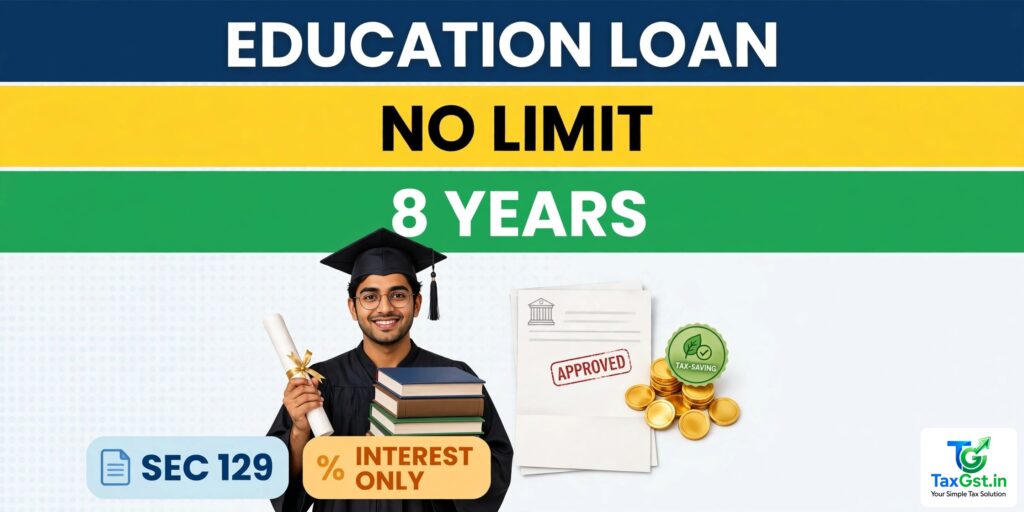
A father in Pune takes a ₹30 lakh education loan for his daughter’s two-year master’s degree abroad. The EMI is about ₹48,000 a month, and in the first year roughly ₹2,40,000 of it is interest. Under Section 80E, every rupee of that ₹2,40,000 comes off his taxable income — there is no ₹1.5 lakh ceiling like 80C, no ₹50,000 ceiling like 80D. At the 30% slab plus 4% cess, that is ₹74,880 of tax saved in a single year. Then the clock starts ticking: the deduction lasts eight years from the year repayment begins, and interest paid in year nine earns nothing.
For the full map of old-regime deductions this one sits inside, see the deductions hub — every deduction, exemption and limit in one place.
Who can claim it
Only an individual can claim Section 80E — not a company, not a firm, not an HUF. The loan must be for the higher education of the individual himself, his spouse, his children, or a student for whom he is the legal guardian. “Higher education” means any course of study pursued after passing the Senior Secondary Examination (Class 12) or its equivalent — a degree, diploma or postgraduate course, in India or abroad. There is no restriction on the institution being in India; a foreign university qualifies, and there is no cap on the loan amount either.
The lender matters as much as the borrower. The loan must come from a financial institution — a bank or an RBI-registered NBFC — or an approved charitable institution. A loan from your employer, from a relative, or from an unregistered lender does not qualify, however genuine the education purpose. If you are planning the loan, check the lender’s status first; if you already borrowed from family, the interest is not deductible however large it is.
The 8-year clock — the catch that catches most people
The deduction is available for the year in which you start paying interest, plus the seven years immediately after it — eight consecutive years in total, or until the interest is fully paid, whichever is earlier. The clock starts in the year of first repayment, not the year the loan was sanctioned, and it runs consecutively: if you claim for six years, skip two years without repaying, you cannot carry the deduction forward to years nine and ten. Once the eight-year window closes, interest paid after it earns no deduction at all.
This changes the tenure decision. A 12-year loan at 9% on ₹30 lakh still charges interest in years nine to twelve — but none of it is deductible. A borrower who can afford a shorter tenure, or who prepays in the early years, keeps more of the interest inside the deductible window. Work this out before signing the loan, not after: the income tax calculator lets you compare the old regime with the deduction against the new regime without it.
Worked examples: what the deduction is actually worth
| Interest paid in the year | Tax saved at 30% slab + 4% cess | Tax saved at 20% slab + 4% cess |
|---|---|---|
| ₹1,00,000 | ₹31,200 | ₹20,800 |
| ₹1,50,000 | ₹46,800 | ₹31,200 |
| ₹2,40,000 | ₹74,880 | ₹49,920 |
| ₹3,00,000 | ₹93,600 | ₹62,400 |
Compare that with 80C, where the maximum saving at the 30% slab is ₹46,800 on a ₹1.5 lakh deduction. A parent paying ₹3 lakh of education-loan interest saves double that — ₹93,600 — because there is no ceiling. The deduction also stacks with 80C: the education-loan interest sits outside the ₹1.5 lakh 80C cap entirely. Our complete 80C guide lists the thirteen options that fill that separate cap, and the NPS guide covers the extra ₹50,000 beyond 80C — both can be claimed in the same year as 80E, provided you are in the old regime.
Here is the catch that decides everything: 80E exists only in the old regime. The new regime, which is the default from tax year 2026-27, does not allow it. If your education-loan interest is ₹2,40,000 a year, the old regime’s deduction alone is worth ₹74,880 at the 30% slab — often enough to make the old regime beat the new regime outright, even though the new regime’s slabs look lower. Run both regimes every year while the loan is active; the answer flips as the interest falls. And if you claim no deduction in a year because you chose the new regime, that year still counts against the eight-year clock — the window does not pause.
Principal earns nothing — the most common mistake
Only the interest component of the EMI qualifies. The principal repaid earns no deduction under 80E, and it does not count under 80C either (unlike a home-loan principal, which does). Many borrowers look at a ₹48,000 EMI and assume the whole amount is deductible; in the early years of a long loan, interest is most of the EMI, but as the loan ages the principal share grows and the deductible share shrinks. Get the interest certificate from your lender every year — it splits interest and principal for you, and it is the document your employer and the assessing officer will ask for.
Checklist before you claim
- Lender: bank, RBI-registered NBFC or approved charitable institution — not family or employer.
- Student: self, spouse, children or legal ward; course after Class 12, in India or abroad.
- Regime: old regime only. If you file under the new regime, the deduction is zero.
- Window: eight consecutive years from the first repayment year. Mark the last eligible year on your calendar now.
- Proof: interest certificate from the lender, every year; keep the loan sanction letter and fee receipts too.
- Regime comparison: re-run the old-versus-new comparison each year — the right answer changes as interest falls.
One last point: the deduction is claimed by the person who took the loan and pays the interest. If a parent takes the loan for a child’s education, the parent claims it. If the child takes the loan and the parent merely pays the EMIs, the claim belongs to the borrower who is legally liable and actually pays — so keep the loan in the name of the person with the taxable income you want to shelter.
Frequently asked questions
Is there any maximum limit on the 80E deduction?
No. The entire interest paid in the year is deductible, with no rupee cap — unlike 80C’s ₹1.5 lakh ceiling. The only limits are the 8-year window and the old-regime requirement.
Can I claim the principal repaid on the education loan?
No. Section 80E covers interest only. Principal repayment on an education loan earns no deduction under any section.
Does 80E work under the new tax regime?
No. It is available only under the old regime. Under the new regime — the default from tax year 2026-27 — the deduction is not allowed at all.
What if I take a 12-year loan? Do I lose the deduction after 8 years?
Yes. The deduction runs for eight consecutive years from the year you start paying interest, or until the interest is fully paid, whichever is earlier. Interest paid in years nine to twelve earns no deduction.
Can I claim 80E for a loan taken for my spouse’s or child’s education?
Yes — the loan can be for your own higher education, or for your spouse, your children, or a student for whom you are the legal guardian. The loan must be in your name and the interest paid by you.
Sources
Section 80E of the Income-tax Act, 1961 (deduction for interest on a loan taken for higher education; no upper limit; eight consecutive assessment years from the initial assessment year) and Section 129 of the Income-tax Act, 2025, its successor from 1 April 2026, with the same rules. Section 202 of the Income-tax Act, 2025 (successor to Section 115BAC) — the new regime does not allow Chapter VIII deductions including Section 129, except the employer’s NPS contribution. Finance Act, 2026 — old-regime framework for tax year 2026-27. For the full deduction map, see the deductions hub; for the regime comparison, see the Section 80GG rent-deduction guide, another old-regime-only benefit.
Discover more from TaxGst.in
Subscribe to get the latest posts sent to your email.