C.K. Gupta
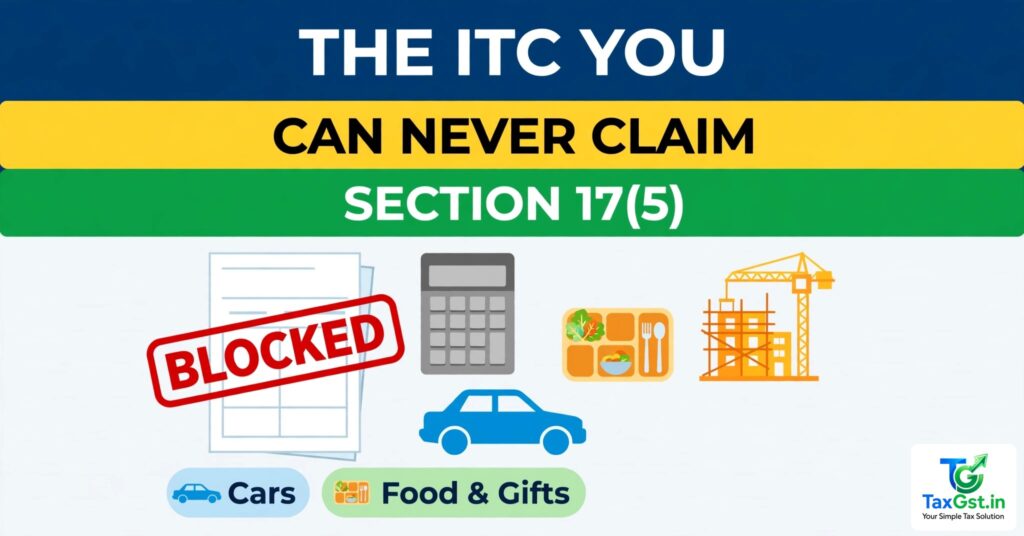
Picture a business owner adding up the GST on the new office car, the team lunch, the staff gym memberships and the office renovation — and claiming every rupee in GSTR-3B. The bills are genuine, the GSTIN on each one. Eighteen months later a demand notice arrives: the credit was never available, and now it must be paid back with interest. This article is the list that would have saved him the notice.
Why Section 17(5) overrides everything else
Section 16(1) is the general rule: credit of the tax paid on purchases used for business. Section 17(5) then starts with a non-obstante clause — “notwithstanding anything contained in sub-section (1) of section 16 and sub-section (1) of section 18” — and names the purchases where credit is blocked outright. Business purpose does not save them: a car used 100% for client visits is still blocked, and so is a team lunch.
The consequence is not a small penalty: credit wrongly claimed is recovered with interest at 18% a year, plus penalty, and blocked-credit reversals are one of the first things an audit looks for. If you have already claimed blocked credit, reverse it in Table 4(B) of your next GSTR-3B and pay the interest — far cheaper than a notice. With the 30 November 2026 deadline for claiming FY 2025-26 ITC days away, check your books now.
The full blocked list
| Clause | What is blocked | When credit survives |
|---|---|---|
| 17(5)(a) | Motor vehicles for transport of persons, seating up to 13 including the driver; vessels and aircraft | Further supply, passenger transport, driving/flying training, goods transport |
| 17(5)(aa) | Insurance, servicing, repair and maintenance of those vehicles, vessels and aircraft | Same exceptions as (a) |
| 17(5)(b)(i) | Food and beverages, outdoor catering, beauty treatment, health services, cosmetic and plastic surgery, hiring of blocked vehicles, life and health insurance | Same-category outward supply, or part of a taxable composite/mixed supply; or where the employer is legally obliged to provide it |
| 17(5)(b)(ii) | Membership of a club, health and fitness centre | Never |
| 17(5)(b)(iii) | Travel benefits to employees on vacation (leave travel) | Never |
| 17(5)(c) | Works contract for construction of immovable property (other than plant and machinery) | Input for a further works contract supply |
| 17(5)(d) | Goods or services for own-account construction of immovable property | Plant and machinery only |
| 17(5)(e) | Tax paid under the composition scheme (Section 10) | Never |
| 17(5)(f) | Supplies to a non-resident taxable person (except goods imported by him) | Never |
| 17(5)(g) | Goods or services used for personal consumption | Never |
| 17(5)(h) | Goods lost, stolen, destroyed, written off, or given as gift or free samples | Never |
| 17(5)(i) | Tax paid under Section 74 (fraud) for periods up to FY 2023-24 | Never |
| 17(5)(fa) | Goods or services used for CSR activities (Section 135, Companies Act, 2013) | Never |
The four traps that catch real businesses
1. The company car. A car costing ₹8,00,000 carries GST of 28%, or ₹2,24,000 — every rupee blocked, even if the car never leaves office duty. The block covers passenger vehicles seating up to 13, including the driver; trucks, tempos and delivery vans are not on the list, so a goods vehicle keeps its credit. Exceptions: transport businesses, car dealers and driving schools.
2. Food, parties and staff welfare. A Diwali team lunch of ₹50,000 carries ₹2,500 of GST at 5%, and gym memberships of ₹1,20,000 a year carry ₹21,600 — both blocked. But the same food bill is claimable for a restaurant or caterer, whose food goes into an outward supply of the same category. One wrinkle: individual life and health insurance has been exempt from GST since 22 September 2025, so there is no GST on those premiums to claim.
3. Building your own office. A ₹50 lakh works contract for your office floor carries ₹9 lakh of GST at 18% — blocked under clause (c). Buy the cement and steel yourself and the block follows under clause (d), even though the building is used only for business. The one door briefly open — the Supreme Court’s Safari Retreats ruling of October 2024, which read “plant or machinery” widely — was closed by the Finance Act, 2025, which substituted “plant and machinery” from 1 July 2017. The test now: plant and machinery, or a building? A building loses.
4. Free samples and gifts. Goods you give away — free samples to distributors, gift hampers to clients — carry blocked credit under clause (h). This block shows up most often in audits of trading businesses, where promotional stock is written off without reversing the credit. Track freebies separately, so the reversal is a line item, not a surprise.
What the 57th GST Council wants to change
At its 57th meeting on 8 October 2026, the GST Council recommended widening ITC to employee insurance and telecom towers — two of the most complained-about blocks above. As per the 57th GST Council press release, these are recommendations only: they take effect through amendments to the CGST Act and Rules, expected from 1 April 2027.
Until then, the block stands — do not pre-claim the insurance credit on a press release. Our inverted-duty refund guide covers the one ITC widening already in effect, input-service credit from 1 November 2026: it arrived by notification, and only then became claimable. For what else changed this month, see our GST rate changes from 1 November 2026. Genuine buyers should also read our fake-ITC notice protection checklist — blocked credit wrongly claimed is one of the fastest routes to a notice.
A five-minute monthly checklist
- Tag the blocked categories in your accounting software — car, food, gym, construction, gifts — so their GST never flows into the ITC column.
- Reverse in Table 4(B) of GSTR-3B. If blocked credit has entered your credit ledger, reverse it and pay interest at 18% — a voluntary reversal beats a departmental one.
- Keep the exception proofs on file. A transport business claiming vehicle credit should hold its passenger-transport registration; a caterer claiming food credit should be able to show the outward supply.
- Reconcile GSTR-2B against your books every month — and check before the 30 November cut-off. A credit in 2B is not automatically claimable, and FY 2025-26 ITC can only be claimed until 30 November 2026; a blocked credit in that last return is the worst kind of last-minute mistake.
For broader ITC rules — conditions, time limits, documents — start from the GST hub.
FAQs
Can I claim ITC on a car bought for business use?
No, if it is a passenger vehicle seating up to 13 including the driver — Section 17(5)(a) applies regardless of business use. Exceptions: you resell such vehicles, transport passengers, or run a driving school. Goods vehicles such as trucks are not blocked.
Can I claim ITC on food and lunch bills for employees?
No, as a rule. Food and beverages and outdoor catering are blocked under Section 17(5)(b)(i), unless the food is used to make an outward supply of the same category — a restaurant serving the food it bought — or the employer is legally obliged to provide it, such as a statutory canteen.
Can I claim ITC on constructing my own office?
No. Works contracts for construction are blocked under Section 17(5)(c), and own-account construction purchases under Section 17(5)(d). Only plant and machinery escapes.
I already claimed blocked ITC last year. What now?
Reverse it in Table 4(B) of your next GSTR-3B and pay interest at 18% a year — far cheaper than a demand under Section 74A, which adds penalty on top.
Will the 57th Council’s ITC widening help me this year?
Not yet. The Council recommended ITC on employee insurance and telecom towers, but recommendations become law only through amendments, expected from 1 April 2027. Until then, the block applies.
Sources
CGST Act, 2017, Section 17(5); 57th GST Council press release, 8 October 2026 (PIB); Safari Retreats v. Commissioner of CGST, Supreme Court, October 2024; Finance Act, 2025; Notification No. 05/2026-Central Tax, 26 October 2026.
Discover more from TaxGst.in
Subscribe to get the latest posts sent to your email.