C.K. Gupta
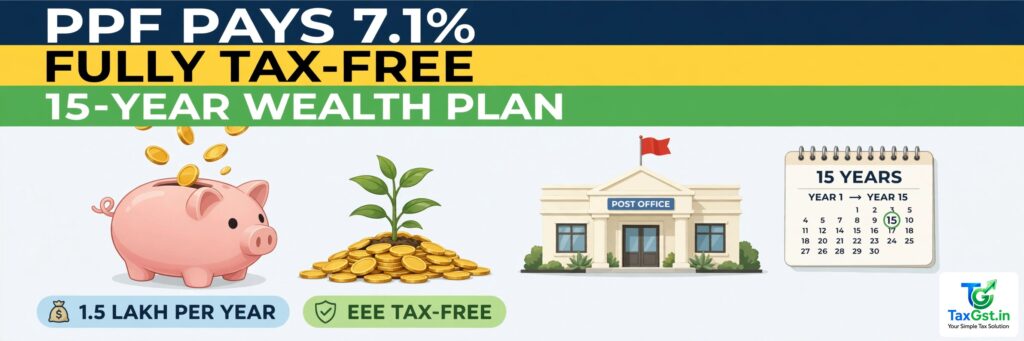
Your bank is offering 6.5% on a five-year fixed deposit. If you are in the 30% slab, that 6.5% becomes about 4.5% after tax. Meanwhile, in the same post office or bank branch, there is an account paying 7.1% — and the interest is not taxed at all. It has been paying 7.1% since April 2020, and the government has just confirmed it again for the October–December 2026 quarter. The reason most people do not use it properly is not the rate. It is the 15-year lock-in, which sounds like a prison sentence until you do the maths.
The deal, in one paragraph
The Public Provident Fund is a government-backed savings scheme under the Public Provident Fund Scheme, 2019. Any Indian resident can open one account; a parent can also open one for a minor child. You deposit between ₹500 and ₹1.5 lakh in a financial year, for 15 years. The interest rate is set by the government every quarter: for 1 October to 31 December 2026 it is 7.1% a year, compounded annually, as notified by the Ministry of Finance’s office memorandum of 30 September 2026. At the end of 15 years you can withdraw everything, tax-free, or extend the account in blocks of five years. The tax treatment is the full EEE triple exemption: the deposit is deductible, the interest is exempt, and the maturity amount is exempt.
The deduction sits under Section 123 of the Income-tax Act, 2025 (the successor to the old Section 80C), within the combined ₹1.5 lakh annual ceiling shared with EPF, ELSS, life-insurance premiums and SSY deposits — and only under the old regime. On the default regime the deposit saves no tax, though the interest and maturity stay tax-free. For the full list of what still saves tax under the old regime, see the deductions hub.
The numbers: what your money becomes
Interest is calculated monthly on the lowest balance between the 5th and the end of the month, and credited once a year on 31 March. That 5th-of-the-month rule is the single most valuable detail in this article: money deposited on the 6th earns nothing that month. Deposit before the 5th, every month, or deposit the year’s full amount in April.
| Yearly deposit | Total deposited (15 years) | Maturity at 7.1%* | Tax-free interest earned |
|---|---|---|---|
| ₹1,50,000 | ₹22,50,000 | ~₹40.68 lakh | ~₹18.18 lakh |
| ₹1,00,000 | ₹15,00,000 | ~₹27.11 lakh | ~₹12.11 lakh |
| ₹50,000 | ₹7,50,000 | ~₹13.55 lakh | ~₹6.05 lakh |
| ₹25,000 | ₹2,50,000 | ~₹6.78 lakh | ~₹3.03 lakh |
*Illustrative, at a level 7.1% with deposits at the start of each year. The rate is reviewed every quarter.
Now compare that with a taxable FD at the same headline rate. A 30%-slab taxpayer earning 7.1% on an FD keeps about 4.9% after tax; over 15 years, the same ₹1.5 lakh a year grows to roughly ₹33 lakh instead of ₹40.68 lakh. The gap — about ₹7.5 lakh — is the value of the EEE status, and it is the reason PPF still deserves a place even though its headline rate looks modest next to equity. It is competing with your FD — and it wins by a distance. If you are comparing it with other government schemes, our Sukanya Samriddhi guide (8.2%, same quarter) is the closest comparison — but SSY is only for parents of a girl child under 10, while PPF is open to everyone.
How PPF stacks up this quarter
| Scheme | Rate (Oct–Dec 2026) | Tax on interest | Who can open |
|---|---|---|---|
| PPF | 7.1% | Tax-free | Any resident |
| Sukanya Samriddhi | 8.2% | Tax-free | Girl child under 10 only |
| Senior Citizens’ Savings Scheme | 8.2% | Taxable | 60+ only |
| National Savings Certificate | 7.7% | Taxable | Any resident |
| EPF | 8.25% (FY 2025-26) | Tax-free* | Salaried employees only |
*EPF interest is tax-free up to the prescribed contribution limits. Senior citizens weighing the 8.2% SCSS against PPF should read our senior and super-senior citizen tax benefits guide first — the SCSS rate is higher, but its interest is taxable.
The rules that trip people up
- The 15 years start from the end of the financial year of opening. Open in November 2026 and the clock runs to 31 March 2042, not November 2041 — opening in April gives nearly a full extra year of compounding.
- ₹500 a year is not optional. Skip the minimum deposit in any year and the account goes dormant; it can be revived with a ₹50 penalty per default year plus the missed minimum, but the interest for the gap is lost.
- Partial withdrawal starts in the 7th year. From the seventh financial year you can withdraw up to 50% of the balance at the end of the fourth preceding year (or the preceding year, whichever is lower), once a year, tax-free.
- Premature closure is narrow. After five financial years, early closure is allowed only for higher education or medical treatment of the holder or a dependent, with 1% lower interest. It is not an emergency fund.
Who should use it — and who should not
PPF is at its best as the debt anchor of a long-term plan: the money you know you will need in 15 years, earning a sovereign-backed, tax-free return with zero market risk. It suits the old-regime taxpayer who has not yet used the ₹1.5 lakh 80C ceiling, the parent building a 15-year education fund, and anyone who wants a guaranteed floor under an equity-heavy portfolio. Its extra ₹50,000 NPS deduction under Section 80CCD(1B) is a separate lever — see our NPS ₹50,000 extra deduction guide — and the two stack: ₹1.5 lakh in PPF plus ₹50,000 in NPS is ₹2 lakh of deduction for the old-regime saver.
It is a poor choice for money you may need in three years, for the default-regime taxpayer who values liquidity, and for anyone without an emergency fund yet. And the honest caveat: 7.1% is not guaranteed for 15 years. The rate is reviewed every quarter and has been flat since April 2020 only because the government has chosen to hold it there; a future quarter can move it either way. Treat the maturity figures above as what today’s rate produces, not as a promise.
One last habit worth building: deposit the full year’s amount before 5 April. A lump sum in early April earns a full year’s interest; the same money dribbled in monthly earns measurably less. Before December, run the 15-minute year-end tax health check to see whether your 80C ceiling still has room for PPF this year.
FAQs
Is PPF interest really tax-free?
Yes. PPF is EEE: the deposit is deductible under Section 123 of the Income-tax Act, 2025 (old regime only), and the interest and maturity are exempt.
What is the current PPF interest rate?
7.1% a year for 1 October to 31 December 2026 (Ministry of Finance memorandum of 30 September 2026). Unchanged since April 2020; reviewed every quarter.
Can I withdraw from PPF before 15 years?
Partially, from the seventh financial year — up to 50% of the balance at the end of the fourth preceding year (or the preceding year, whichever is lower), once a year, tax-free. Full premature closure is allowed only after five years and only for higher education or medical treatment, with 1% lower interest.
What happens to PPF after 15 years?
You can withdraw the full balance tax-free, or extend the account in blocks of five years, with or without fresh deposits. In an extension without fresh deposits, the balance keeps earning interest and you can withdraw any amount once a year.
Sources
- Ministry of Finance (Department of Economic Affairs), office memorandum dated 30 September 2026 — small savings interest rates for 1 October to 31 December 2026; PPF 7.1% per annum.
- Public Provident Fund Scheme, 2019 (Government of India) — deposit limits, tenure, withdrawal, loan and premature-closure rules; National Savings Institute rate history — PPF at 7.1% since April 2020.
- Income-tax Act, 2025, Section 123 and Schedule XV — deduction for PPF deposits (successor to the old Section 80C); EPFO notification for FY 2025-26 — EPF interest rate 8.25%.
Discover more from TaxGst.in
Subscribe to get the latest posts sent to your email.