C.K. Gupta
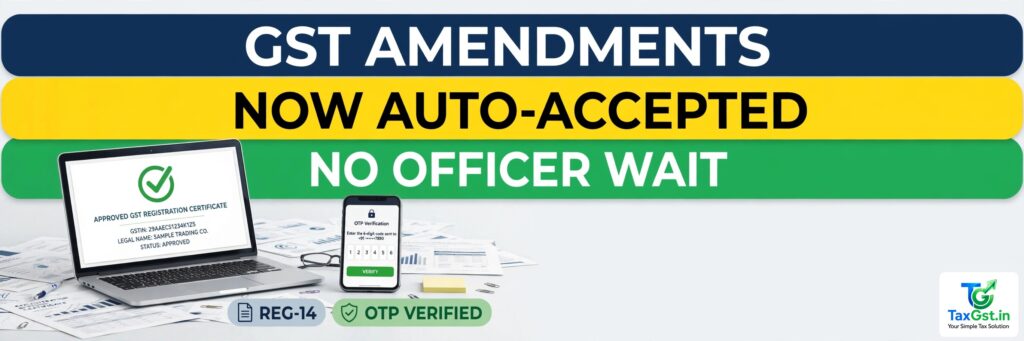
You moved your office from Karol Bagh to Okhla in September and updated the address on the GST portal the same week. In October, a supplier’s accountant called: your GSTR-1 still showed the old address, and their system had flagged the mismatch. The amendment was sitting with the proper officer, unexamined, for six weeks. If you have lived through that queue, the change that arrived on 1 November 2026 is the one you have been waiting for: most registration amendments no longer wait for an officer at all.
What changed on 1 November
Under a GSTN advisory dated 1 November 2026, the registration amendment process has moved to electronic processing with automatic acceptance for specified amendments. The mechanics are simple: you file the amendment in Form GST REG-14, the portal runs its online validations, and if they pass, the amendment takes effect on submission. There is no “pending with officer” stage for the covered categories.
This sits inside the same 1 November reform package as the revised REG-01 form itself. As our guide to the revised GST REG-01 explains, Notification No. 05/2026–Central Tax, dated 26 October 2026, substituted Rules 19 to 21 and standardised the documents and information required with registration applications. The amendment advisory is the other half of that change: new registrations got a cleaner form, and existing registrations got a faster amendment route. For the wider reform picture, see the GST hub guides.
Which amendments are auto-accepted
- Legal name of the business — the name as it appears on your PAN and incorporation documents.
- Partners, directors and Karta — additions, removals and changes in the constitution’s people.
- Additional places of business — a new godown, branch or office, added without an officer’s examination.
- Other particulars furnished in Form GST REG-01 — the remaining registration details, subject to successful online validation.
The one category that still goes to the proper officer is a change to your principal place of business. That is deliberate: the principal place is the anchor for jurisdiction, verification and, in many cases, the biometric-based Aadhaar authentication done at registration. Moving it still needs a human to look at it. Everything else on the list is now a system decision.
The OTP step nobody should skip past
Speed comes with a new control. The revised process requires OTP verification of the mobile number and email address of the Primary Authorised Signatory — and of one selected promoter, partner, director or other specified person. In practice, this means an amendment is a two-person job: the signatory files it, and a second named person confirms it by OTP.
Here is the catch. If the promoter whose OTP is needed is travelling, or the registered mobile number belongs to a consultant who left last year, the amendment stalls — not in an officer’s queue this time, but at your own front door. Before you file anything, check two things: that the Primary Authorised Signatory’s mobile and email on the portal are current, and that the second person named for OTP is available and reachable. Updating contact details is itself an amendment, and it is worth doing while nothing else is urgent.
What this does not change
Automatic acceptance is not automatic approval of anything you type. The portal validates what it can check online — PAN, CIN, LLPIN and DIN particulars are validated before an application reference number is generated, as the REG-01 changes require. What it cannot validate, it cannot approve: a wrong address, a misspelt name, or a director’s details that do not match the MCA records will still be rejected or, worse, accepted wrongly and discovered later. The officer’s examination used to catch some of these errors. Now the responsibility sits squarely with whoever files.
It also does not change the underlying law — only the processing has moved from manual to system-based. And it does not touch registration itself: if you are registering for the first time, the thresholds and compulsory cases still apply — see the GST registration threshold and documents guide before you apply. E-commerce sellers have a separate new route as well: under Rule 14B, explained in our Rule 14B e-commerce registration guide, you can now declare an operator’s warehouse as your principal place of business in a state where you have no physical presence.
Two related 1 November changes worth knowing
The same advisory round also revised two neighbouring processes. First, cancellation of registration through Form GST REG-16 now runs on system-based validation of pending returns with electronic approval of eligible applications under Rule 20. If you are winding up a registration, every return due on or before your proposed effective date must be furnished first — the system checks that before it approves anything. That is a sharp contrast with a registration cancelled by the officer against your will, where the remedy is revocation; our guide to suo-moto cancellation and revocation covers that route.
Second, the composition levy got a new portal category — “Person eligible for composition levy under Section 10(2A)” — for small service providers and mixed suppliers, alongside the existing categories. The change matters if you are weighing quarterly filing against the regular scheme, but it is a portal change, not a rate change: the tax itself is unchanged.
A short checklist for your next amendment
- Confirm the Primary Authorised Signatory’s mobile number and email on the portal are current.
- Pick the second person for OTP verification and make sure they are available on the day you file.
- Keep the supporting document ready — a change of legal name needs the document that proves it, and the portal validates against PAN and MCA records.
- File the amendment before you need the change reflected — a new additional place of business should be on the portal before you start billing from it, not after.
- After submission, download the amended registration certificate and check every field. With no officer in the loop, your own check is the only quality control left.
The direction of travel is clear: registration administration is becoming a self-service system with validation instead of discretion. That is good news for the honest filer whose only problem was the queue. It is also a quiet transfer of responsibility — the portal will accept your amendment in minutes, and it will be your mistake, on your certificate, in your returns. File carefully, and the speed is all upside.
FAQs
Which GST registration amendments are auto-accepted now?
Under the GSTN advisory dated 1 November 2026, amendments to the legal name, partners, directors, Karta, additional places of business and other REG-01 particulars take effect on submission once online validation passes.
Does a change of principal place of business still need an officer?
Yes. Amendments involving the principal place of business continue to require examination by the proper officer. Only the other categories are auto-accepted.
Whose OTP is needed for an amendment?
OTP verification is required for the mobile number and email of the Primary Authorised Signatory, plus one selected promoter, partner, director or other specified person.
Can I amend my registration if a return is pending?
An amendment can be filed while returns are pending, but note the parallel change for cancellation: a REG-16 cancellation now needs all returns due on or before the proposed effective date to be furnished first, verified by the system under Rule 20.
Sources
- GSTN advisory dated 1 November 2026 — key changes in the GST registration amendment process: electronic processing, automatic acceptance of specified amendments, OTP verification requirements.
- CBIC Notification No. 05/2026–Central Tax, dated 26 October 2026 (CGST (Amendment) Rules, 2026) — Rules 19 to 21 substituted; revised Form GST REG-01.
- GSTN advisories dated 1 November 2026 — revised process for approval of registration cancellation applications (Form GST REG-16, Rule 20); composition levy functionality, Section 10(2A) category.
- TaxGuru weekly roundup, 2–8 November 2026 — summary of the GSTN advisories and notifications cited above.
Discover more from TaxGst.in
Subscribe to get the latest posts sent to your email.