C.K. Gupta
You check your bank account after payout day. The company announced ₹25,000, but only ₹22,500 landed. The missing ₹2,500 is not a bank charge — it is TDS. Since the Finance Act, 2020 abolished Dividend Distribution Tax, the company no longer pays tax on dividends. You do: it deducts 10% first, and you settle the rest.
The deduction is not the final bill — it is an advance payment of your own tax. Lower slab than 10%? You get the difference back. Higher? You pay the balance. First, know when the company must deduct — and when it must not.
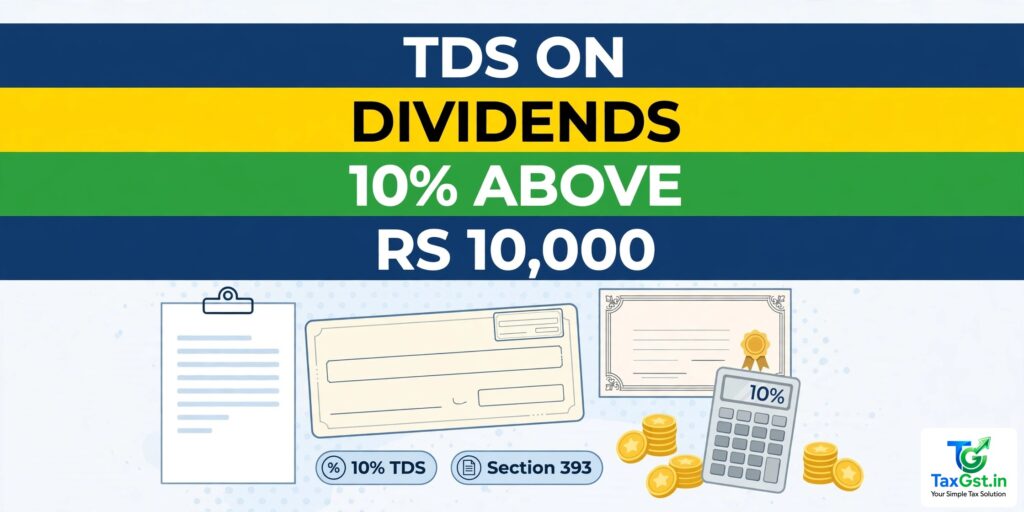
The 10% rate and the ₹10,000 limit
TDS on dividends from a domestic company to residents sits in Section 393(1), Table Sl. No. 7 of the Income-tax Act, 2025 (successor to old Section 194): 10% with a valid PAN, 20% where the PAN is missing or inoperative, under Section 397(2) (successor to old Section 206AA). Same dividend, same company, twice the deduction — purely because the PAN on record is wrong.
The ₹10,000 threshold is where confusion lives: no TDS for a resident individual if the dividend from that company in the tax year is ₹10,000 or less, paid other than in cash. The limit was raised from ₹5,000 by the Finance Act, 2025, from 1 April 2025. Three details matter. First, per company — ₹9,000 each from Companies A and B means no TDS from either, though your total is ₹18,000. Second, per shareholder per year — a joint holding counts against the first holder. Third, once crossed, TDS applies on the full dividend, not just the part above ₹10,000: a ₹10,500 dividend attracts ₹1,050 of TDS — not ₹50.
For TDS on other income, see the TDS hub — rates, thresholds and forms for salary, interest, rent and professional payments.
| Situation | TDS rate | What happens |
|---|---|---|
| Resident individual, up to ₹10,000 from one company | Nil | Full amount credited |
| Resident individual, above ₹10,000, valid PAN | 10% | TDS on the full dividend |
| Resident individual, PAN missing or inoperative | 20% | TDS on the full dividend |
| HUF, firm, company or trust (any amount) | 10% | TDS from the first rupee |
| Non-resident | 20% + surcharge/cess, or treaty rate | Treaty rate needs TRC + Form 41 |
| Exempt payees (LIC, GIC, insurers, mutual funds, Government) | Nil | No TDS regardless of amount |
Who the ₹10,000 limit leaves out
The threshold applies only to resident individuals. If shares are held by an HUF, a firm, a company or a trust, there is no threshold — 10% TDS from the first rupee. A family HUF therefore loses TDS on dividends an individual would receive in full.
Fully exempt: LIC, GIC and other insurers, mutual funds, and Central and State Government entities. The threshold also needs payment other than in cash — dividends come by bank transfer or cheque, so this rarely bites.
Worked examples
Example 1 — below the limit. You receive ₹8,000 as dividend from one company in the tax year. No TDS; the full ₹8,000 reaches your account. Still taxable — report it.
Example 2 — just above the limit. You receive ₹25,000 from one company. TDS is 10% of the full ₹25,000 — ₹2,500 — so you receive ₹22,500. Not 10% of the ₹15,000 excess (₹1,500): the threshold is an on/off switch.
Example 3 — the slab-rate reality. In the 30% slab, you receive ₹1,00,000 as dividend. Your tax is ₹31,200 (30% plus 4% cess). The company deducts ₹10,000 as TDS, so you still owe ₹21,200 with your return — the 10% was a part-payment, not the full tax. Before filing, work out your numbers on the income tax calculator.
Example 4 — the missing PAN. Same ₹25,000 dividend, no valid PAN on record. TDS jumps to 20% — ₹5,000 — and you receive ₹20,000. Updating your PAN with the company’s registrar (RTA) is the cheapest fix: five minutes of paperwork, ₹2,500 saved per ₹25,000 of dividend.
Non-residents and treaty rates
For non-residents, TDS is 20% plus surcharge and cess — but tax treaties often cut the dividend rate to 10% or 15%. Claim it with a Tax Residency Certificate and Form 41 (successor to old Form 10F). Without them, the company must deduct the full 20% plus surcharge and cess. An NRI who never filed a TRC with the RTA is almost certainly overpaying — recoverable only as a refund.
Stopping TDS — or getting it back
Below the taxable limit, you should not suffer TDS. A resident individual can submit Form 121 (successor to Forms 15G and 15H from tax year 2026-27) to the company or its RTA; once accepted, the dividend is paid in full. For the process and rejection reasons, read our Form 121 guide. If you submitted the form and TDS was still deducted, this fix guide for a rejected Form 121 explains what went wrong and how to correct it.
One change: from tax year 2026-27, interest on a loan to buy shares is no longer deductible against dividend income — the old Section 57 deduction was removed by the Finance Act, 2026. Borrowed to build a dividend portfolio? That interest is now a cost you bear in full.
If TDS has already been deducted:
- Check the credit. Open Form 168 (successor to Form 26AS) and your Annual Information Statement (AIS). The TDS should appear against the company’s name; if missing, the company has not filed its TDS return yet — ask the RTA.
- Collect the certificate. The company issues a TDS certificate in Form 131 (successor to Form 16A) — keep it as proof if portal and company records ever disagree.
- Claim the credit in your return. Report the full dividend, claim the TDS as credit; any excess comes back as a refund. Unsure how it fits into your return? Our plain-English guide to what an ITR is explains the filing basics.
- Fix it for next time. Below the taxable limit? File Form 121 before the next record date. PAN missing or inoperative? Update it with the RTA now — the problem repeats every payout.
- Watch the interest threshold too — bank FD interest has its own TDS limits: see bank FD interest TDS thresholds for 2026.
FAQs
Is TDS on dividends my final tax?
No — TDS is an advance payment, not the final tax. Dividends are taxed at your slab rate: at 5%, most of the 10% TDS comes back as a refund; at 30%, you pay the balance. The credit sits in Form 168 and the AIS.
I got ₹9,000 from each of two companies. Why no TDS?
Because the ₹10,000 limit is per company, not per shareholder. Each company looks only at its own dividend, so neither deducts TDS — though your total is ₹18,000. Still report it.
My ₹10,200 dividend lost ₹1,020 to TDS. Is that a mistake?
No — once crossed, TDS applies to the full dividend, not just the ₹200 above it. Ten percent of ₹10,200 is ₹1,020: the threshold is a switch, not a slab.
I submitted Form 121 but TDS was still deducted. What now?
Check whether the form reached the RTA before the record date — a form filed after it only helps the next payout. Confirm it was accepted; a rejected Form 121 leaves the company obliged to deduct. Then claim the TDS as credit, and re-file correctly before the next record date.
Sources
- Income-tax Act, 2025 — Section 393(1), Table Sl. No. 7 (TDS on dividends) and Section 397(2) (20% rate where PAN is missing or inoperative). Old law: Sections 194 and 206AA of the 1961 Act.
- Finance Act, 2025 — dividend TDS threshold raised from ₹5,000 to ₹10,000, effective 1 April 2025.
- Finance Act, 2020 — abolished Dividend Distribution Tax (DDT) from FY 2020-21; dividends now taxed in shareholders’ hands.
- Finance Act, 2026 — interest on loans to acquire shares no longer deductible against dividends, from tax year 2026-27.
- CBDT TDS FAQs for tax year 2026-27 — Form 121 (successor to 15G/15H), Form 168 (26AS), Form 131 (16A) and Form 41 (10F).
Discover more from TaxGst.in
Subscribe to get the latest posts sent to your email.