C.K. Gupta
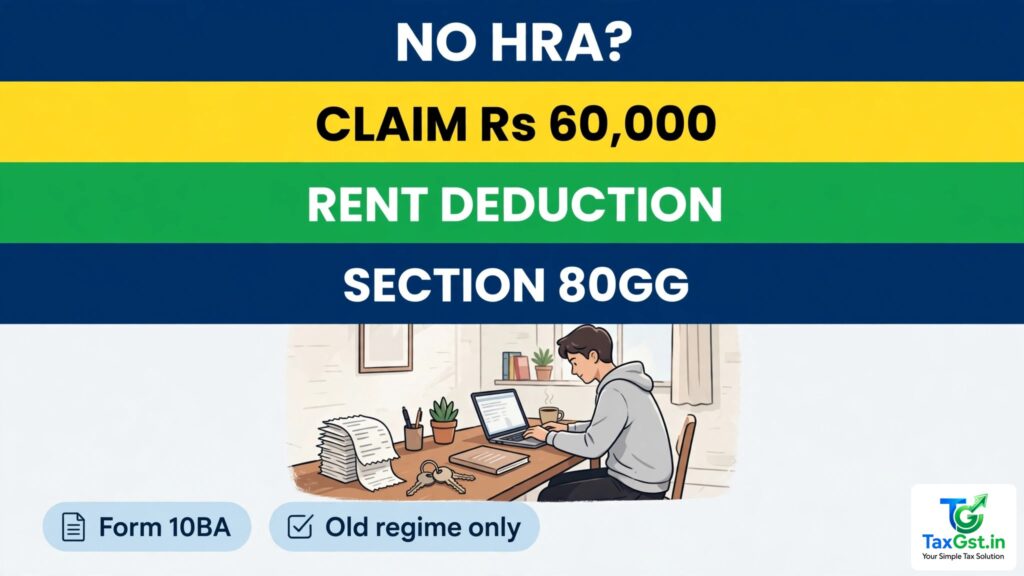
Rohan is a freelance designer in Pune. He pays ₹15,000 a month in rent — ₹1.8 lakh a year — and his accountant told him there is nothing to claim because he gets no HRA. That is wrong. Salaried employees with HRA get an exemption; everyone else who pays rent gets Section 80GG. It is a smaller benefit than HRA, and it comes with a form most people never file — but for a freelancer or a salaried person whose CTC carries no HRA component, it is real money back.
Who can actually claim it
Section 134 of the Income-tax Act, 2025 — Section 80GG under the 1961 Act, renumbered from tax year 2026-27 — is for individuals who pay rent for the house they live in and receive no house rent allowance at any point in the year. All of these conditions must hold together:
- You are an individual. HUFs, firms and companies cannot claim it.
- No HRA received. Even one rupee of HRA in the year ends the claim — it does not matter that the HRA was tiny or that the exemption on it worked out to almost nothing.
- You actually pay rent for residential accommodation you occupy.
- No disqualifying house. You, your spouse, your minor child, or an HUF you belong to must not own a residential house at the place where you live or work. Owning a house in another city does not block the claim.
- Form 10BA filed. A mandatory self-declaration — without it, the deduction fails even if every other condition is met.
For the HRA side of the same coin — how the exemption works when your employer does pay HRA, including the eight-metro rule and Form 124 — see our HRA rules guide for 2026-27.
How much you can deduct — the least of three figures
The deduction is not simply the rent you paid. It is the smallest of these three:
| Test | Amount |
|---|---|
| (a) Flat cap | ₹5,000 a month — ₹60,000 a year |
| (b) 25% of total income | 25% of total income, computed before this deduction |
| (c) Rent minus 10% of income | Actual rent paid in the year, less 10% of total income |
Worked example — Rohan. Total income ₹9,00,000; rent ₹15,000 a month, ₹1,80,000 a year. (a) ₹60,000. (b) 25% × ₹9,00,000 = ₹2,25,000. (c) ₹1,80,000 − 10% × ₹9,00,000 (₹90,000) = ₹90,000. The least is ₹60,000 — so Rohan deducts ₹60,000. At the 20% slab, that saves ₹12,000 in tax plus 4% cess: ₹12,480 back, for a form that takes ten minutes.
Worked example — lower income. Priya earns ₹4,80,000 and pays ₹8,000 a month (₹96,000 a year). (a) ₹60,000. (b) 25% × ₹4,80,000 = ₹1,20,000. (c) ₹96,000 − ₹48,000 = ₹48,000. The least is ₹48,000 — test (c) bites first when rent is modest relative to income. Before you decide which regime to pick, work out your numbers on the income tax calculator — the old regime only wins if your total deductions beat the new regime’s lower slabs.
Form 10BA — mandatory, and frequently skipped
Form 10BA is a self-declaration confirming the rent paid, the landlord’s name and address, the period of tenancy, and that you own no disqualifying property. File it online before or along with your return — Rule 11B allows the deduction only if the form is filed. For tax year 2026-27 onwards, the corresponding declaration under the Income-tax Rules, 2026 is Form 31, for the deduction under Section 134. Two practical points: if your annual rent crosses ₹1 lakh, you must also furnish your landlord’s PAN; and keep the rent agreement, rent receipts and bank-transfer trail — the department asks for them far more often than it asks about HRA.
The old-regime catch
Here is the catch: Section 134 is a Chapter VI-A deduction, and like 80C, 80D and the HRA exemption, it is available only under the old tax regime. The new regime is the default unless you actively opt out while filing — and if you are in the new regime, no 80GG deduction at all, however much rent you pay. So the real question is not “can I claim 80GG?” but “does the old regime, with 80GG plus my 80C, 80D and other deductions, beat the new regime’s slabs?” For most people paying significant rent with no HRA, the answer is often yes — but run both computations before choosing. Our 15-minute year-end tax health check walks through the same comparison as a ten-point self-audit.
HRA vs 80GG — the honest comparison
| HRA exemption | Section 134 / 80GG | |
|---|---|---|
| Who gets it | Salaried employees receiving HRA | Individuals receiving no HRA — salaried or self-employed |
| Cap | No fixed cap; formula-driven, often ₹1–3 lakh | ₹60,000 a year, hard cap |
| Extra form | Form 124 (from TY 2026-27) | Form 10BA (Form 31 from TY 2026-27) |
| Regime | Old regime only | Old regime only |
One more thing: 80GG stacks with your other old-regime deductions. The ₹60,000 sits alongside 80C, the NPS additional ₹50,000 under Section 124 (old 80CCD(1B)) — see our NPS extra-₹50,000 guide — and 80D health cover. The full menu lives on the deductions hub.
FAQs
I get a small HRA — ₹2,000 a month. Can I still claim 80GG?
No. Receiving any HRA at all in the year disqualifies you from 80GG, even if the HRA exemption itself works out to nearly nothing. Claim the HRA exemption instead.
I own a flat in my hometown but rent in the city where I work. Am I eligible?
Yes — the ownership test applies only to the place where you reside or are employed. A house in another city does not block the claim.
My spouse owns the house we live in. Can I claim rent I pay to her?
No. If your spouse owns a residential house at your place of residence, the condition fails — and rent paid to a spouse for a house you live in together invites scrutiny on whether the rent is genuine.
What if I forget Form 10BA?
The deduction cannot be validated without it. File it before or with the return; a belated filing of the form alone does not fix a return already filed without it — you would need a revised return within the window.
Does 80GG work in the new tax regime?
No. It is available only under the old regime. If your deductions are small, the new regime’s lower slabs usually win anyway — compare both before opting.
Sources
Income-tax Act, 2025 — Section 134 (deduction for rent paid, successor to Section 80GG of the Income-tax Act, 1961); Income-tax Rules, 2026 — Form 31 (declaration for the Section 134 deduction; Form 10BA under Rule 11B of the Income-tax Rules, 1962 for AY 2026-27 and earlier); Section 202 of the Income-tax Act, 2025 (new regime, successor to Section 115BAC) — Chapter VI-A deductions, including Section 134, are available only under the old regime.
Discover more from TaxGst.in
Subscribe to get the latest posts sent to your email.