 C.K. Gupta
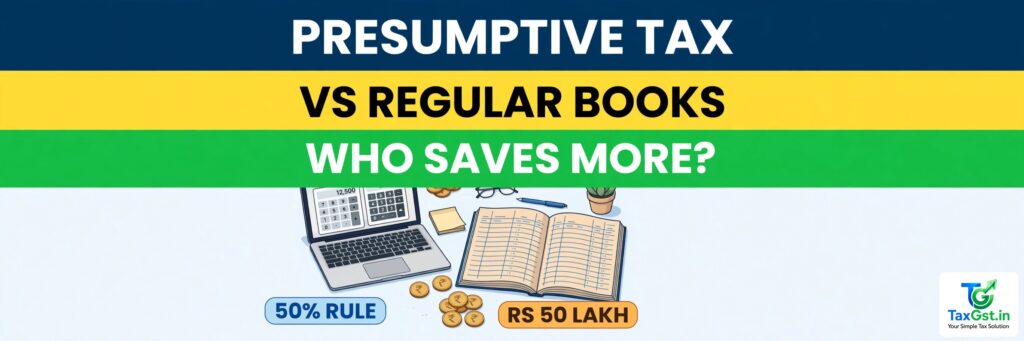
If you are a doctor, CA, architect, lawyer or consultant, presumptive taxation lets you declare 50% of your gross receipts as taxable profit — no detailed books, no audit — provided receipts stay within ₹50 lakh (₹75 lakh if cash receipts are 5% or less). Regular books win only when your real expenses exceed 50% of receipts. Run both numbers before you choose. Verified October 2026 · TaxGST.in
Meera is an architect in Pune. Last year she billed ₹40 lakh. Her CA asks one question: presumptive or regular books? She has no idea what either means for her tax bill, so she defaults to whatever her friend does. That is how professionals overpay tax for years — the choice is a maths problem, not a habit, and it takes about ten minutes once you see a worked example.
This article compares the two routes with real figures. The presumptive scheme for specified professionals — earlier numbered Section 44ADA of the 1961 Act, now carried into the Income-tax Act, 2025 — is the simpler route. Regular books are the accurate route. Which one saves you money depends entirely on your expense ratio. For the wider picture, start with the income tax hub and keep our mid-year tax checklist handy for the moves still open this year.
Who can use presumptive taxation?
- Specified professions: legal, medical, engineering, architectural, accountancy, technical consultancy, interior decoration, and other professions notified by the CBDT.
- Who qualifies: resident individuals, HUFs and partnership firms (LLPs excluded).
- Receipts limit: gross receipts up to ₹50 lakh in the tax year — raised to ₹75 lakh where cash receipts do not exceed 5% of total receipts.
- The deal: 50% of gross receipts is deemed to be your profit. No further expenses can be claimed, and no detailed books of account are required.
- Advance tax: the whole advance tax for the year can be paid in a single instalment by 15 March.
Worked example 1: low expenses — presumptive wins
Meera’s numbers: gross receipts ₹40,00,000. Her real expenses — a part-time draughtsman, software subscriptions, travel to sites — total ₹12,00,000. Her real profit is ₹28,00,000.
| Route | Taxable profit | Why |
|---|---|---|
| Presumptive (50%) | ₹20,00,000 | 50% of ₹40 lakh, regardless of actual expenses |
| Regular books | ₹28,00,000 | ₹40 lakh minus ₹12 lakh actual expenses |
Presumptive taxation saves Meera tax on ₹8,00,000 of income — and she skips maintaining full books and an audit. Here is the catch in reverse: she cannot claim her ₹12 lakh of expenses on top of the 50%. The scheme is a package deal. For a solo professional working from home with modest costs, that package is usually a bargain.
Worked example 2: high expenses — regular books win
Now take Dr. Rao, who runs a small clinic. Gross receipts ₹48,00,000. His expenses are heavy: two nurses and a receptionist (₹14 lakh), clinic rent (₹9 lakh), equipment maintenance and consumables (₹7 lakh) — ₹30,00,000 in total. Real profit: ₹18,00,000.
| Route | Taxable profit | Why |
|---|---|---|
| Presumptive (50%) | ₹24,00,000 | 50% of ₹48 lakh |
| Regular books | ₹18,00,000 | ₹48 lakh minus ₹30 lakh actual expenses |
Regular books save Dr. Rao tax on ₹6,00,000. The price: he must maintain proper books, and — this is the rule people miss — if he declares profit lower than the 50% presumptive figure and his total income exceeds the basic exemption limit, he must get his accounts audited. The audit cost and hassle are part of the comparison, not an afterthought.
The decision rule in one line
If your genuine expenses are less than 50% of your receipts, presumptive usually wins. If they are more than 50%, regular books usually win. The break-even point is exactly 50%: at ₹40 lakh of receipts, a professional with ₹20 lakh of expenses pays the same either way — and then simplicity should decide it.
Five traps to avoid
- Crossing the receipts limit mid-year. A big late-year project can push you past ₹50 lakh (or ₹75 lakh on the cash condition) and out of the scheme entirely. Track cumulative receipts quarterly.
- Declaring less than 50% without an audit. Claiming lower profit than the presumptive figure while skipping books and audit invites a defective-return and scrutiny problem. If you go below 50%, do the compliance properly.
- Forgetting that depreciation is deemed claimed. Under the scheme, the written-down value of your assets is computed as if depreciation had been claimed and allowed — you cannot double-count it later.
- Mixing salary and profession. The scheme covers professional income, not salary. If you also earn a salary, that is taxed separately under its own head — presumptive taxation does not touch it.
- Missing the 15 March advance-tax date. Presumptive taxpayers get the single-instalment convenience, but miss 15 March and interest applies. Put it in your calendar now; our compliance calendar hub tracks it.
What if you filed late or need to correct?
Choosing the wrong route in a filed return is not fatal: a belated return can still be filed until 31 December 2026 and a return can be revised until 31 March 2027. See our belated and revised return guide for the exact windows — but do not plan around corrections. Run the two-column comparison before filing, not after.
FAQs
Q. Can a salaried employee use presumptive taxation?
No. The scheme is for specified professionals earning professional income. Salary income is taxed under its own head on actual figures.
Q. What is the gross receipts limit for presumptive taxation?
₹50 lakh per tax year, or ₹75 lakh where cash receipts are 5% or less of total receipts.
Q. Do I need to maintain books under presumptive taxation?
No detailed books are required if you declare 50% (or more) of receipts as profit. Declaring less triggers books and audit requirements.
Q. Can I switch between presumptive and regular books every year?
You choose each year based on that year’s numbers, but switching to a lower-than-presumptive profit figure brings audit obligations with it — factor that cost in.
Q. When is advance tax due for presumptive professionals?
The entire advance tax for the year may be paid in one instalment by 15 March.
Sources
Income-tax Act, 2025 — presumptive taxation provisions for specified professionals (corresponding to former Section 44ADA of the Income-tax Act, 1961, which prescribed 50% of gross receipts as deemed profits for resident individuals, HUFs and partnership firms other than LLPs in notified professions). Finance Act, 2023 — raising the receipts threshold to ₹75 lakh where cash receipts do not exceed 5% of total receipts. Advance-tax single-instalment rule for presumptive cases (15 March) as per the Income-tax Rules and CBDT guidance for presumptive taxpayers.
Discover more from TaxGst.in
Subscribe to get the latest posts sent to your email.