 C.K. Gupta
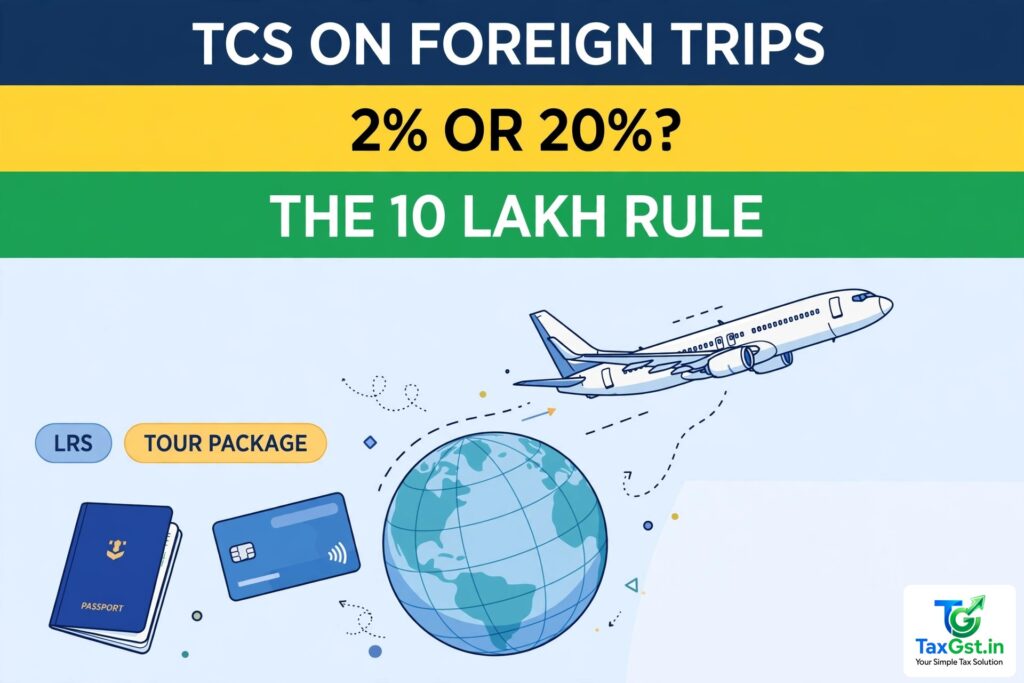
From 1 April 2026, TCS on foreign remittances works like this: education and medical remittances above ₹10 lakh attract 2%; an overseas tour package attracts 2% from the first rupee; every other LRS purpose above ₹10 lakh attracts 20%. Education funded by a qualifying loan attracts no TCS. TCS is not an extra tax — it is a credit you claim in your ITR. Verified October 2026 · TaxGST.in
A family books a Europe tour package for ₹6 lakh, sends a daughter ₹14 lakh for self-funded study abroad, and wires ₹16 lakh into an overseas investment account — all in the same tax year. At the bank counter, three different TCS rates apply, and the total TCS comes to ₹1,40,000. Most travellers discover this only when the bank asks for the extra amount. Here is how it actually works, so the number never surprises you.
The framework is the RBI’s Liberalised Remittance Scheme (LRS) — resident individuals may remit up to USD 250,000 per financial year for permitted purposes — combined with tax collection at source under Section 394 of the Income-tax Act, 2025 (the successor to the old Section 206C(1G)). For the wider TDS/TCS picture, see the TDS hub and the income tax hub.
The rates from 1 April 2026
| Purpose | Threshold (per PAN, per tax year) | TCS rate |
|---|---|---|
| Education funded by a qualifying loan | — | Nil |
| Education (self-funded) or medical treatment | ₹10 lakh | 2% on the excess |
| Overseas tour programme package | None | 2% from the first rupee |
| Any other LRS purpose (investment, gift, property, maintenance) | ₹10 lakh | 20% on the excess |
Two things changed on 1 April 2026 under the Finance Act, 2026, and they are worth knowing because older guides still show the old figures: education and medical rates fell from 5% to 2%, and tour packages moved to a flat 2% from the earlier 5%/20% slab structure. The ₹10 lakh threshold itself is unchanged since April 2025. If a blog still quotes a ₹7 lakh threshold or 5% education TCS, it is out of date.
Worked example: one family, three remittances
| Remittance | Amount | TCS |
|---|---|---|
| Tour package (Europe, family of four) | ₹6,00,000 | 2% × ₹6,00,000 = ₹12,000 |
| Self-funded education abroad | ₹14,00,000 | 2% × (₹14,00,000 − ₹10,00,000) = ₹8,000 |
| Overseas investment account | ₹16,00,000 | 20% × (₹16,00,000 − ₹10,00,000) = ₹1,20,000 |
| Total TCS collected | ₹1,40,000 |
Note the trap in the third row: the 20% applies only to the amount above ₹10 lakh, not to the whole ₹16 lakh. And note the tour-package trap in the first row: there is no ₹10 lakh shelter for packages at all. A ₹1.5 lakh package still carries ₹3,000 of TCS.
Here is the catch that softens the blow: TCS is an advance tax credit, not a fee. When you file your ITR, the TCS appears in your tax credit statement and is set off against your final tax liability. If your liability is lower than the TCS collected, the excess comes back as a refund. The family above does not “lose” ₹1,40,000 — it prepays it, and the timing is the real cost.
Five rules people get wrong
- The threshold is per PAN, aggregated across banks. Splitting a ₹16 lakh remittance across two banks does not create two ₹10 lakh shelters. The authorised dealer aggregates by PAN, and the ITR reconciliation will catch the split anyway.
- Purpose classification decides the rate. The same ₹14 lakh costs 2% as education, 20% as investment. Tell the bank the correct purpose code and keep the supporting documents — a wrong code is an expensive typo.
- Credit-card spends abroad are outside LRS for now. International credit-card spends while travelling are currently not brought under LRS TCS; the proposal to include them has been deferred. TCS applies to bank/wire remittances and tour-package purchases, not to swiping your card overseas.
- Inward money is not TCS. Money you receive from abroad — freelance income, export proceeds, family support — is not subject to LRS TCS. It is taxed, if at all, as your own income in your return.
- Your paperwork is the credit. The collector files the quarterly TCS statement in Form 143 (the new form; earlier 27EQ) and issues you a TCS certificate in Form 133 (earlier 27D). Reconcile the certificate with your tax credit statement before filing — a missing certificate is the most common reason TCS refunds get delayed. Our old-vs-new form number guide maps every renumbered form if a bank document still shows an old number.
How this fits the 2026 changes
The TCS cut was part of the broader 2026 rationalisation covered in our Union Budget 2026 highlights: tour packages and education/medical remittances at a flat 2% were explicitly framed as middle-class relief for families funding study and travel abroad. The 20% rate survives only for discretionary purposes — investments, gifts and property — where the government still wants a collection trail on large outflows.
Before you remit: checklist
- Confirm your total LRS usage this tax year against the USD 250,000 limit and the ₹10 lakh TCS threshold.
- Classify the purpose correctly with the bank — education, medical, tour package or other.
- If education is loan-funded, carry the loan sanction letter: it is what makes the remittance NIL-TCS.
- Budget for the TCS cash outflow even though it is refundable — a 20% collection on a large investment remittance is real money locked up until your return is processed.
- Collect Form 133 and reconcile it with your tax credit statement before filing your ITR.
FAQs
Q. Is TCS on foreign remittance an extra tax I never get back?
No. TCS is a tax credit. It is set off against your final income-tax liability in your ITR, and any excess is refunded after processing.
Q. I am sending ₹8 lakh abroad for my son’s education. Is there TCS?
No — self-funded education remittances attract TCS only on the amount above ₹10 lakh per tax year. And if the education is funded by a qualifying loan, there is no TCS at any amount.
Q. Does a tour package get the ₹10 lakh exemption?
No. Overseas tour packages attract 2% TCS from the first rupee, with no threshold.
Q. Can I avoid TCS by splitting remittances across banks?
No. The ₹10 lakh threshold is aggregated per PAN across all authorised dealers in the tax year.
Q. Do credit-card spends abroad attract TCS?
Not currently. International credit-card spends are outside LRS TCS for now; the inclusion proposal has been deferred.
Sources
Income-tax Act, 2025, Section 394 — tax collection at source on Liberalised Remittance Scheme remittances and overseas tour packages (successor to Section 206C(1G) of the Income-tax Act, 1961). Finance Act, 2026 — rationalisation of TCS rates from 1 April 2026: 2% for education/medical above ₹10 lakh, 2% flat for tour packages, 20% for other LRS purposes above ₹10 lakh, NIL for qualifying education loans. Reserve Bank of India, Liberalised Remittance Scheme — USD 250,000 per financial year limit for resident individuals. CBDT / Income Tax Department form mapping — quarterly TCS statement Form 143 and certificate Form 133 under the Income-tax Rules, 2026.
Discover more from TaxGst.in
Subscribe to get the latest posts sent to your email.