 C.K. Gupta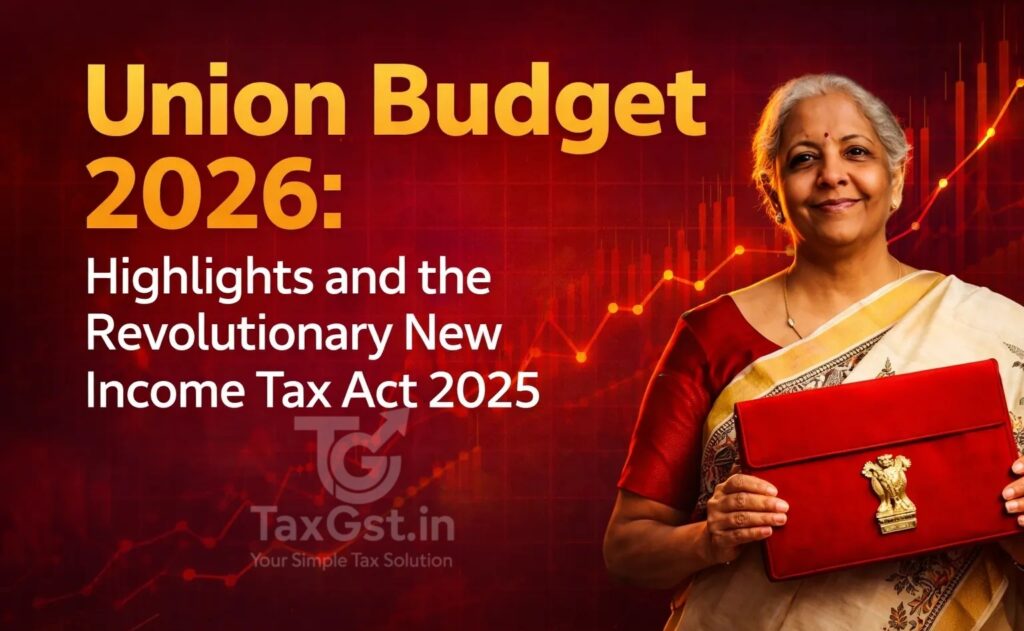
Last Updated: February 1, 2026 | By: Taxgst Editorial Team
If you were sitting at a local tea stall today, the conversation wouldn’t have been about the weather. It would have been about the “Chai-pe-Budget” discussion that’s taking over every corner of India. Finance Minister Nirmala Sitharaman just dropped the Union Budget 2026-27, and let me tell you, it’s not just another pile of spreadsheets. Presenting from the newly inaugurated Kartavya Bhawan, the FM made it clear that the government is shifting gears. It’s no longer just about “handouts”; it’s about “Kartavya” or duty—both of the government and the citizens.
Whether you’re a small business owner in the narrow lanes of Delhi’s Chandni Chowk or a salaried professional navigating the traffic of Mumbai, this budget has something that’s going to change how you look at your bank account. The FM didn’t just rattle off numbers; she spoke about a vision for a “Viksit Bharat” that feels a lot more real today. It’s about making life easier for the common man, or as we like to say, the “Aam Aadmi” who just wants to do his bit and live a peaceful life.
Budget 2026 at a Glance: Key Takeaways for You
| Category | Budget 2026 Rule | Impact on You |
|---|---|---|
| New IT Act | Effective April 1, 2026 | Simpler laws, fewer court cases. |
| Foreign Travel TCS | Slashed to 2% | Cheaper family trips abroad. |
| F&O Trading (STT) | Hiked to 0.05% – 0.15% | Higher cost for speculative trading. |
| Cancer Drugs | Duty Exempted | Major relief on healthcare costs. |
The Three Kartavyas: A New Foundation for India
The entire budget is built on three pillars, or what the FM calls the Three Kartavyas. Think of these as the government’s “To-Do List” for the next year. It’s a shift from just rights to responsibilities, and it’s quite a refreshing change if you ask me.
 Union Budget 2026″ width=”1024″ height=”852″ />
- Accelerating and Sustaining Economic Growth: This isn’t just about GDP numbers that look good on TV. It’s about making sure our factories are humming and our exports are flying. The government wants to build resilience so that even if the global economy hits a rough patch, India stays steady. It’s about being “Atmanirbhar” in the truest sense.
- Fulfilling Aspirations of the People: This is for the youth. It’s about building capacity—giving people the skills and the resources to become partners in India’s prosperity. It’s not just about finding a job; it’s about creating an enterprise. The FM wants every young Indian to feel like they can take on the world.
- Sabka Saath, Sabka Vikas: This is the heart of the budget. It ensures that every family, whether in a remote village in Bihar or a high-rise in Bengaluru, has access to the same amenities and opportunities. It’s about bridging the gap between “India” and “Bharat.”
The 3 Kartavyas: India’s Growth Roadmap
| Kartavya (Duty) | Core Focus | Key Initiatives & Interventions |
| 1. Economic Growth | Accelerating & sustaining growth with global resilience. | Scaling manufacturing in 7 frontier sectors (Biopharma SHAKTI, ISM 2.0), Infrastructure push (₹12.2L Cr Capex), & 7 High-Speed Rail corridors. |
| 2. People’s Aspirations | Capacity building & making citizens partners in prosperity. | Service Sector push, National Institute of Hospitality, Girls’ hostels in STEM institutions, & Khelo India Mission for sports talent. |
| 3. Sabka Saath, Sabka Vikas | Universal access to resources, amenities, and opportunities. | Increasing farmer incomes (Bharat-VISTAAR AI tool), Divyang Kaushal Yojana, Purvodaya for Eastern India, & 5 Regional Medical Hubs. |
As the FM noted in her speech, “Our focus is on the Kar-daata (taxpayer) who is the silent hero of our growth story, and the Niveshak (investor) who believes in the Indian dream.”
The Big Revolution: New Income Tax Act 2025
Now, let’s talk about the elephant in the room—the New Income Tax Act 2025. If you’ve ever felt like you needed a PhD just to file your taxes, this is for you. Starting April 2026, the government is replacing the old, clunky Income Tax Act with a brand-new version. For a detailed look at current rates, you can check our income tax slab rate guide.
“The goal? Simplicity. For decades, the 1961 Act was like a maze—if you turned left at Section 80C, you got lost in Section 115BAC. The FM promised the new Act is written in ‘Aam’ English, cutting the fluff by 50%. It’s like switching from a heavy Sanskrit legal manual to a simple WhatsApp guide.”
Why this matters for the “Common Man”
- Trust-Based Compliance: The government is finally saying, “We trust you.” If you make a mistake in your return, you don’t have to panic about a notice. You can now update your returns even after a reassessment has started, just by paying a small 10% additional tax. It’s about reducing litigation and making life easier for the honest Kar-daata.
- Decriminalization: In a huge relief, the government has decided to decriminalize several minor offenses. For instance, if you fail to produce books of account or make a mistake in TDS payment in kind, you won’t be treated like a criminal. This is a massive win for small business owners who often live in fear of the “taxman.”
- Motor Accident Relief: This one is personal. If someone receives interest on a motor accident claim, that interest is now completely exempt from tax. It’s a small move, but it shows a government that has a heart. No more TDS on your compensation!
- TCS Rationalization for Foreign Travel: Planning a family trip abroad or sending money for education/medical needs? The TCS on overseas tour packages and LRS remittances (including education/medical above ₹10 lakh) has been slashed from 5% (and 20% in some cases) to a flat **2%**. This is a huge “bhai-style” win for the middle class!
The Numbers: Where is the Money Going?
For those who like to keep a tab on the nation’s wallet, the budget estimates are quite impressive. The government is doubling down on building India. The Capital Expenditure (Capex) has been pushed to ₹12.2 lakh crore. To put that in perspective, that’s money going directly into new highways, railway tracks, and power plants. It’s about building the “bones” of a modern nation.

| Budget Component | Estimate (BE 2026-27) |
|---|---|
| Total Expenditure | ₹53.5 Lakh Crore |
| Capital Expenditure | ₹12.2 Lakh Crore |
| Net Tax Receipts | ₹28.7 Lakh Crore |
| Fiscal Deficit | 4.3% of GDP |
| Debt-to-GDP Ratio | 55.6% |
Tax Slabs: Steady as She Goes, with a New Look
For the salaried class, there were significant clarifications and a more granular structure introduced this year under the New Tax Regime. But don’t be disappointed! The stability in the overall approach is actually a good thing. It allows you to plan your investments without worrying about the rules changing every six months. If you are looking for best tax saving solutions, now is the time to lock them in.
New Tax Regime Slabs (FY 2026-27) – Updated
| Income Slab | Tax Rate | Note |
| Up to ₹4,00,000 | Nil | |
| ₹4,00,001 – ₹8,00,000 | 5% | |
| ₹8,00,001 – ₹12,00,000 | 10% | Rebate covers this up to ₹12L! |
| ₹12,00,001 – ₹16,00,000 | 15% | |
| ₹16,00,001 – ₹20,00,000 | 20% | |
| ₹20,00,001 – ₹24,00,000 | 25% | |
| Above ₹24,00,000 | 30% |
The “Hidden” Benefit: Don’t forget the Standard Deduction of ₹75,000 for salaried employees in the new regime. When you combine this with the rebate under Section 87A, many people earning up to **₹12.75 lakh** won’t have to pay a single paisa in tax. That’s more money for your kids’ education or that new car you’ve been eyeing. It’s a “common man wins” situation!
Check your Income Tax Calculation now.
Manufacturing: Making India a Global Hub
The FM announced a massive push for manufacturing under the Biopharma SHAKTI scheme. With an outlay of ₹10,000 crore, the goal is to make India a global leader in medicine manufacturing. But it’s not just about pharma. From semiconductors (ISM 2.0) to textiles, the government is setting up “Mega Parks” to help our industries compete with the best in the world.
For the small business owner, the **₹10,000 crore SME Growth Fund** is a game-changer. And if you’re worried about the paperwork, the new ‘Corporate Mitras’—trained professionals like CAs and CSs in Tier-II and Tier-III towns—will be there to hold your hand and guide you through the process. It’s like having a business coach provided by the government! For those looking to start up, check our guide on company incorporation process.

Infrastructure: Connecting the Dots Across India
If you’ve ever traveled by train in India, you know how much we need better connectivity. The budget has announced Seven High-Speed Rail corridors, including Mumbai-Pune, Delhi-Varanasi, and Hyderabad-Bengaluru. Imagine reaching Varanasi from Delhi in just a few hours! But it’s not just about speed; it’s about the “last mile.” The new Seaplane VGF Scheme will help connect remote tourist spots, making it easier for you to explore the hidden gems of India.
And let’s not forget the PM Surya Ghar initiative. The government is pushing hard for rooftop solar, which means lower electricity bills for you and a cleaner planet for your children. It’s a win-win! Plus, the new Dedicated Freight Corridors from Dankuni to Surat will ensure that goods move faster, which eventually means lower prices for the things you buy at the local store.
Purvodaya and Social Welfare: No One Left Behind
A significant portion of the budget was dedicated to the Purvodaya States (the Eastern states like Bihar, Odisha, and West Bengal). From new industrial corridors to developing Buddhist circuits for tourism, the government is making sure that the “East” becomes the new engine of India’s growth.
On the social front, the government is focusing on Allied Health Professionals. They plan to add 100,000 such professionals over the next five years. This means better healthcare at the grassroots level. Also, a National Destination Digital Knowledge Grid will be established to document all our cultural and spiritual heritage. It’s about preserving our past while building our future.
Investor Tips for the Modern Niveshak
For the investors out there, the budget has some subtle but important messages:
- Safe Harbour Rules for IT Services: The threshold for availing safe harbour for IT services has been significantly hiked from ₹300 crore to **₹2,000 crore**. This is great news for our tech sector, making India an even more attractive hub for global IT companies and reducing compliance burdens.
- Buyback Taxation: Buybacks will now be taxed as Capital Gains, which is a fairer deal for minority shareholders. It levels the playing field.
- LRS Remittance: Planning to send your child abroad for studies? The TCS has been reduced to 2%, which is a huge relief for parents who are already struggling with high tuition fees.
- STT Hikes for Traders: A word of caution for the traders—the STT on **Equity Futures** has been hiked from 0.02% to **0.05%**, and on **Options Premium** from 0.1% to **0.15%**. This is a move to curb excessive speculation and encourage long-term investing, acting as a “speed breaker” for frequent traders.
“Our path is clear—to build a resilient India where every citizen has the tools to succeed. This budget is a testament to our commitment to the three Kartavyas.”
— Prime Minister Narendra Modi
Final Thoughts: A Budget for the “Honest Indian”
At the end of the day, this budget is a pat on the back for the honest Indian. Whether you’re a Kar-daata or a Niveshak, the message from Kartavya Bhawan is clear: the government is here to simplify your life, not complicate it. For more tips on saving money on taxes, keep reading our blog.
The New Income Tax Act 2025 is a bold step towards a more transparent and trust-based India. It might take a year to fully kick in, but the foundation has been laid. It’s about moving away from the “Inspector Raj” and towards a “Mitra Raj.” So, the next time you sit down for a cup of chai, remember—the future of India isn’t just in the hands of the FM; it’s in your hands too, as you fulfill your own “Kartavya” towards the nation.
Frequently Asked Questions (FAQs) on Union Budget 2026 & New Income Tax Act
When will the New Income Tax Act 2025 come into effect?
What is the new “Tax Year” concept in the 2025 Act?
Is there any relief for students or NRIs with small foreign assets?
How has the Safe Harbour threshold changed for the IT sector?
What are the new STT rates for F&O trading in 2026?
Can small taxpayers get a Nil-TDS certificate automatically?
Disclaimer: The information provided in this article is based on official government press releases and the Finance Bill 2025. While we strive for accuracy, tax laws are subject to legislative changes and specific notifications. Readers are advised to consult with a qualified tax professional or Chartered Accountant before making financial decisions based on these highlights.
Official Budget Resources & Verification
For a deeper look into the policy papers and the full text of the Finance Bill, we recommend visiting these official Government of India portals:
- ➔
India Budget Portal (Ministry of Finance)
Download the full Budget Speech, Finance Bill, and Key Highlights. - ➔
Press Information Bureau (PIB) – Budget Highlights
Official press release verifying the 3 Kartavyas and Capex estimates. - ➔
Income Tax Department – New Act 2025 Navigator
Explore the simplified clauses and new “Tax Year” definitions.
For more updates and a deep dive into the Finance Bill 2025, keep following Taxgst.in. We’ll keep you posted as the fine print comes out!
Related Reading
- Income Tax Act 2025: Complete Breakdown of India’s New Tax Law (Replaces 1961 Act)
- New Income Tax Return Filing Portal Features for AY 2026-27
Discover more from TaxGst.in
Subscribe to get the latest posts sent to your email.



Never Miss a Tax Deadline Again
Due-date alerts, GST updates and tax tips — free on the app you already use.
event Next: TDS Return (138 / 140) · 31 Oct