 C.K. Gupta
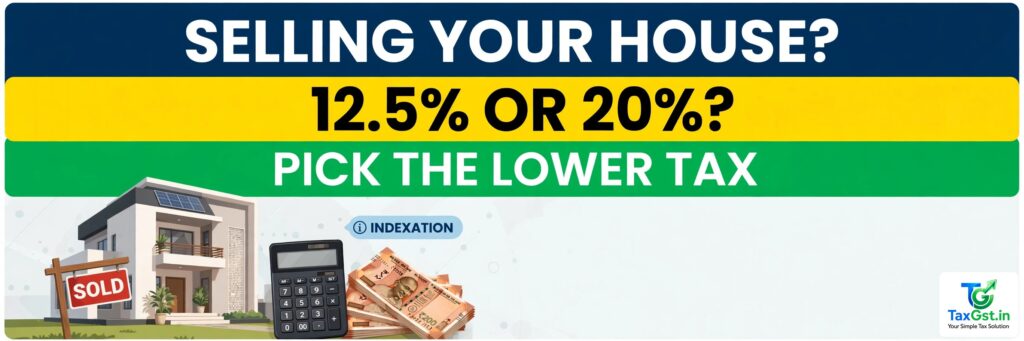
If you sell a house you held for more than 24 months, the gain is long-term and taxed at 12.5% without indexation for transfers on or after 23 July 2024. But if you are a resident individual or HUF and you bought the property before 23 July 2024, you pay the lower of two numbers: 12.5% on the plain gain, or 20% on the gain after indexation. Work both computations before you file — for older properties, indexation often wins by lakhs. Verified November 2026 · TaxGST.in
Meera bought a two-bedroom flat in Pune in 2012 for ₹40 lakh. She is selling it now for ₹90 lakh and her broker told her “indexation is gone, you’ll pay 12.5% on ₹50 lakh.” That advice would cost her about ₹3.3 lakh in extra tax. Indexation is not quite gone — for property bought before 23 July 2024, it survives as a cap on the tax you pay. This guide explains the post-July-2024 rule, the grandfathering choice, and the two exemptions that can cut the bill to zero. If you are new to return filing itself, start with what an ITR actually is and which form you file.
What changed on 23 July 2024
The Finance (No. 2) Act, 2024 rewrote long-term capital gains (LTCG) taxation for transfers on or after 23 July 2024. The headline rate for property fell from 20% to 12.5%, but the indexation benefit — adjusting your purchase cost upward for inflation using the Cost Inflation Index (CII) notified by the CBDT — was withdrawn for most assets. Holding periods were also simplified: 12 months for listed securities and 24 months for everything else, including immovable property. So a house sold within 24 months of purchase is still short-term, taxed at your slab rate; beyond 24 months, it is long-term.
Under the Income-tax Act, 2025, which applies from tax year 2026-27, the LTCG rate provision sits in Section 197 (the old Section 112 of the 1961 Act), and the grandfathering choice in Section 197(3) (the old second proviso to Section 112(1)). Old section numbers appear here only so you can match them to older advice — the 2025 Act is the law that governs your filing now.
The grandfathering choice, in plain English
The choice applies only when all four conditions are met: you are a resident individual or HUF; the asset is land or a building (or both); you acquired it before 23 July 2024; and you transfer it on or after 23 July 2024. If all four hold, the tax you pay is restricted to the lower of (a) 12.5% on the gain computed without indexation, and (b) 20% on the gain computed with indexation. Note the precise design: indexation does not reduce the gain in your return — the gain is always the un-indexed figure — it lives on inside a parallel computation whose only job is to cap your tax.
Companies, firms, LLPs, non-residents, and anyone who bought on or after 23 July 2024 cannot use this choice: for them it is simply 12.5% without indexation. And one trap: an indexed loss in the parallel computation cannot be set off or carried forward — the shadow computation can only reduce tax, never create a loss.
Worked example: Meera’s flat, both ways
Meera bought in FY 2012-13 (CII 200) for ₹40,00,000 and sells in FY 2025-26 (CII 376, per CBDT Notification No. 70/2025) for ₹90,00,000. Ignore improvement costs and transfer expenses for clarity.
| Computation | Maths | Tax |
|---|---|---|
| Option A — 12.5% without indexation | ₹90,00,000 − ₹40,00,000 = ₹50,00,000 gain | 12.5% × ₹50,00,000 = ₹6,25,000 |
| Option B — 20% with indexation | Indexed cost = ₹40,00,000 × 376/200 = ₹75,20,000; gain = ₹90,00,000 − ₹75,20,000 = ₹14,80,000 | 20% × ₹14,80,000 = ₹2,96,000 |
Meera pays ₹2,96,000 — less than half the broker’s figure. The rule of thumb: the longer you held and the smaller the real appreciation, the more indexation helps. Flip the numbers and the answer flips too: a flat bought in 2020 for ₹60 lakh and sold now for ₹1.2 crore gains ₹60 lakh plain (tax ₹7,50,000 at 12.5%) versus an indexed gain of roughly ₹33 lakh (tax about ₹6,60,000 at 20%) — still indexation, but only just. For a property that doubled in three years, the flat 12.5% usually wins. Never assume; compute both. You can sanity-check your numbers against the Income Tax hub’s capital-gains guides before filing.
Two exemptions that can beat both options
Section 54 — buy another house. If you reinvest the capital gain in another residential house — purchase within two years after the sale, or construct within three years — the reinvested gain is exempt. The catch people miss: it is the gain that must be reinvested, not the full sale price, and the new house cannot be sold within three years without clawing the exemption back.
Section 54EC — NHAI/REC bonds. Invest up to ₹50 lakh of the gain in specified bonds (NHAI, REC and the like) within six months of the sale, lock in for five years, and that portion of the gain is exempt. The ₹50 lakh cap is per financial year, so it cannot shelter a very large gain on its own — but combined with Section 54 it is the standard two-step plan for sellers who want part cash, part shelter.
Checklist before you sign the sale deed
- Confirm the holding period: more than 24 months from purchase date to sale date for long-term treatment
- If you bought before 23 July 2024 and are a resident individual/HUF, compute both options — do not let anyone file on the 12.5% figure alone
- Collect the CII for your purchase year and sale year from the CBDT notification; do not use a blog’s index table without checking the year
- Add genuine improvement costs (with bills) and transfer expenses like brokerage to your cost base — both reduce the gain under either option
- Decide on Section 54 or 54EC before the six-month and two-year clocks start running
- Remember TDS: a buyer of property above ₹50 lakh must deduct TDS — the Section 393 TDS table explained covers how the new Act frames these deductions, and how to read a Section 143(1) intimation if the department processes your return differently from your computation
FAQs
Is indexation still available on property sold in 2026?
As a tax cap, yes — but only for resident individuals and HUFs who bought land or a building before 23 July 2024 and sell on or after that date. They pay the lower of 12.5% without indexation or 20% with indexation.
What if I bought my house after 23 July 2024?
Only the new regime applies: 12.5% LTCG without indexation (if held over 24 months), or slab-rate tax if sold within 24 months.
Can a company use the indexation choice?
No. The grandfathering choice is restricted to resident individuals and HUFs. Companies, firms, LLPs and non-residents pay a flat 12.5% without indexation.
Do I need to reinvest the whole sale price under Section 54?
No — you must reinvest the capital gain (up to the exemption claimed), not the full consideration. But the new house must be bought within two years or constructed within three years of the sale.
What is the CII for FY 2025-26?
376, as notified by the CBDT in Notification No. 70/2025. The CII for your purchase year depends on that year — for FY 2012-13 it was 200, for FY 2015-16 it was 254.
Sources
Finance (No. 2) Act, 2024, amending Section 112 of the Income-tax Act, 1961 with effect from 23 July 2024 (LTCG rate reduced from 20% to 12.5%; indexation withdrawn except the second-proviso safeguard for resident individuals/HUFs acquiring land or buildings before 23 July 2024), now reflected in Section 197 of the Income-tax Act, 2025. CBDT Notification No. 70/2025, notifying the Cost Inflation Index for FY 2025-26 as 376. Holding-period rationalisation (24 months for immovable property) per the Finance (No. 2) Act, 2024.
Discover more from TaxGst.in
Subscribe to get the latest posts sent to your email.