 C.K. Gupta
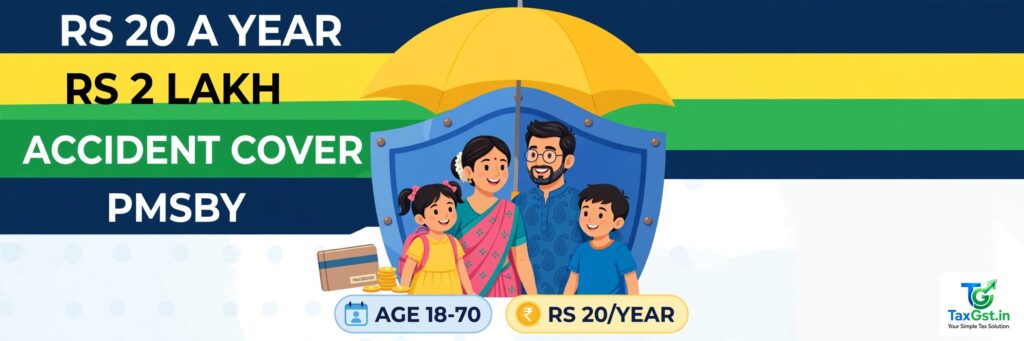
Pradhan Mantri Suraksha Bima Yojana (PMSBY) is the government’s accident insurance scheme: ₹20 a year, auto-debited from your bank account, buys ₹2 lakh of cover for accidental death or total disability and ₹1 lakh for partial disability. Anyone aged 18 to 70 with a savings bank or post office account can join, the cover runs 1 June to 31 May and renews every year, and the claim is filed through your bank. The premium also qualifies for a section 80C deduction under the old regime, and the payout is exempt under section 10(10D). Verified November 2026 · TaxGST.in
Sunita, a domestic worker in Delhi, pays ₹20 a year — less than the cost of one bus ticket a month — and her family is covered for ₹2 lakh if an accident takes her life or leaves her permanently disabled. She has never heard of PMSBY by name. Her bank enrolled her when she opened her Jan Dhan account, and the ₹20 leaves her account every June without her noticing. That is the whole point of the scheme: accident cover so cheap that the people who need it most never have to think about it. The problem is that crores of eligible account holders still have not joined, often because nobody told them it exists — or because they assume ₹20 a year cannot possibly buy real insurance. It can, because the government, not a private insurer’s profit margin, sets the terms.
What the ₹20 buys
PMSBY is a one-year personal accident insurance scheme, renewable from year to year, launched on 9 May 2015 and effective from 1 June 2015. It is offered through public sector general insurance companies and other general insurers, in collaboration with participating banks and post offices. The benefits are fixed and simple:
| Event | Sum insured |
|---|---|
| Accidental death | ₹2,00,000 |
| Total and irrecoverable loss of both eyes, both hands/feet, or sight of one eye plus use of a hand/foot | ₹2,00,000 |
| Total and irrecoverable loss of sight of one eye, or loss of use of one hand/foot | ₹1,00,000 |
The premium is ₹20 per annum per member, auto-debited from the account in one instalment. Accidents caused by natural calamities count as accidents under the scheme; death by suicide is not covered, while death by murder is covered. There are no medical tests and no paperwork beyond consent — the bank handles enrolment.
Who can join, and how
All individual savings bank or post office account holders aged 18 to 70 can join. Enrolment is through your bank branch or post office, or online via the Jan Suraksha portal (jansuraksha.gov.in), by giving consent for the annual auto-debit. The cover period runs from 1 June to 31 May each year, and the cover renews automatically as long as the account holds the ₹20 and the consent stands. Joining mid-year is allowed, with the premium adjusted on a pro-rata basis by some banks. Readers between 60 and 70 should also check the senior vs super senior citizen benefits guide, which covers the higher exemptions and 80TTB that apply alongside this cover. A few practical points: keep the account funded before June, because a failed auto-debit can lapse the cover; keep the nominee details updated — an out-of-date nominee is the most common reason a genuine claim gets delayed; and if you hold accounts in two banks, join through one only, since duplicate enrolment does not double the cover.
If you are already thinking about protection for your family, the other half of the picture is the life-cover sibling scheme, PMJJBY (₹436 a year for ₹2 lakh life cover) — and for the tax side of that planning, the deductions hub covers 80C, 80D and the other sections that reward insurance and saving.
How a claim works
On an accident, the nominee or the insured person approaches the bank branch where the account is held, with the claim form, the death certificate or disability certificate, the FIR or hospital records, and the nominee’s KYC. The bank forwards the claim to the insurer, which settles it into the nominee’s account. Two things decide whether a claim is smooth: the accident must be documented (an FIR or a hospital record that ties the death or disability to the accident), and the nominee in the bank’s records must match the claimant. Update the nominee after a marriage, a death in the family, or any change — it takes five minutes at the branch and saves months later. Claims are not subject to income tax in the nominee’s hands: the payout is exempt under section 10(10D) of the Income-tax Act. The nominee should also check whether a return is needed for the deceased’s final year — the “What is ITR?” guide covers who must file and what happens if you don’t.
The tax angle — small, but real
Here is the part most articles skip. Under the old tax regime, the ₹20 premium is eligible for deduction under section 80C, like any life insurance premium. ₹20 is a trivial deduction on its own — nobody joins PMSBY for the tax saving — but it matters for the principle: the scheme is designed to sit inside the same tax framework as every other insurance product. Under the new regime there is no 80C deduction, but the ₹2 lakh payout remains exempt under section 10(10D) in both regimes. If you are weighing the old versus new regime this year, the maths that actually matters is in the mid-year tax moves checklist (NPS extra ₹50,000, health premiums, loss harvesting) — PMSBY is a ₹20 footnote in that calculation, but it is a footnote that protects your family.
And a word of caution for the household budget: PMSBY is accident cover only. It does not cover illness, hospitalisation or natural death. It is the cheapest layer of a protection plan, not the whole plan — pair it with health cover, and treat the ₹20 as the easiest financial decision you will make all year.
FAQs
How much does PMSBY cost?
₹20 per year, auto-debited from your savings bank or post office account. The premium was ₹12 when the scheme launched and was later revised to ₹20.
What is the age limit for PMSBY?
18 to 70 years. You must hold an individual savings bank or post office account in a participating bank.
What does PMSBY cover?
Accidental death and disability: ₹2 lakh for death or total irrecoverable disability, ₹1 lakh for partial disability. Illness and natural death are not covered.
How do I enrol in PMSBY?
Visit your bank branch or post office and give consent for the auto-debit, or enrol online through the Jan Suraksha portal (jansuraksha.gov.in). Cover runs 1 June to 31 May and renews yearly.
Is the PMSBY payout taxable?
No — the payout is exempt under section 10(10D). Under the old regime, the premium also qualifies for deduction under section 80C.
Sources
Pradhan Mantri Suraksha Bima Yojana scheme rules, JanSuraksha portal (jansuraksha.gov.in) — ₹20 annual premium, ₹2 lakh / ₹1 lakh benefits, age 18–70, cover period 1 June to 31 May; State Bank of India PMSBY FAQs — enrolment, auto-debit, scope of cover including natural calamities, suicide exclusion; section 80C and section 10(10D), Income-tax Act — deduction for the premium under the old regime and exemption of the payout.
Discover more from TaxGst.in
Subscribe to get the latest posts sent to your email.