 C.K. Gupta
In short
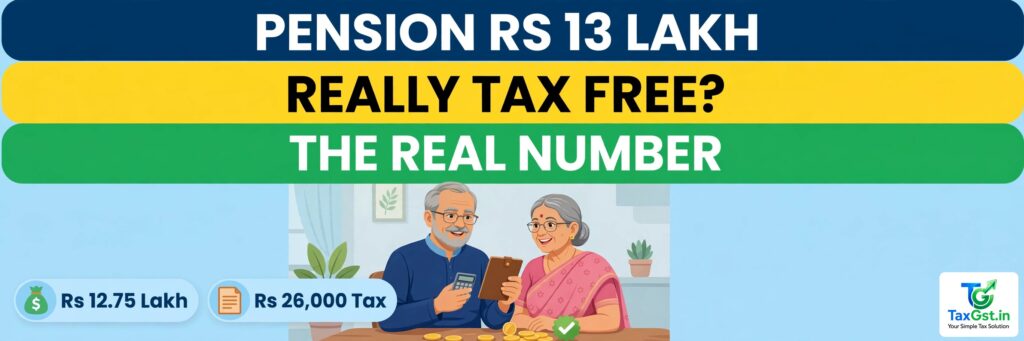
A pension of Rs 13 lakh a year is not tax-free. Under the new regime, a pensioner with only pension income pays zero tax up to Rs 12.75 lakh gross, because the Rs 75,000 standard deduction brings taxable income to Rs 12 lakh and the Section 156 rebate wipes out the Rs 60,000 tax. At Rs 13 lakh gross, the tax is Rs 26,000, not zero. Verified November 2026 · TaxGST.in
Ramesh retired from a public sector bank with a pension of just over Rs 1 lakh a month. A forwarded message told him pension up to Rs 13 lakh is now tax-free, but his old colleague, on almost the same pension, got a small demand in his Form 16. The real zero-tax line for pension alone is Rs 12.75 lakh.
Where the Rs 13 lakh claim comes from
Two real changes sit behind the claim. The Finance Act, 2025 raised the rebate under Section 156 of the Income-tax Act, 2025 to Rs 60,000 for total income up to Rs 12 lakh, and the standard deduction for pension under the new regime is Rs 75,000. Together they make Rs 12.75 lakh of pension into Rs 12 lakh of taxable income, which the rebate makes tax-free.
The Rs 13 lakh figure comes from pensioners with more than pension alone: with Rs 11 lakh of pension plus rental income, the 30 percent standard deduction on rent under Section 24(a) can pull taxable income back to Rs 12 lakh, so gross income escaping tax tops Rs 13 lakh. That maths needs the extra income and deduction, and a pension of Rs 13 lakh alone has no such help. For the full picture, see the complete guide to income tax deductions and exemptions.
The three numbers that decide your tax
Three numbers matter for a pensioner with no other income. The new-regime slabs for Tax Year 2026-27, under Section 202 of the Income-tax Act, 2025, are nil to Rs 4 lakh, then 5, 10, 15, 20 and 25 percent in Rs 4 lakh steps to Rs 24 lakh, and 30 percent above. Before 1 April 2026 this was Section 115BAC of the 1961 Act.
Second, the standard deduction of Rs 75,000, which comes off pension before the slabs are applied. Third, the rebate of up to Rs 60,000 under Section 156, which comes off the tax itself, but only if taxable income is Rs 12 lakh or less. Add 4 percent health and education cess on whatever tax remains. The rebate is only for resident individuals, and only against tax on income charged at normal slab rates.
Worked example 1: Rs 12.75 lakh pension, zero tax
Take a pension of Rs 12,75,000 a year. Less the standard deduction of Rs 75,000, taxable income is Rs 12,00,000. Slice by slice: the first Rs 4 lakh is nil, the 4 to 8 lakh slice at 5 percent is Rs 20,000, and the 8 to 12 lakh slice at 10 percent is Rs 40,000. Total slab tax is Rs 60,000, and because taxable income is exactly Rs 12 lakh the full rebate of Rs 60,000 applies. Tax is zero, and there is no cess either, because cess is charged on tax.
Worked example 2: Rs 13 lakh pension, Rs 26,000 tax
Now take a pension of Rs 13,00,000, just Rs 25,000 more. Less the Rs 75,000 standard deduction, taxable income is Rs 12,25,000. The slabs give Rs 20,000 on the 4 to 8 lakh slice, Rs 40,000 on the 8 to 12 lakh slice, and 15 percent on the last Rs 25,000, which is Rs 3,750. Total slab tax is Rs 63,750.
Here is the catch: you cannot subtract the full Rs 60,000 rebate from Rs 63,750 and call the answer Rs 3,750. The rebate applies only when total income is Rs 12 lakh or less, and here it is Rs 12,25,000. Instead, marginal relief caps the tax at the amount by which income crosses Rs 12 lakh, which is Rs 25,000. So the tax is Rs 25,000, plus 4 percent cess of Rs 1,000, a total of Rs 26,000. Check the rules in how the Section 87A rebate makes Rs 12 lakh tax-free, and your own numbers on the income tax calculator.
Worked example 3: Rs 15 lakh pension, Rs 97,500 tax
At a pension of Rs 15,00,000, taxable income after the standard deduction is Rs 14,25,000. The slabs give Rs 20,000 plus Rs 40,000 plus 15 percent of Rs 2,25,000, which is Rs 33,750, a total of Rs 93,750. There is no rebate at this income, and marginal relief does not help, because the excess over Rs 12 lakh is Rs 2,25,000. Add 4 percent cess of Rs 3,750 and the total is Rs 97,500.
| Gross pension | Taxable income | Slab tax | Tax payable |
|---|---|---|---|
| Rs 12,75,000 | Rs 12,00,000 | Rs 60,000 | Nil (rebate Rs 60,000) |
| Rs 13,00,000 | Rs 12,25,000 | Rs 63,750 | Rs 26,000 (marginal relief) |
| Rs 15,00,000 | Rs 14,25,000 | Rs 93,750 | Rs 97,500 |
Family pension is a different calculation
Family pension, paid to a spouse or dependent after the pensioner’s death, is taxed under Income from Other Sources, not as salary, so there is no Rs 75,000 standard deduction. Instead, Section 93(1)(d) of the Income-tax Act, 2025 allows a deduction of one-third or Rs 25,000, whichever is lower, under the new regime (Rs 15,000 under the old regime). Before 1 April 2026 this was Section 57(iia) of the 1961 Act.
Take a family pension of Rs 6,00,000. One-third is Rs 2,00,000, so the deduction is capped at Rs 25,000 and taxable income is Rs 5,75,000. The slab tax is 5 percent of Rs 1,75,000, which is Rs 8,750, and the rebate covers it in full. Tax is zero. The full rules are in the guide to pension taxation, commuted and uncommuted pension and family pension.
What about the old regime?
For a senior citizen aged 60 to 79, the old regime gives a basic exemption of Rs 3 lakh, and for a super senior citizen aged 80 or more it is Rs 5 lakh, with a Rs 50,000 standard deduction and up to Rs 50,000 of deposit interest under Section 80TTB. The old-regime rebate is only Rs 12,500 for income up to Rs 5 lakh. On a pension of Rs 12,75,000, the old regime gives tax of Rs 1,77,500 before cess, or Rs 1,84,600 with cess, against zero under the new regime. Commuted pension is fully exempt for government employees, and exempt up to one-third with gratuity or one-half without for others; see the guide to pension taxation, commuted and uncommuted pension and family pension. The old regime only competes when 80C, 80D and 80TTB claims are very large. See the senior citizen tax rates guide for 2026-27.
FAQs
Is pension up to Rs 13 lakh really tax-free?
No, not for pension alone. Up to Rs 12.75 lakh gross is tax-free; at Rs 13 lakh gross the tax is Rs 26,000.
Does the Rs 12.75 lakh limit apply to family pension too?
No. Family pension has no standard deduction. It gets one-third or Rs 25,000, whichever is lower, under the new regime, and is taxed under Other Sources.
What is marginal relief?
It caps your tax at the amount by which income exceeds Rs 12 lakh. At taxable income of Rs 12,25,000, the cap is Rs 25,000, though the slab tax is Rs 63,750.
Do senior citizens get a higher zero-tax limit under the new regime?
No, the slabs are the same at every age. The higher exemption of Rs 3 lakh or Rs 5 lakh exists only under the old regime.
Sources
- Finance Act, 2025: new-regime slabs and the Section 87A rebate raised to Rs 60,000 for income up to Rs 12 lakh.
- Income-tax Act, 2025: Section 202 (slabs), Section 156 (rebate with marginal relief), Section 19 (standard deduction) and Section 93(1)(d) (family pension). Before 1 April 2026: Sections 115BAC, 87A, 16(ia) and 57(iia) of the 1961 Act.
- Income-tax Act, 1961, Section 10(10A): commuted pension fully exempt for government employees, up to one-third with gratuity and one-half without for others. Income-tax Act, 2025, Section 153 (old Section 80TTB): up to Rs 50,000 deposit interest for senior citizens, old regime only.
Discover more from TaxGst.in
Subscribe to get the latest posts sent to your email.