 C.K. Gupta
In short
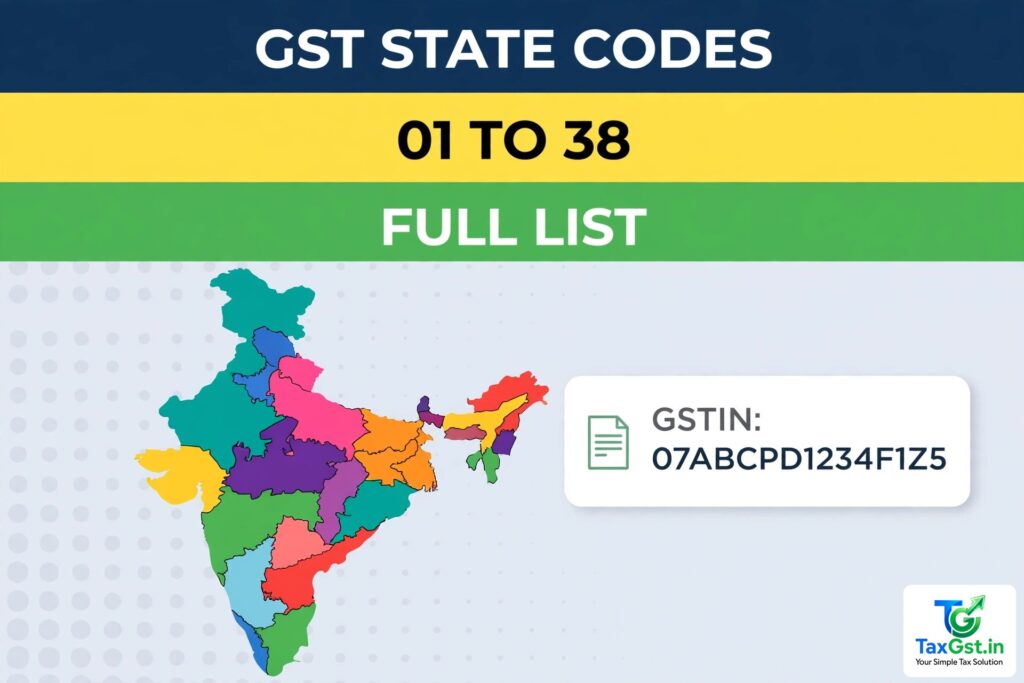
The first two digits of every GSTIN are the GST state code – 07 is Delhi, 27 is Maharashtra, 29 is Karnataka, 09 is Uttar Pradesh. There are 38 current codes, 01 to 38, plus two special codes (97 for other territory, 99 for Centre jurisdiction). Most invoice errors come from three traps: a retired code, a pre-bifurcation code, and a code that belongs to a different registration of the same business.
Verified November 2026 · TaxGST.in
A purchase manager in Noida once rejected a supplier’s invoice because the GSTIN started with 08 – Rajasthan – while the supplier claimed a Noida warehouse and a Delhi delivery address. The amount was right, the tax was right, but the code did not match the story, and the buyer would not risk a credit mismatch over two digits. That is the power of the GST state code: it is the first thing a buyer, an auditor and the GST portal all check. This guide lists every code, explains how a GSTIN is built, and names the traps that catch even experienced accountants.
For the wider GST picture, see the GST hub and the registration-fees guide. The PMT-06 guide shows how the tax computed on an invoice is actually paid, the missing-ITC guide covers the credit problem that often follows a wrong code, and the compliance calendar hub keeps filing dates in one place.
How a GSTIN is built
A GSTIN is a 15-character code. The first two characters are the state code. The next ten are the PAN of the business or person. The thirteenth character is the registration number for that PAN in that state – usually 1, then 2, 3 and so on for additional registrations. The fourteenth character is the letter Z by default. The fifteenth is a check digit.
Example: a Maharashtra business with PAN ABCDE1234F and its first registration has GSTIN 27ABCDE1234F1Z5 – 27 for Maharashtra, then the PAN, then 1, Z and the check digit. If the first two digits do not match the state where the business is registered, the GSTIN is wrong, however plausible the rest looks.
The complete list: codes 01 to 38
| Code | State / Union Territory | Code | State / Union Territory |
|---|---|---|---|
| 01 | Jammu and Kashmir | 20 | Jharkhand |
| 02 | Himachal Pradesh | 21 | Odisha |
| 03 | Punjab | 22 | Chhattisgarh |
| 04 | Chandigarh | 23 | Madhya Pradesh |
| 05 | Uttarakhand | 24 | Gujarat |
| 06 | Haryana | 25 | Daman and Diu (retired — see below) |
| 07 | Delhi | 26 | Dadra and Nagar Haveli and Daman and Diu |
| 08 | Rajasthan | 27 | Maharashtra |
| 09 | Uttar Pradesh | 28 | Andhra Pradesh (pre-bifurcation registrations) |
| 10 | Bihar | 29 | Karnataka |
| 11 | Sikkim | 30 | Goa |
| 12 | Arunachal Pradesh | 31 | Lakshadweep |
| 13 | Nagaland | 32 | Kerala |
| 14 | Manipur | 33 | Tamil Nadu |
| 15 | Mizoram | 34 | Puducherry |
| 16 | Tripura | 35 | Andaman and Nicobar Islands |
| 17 | Meghalaya | 36 | Telangana |
| 18 | Assam | 37 | Andhra Pradesh |
| 19 | West Bengal | 38 | Ladakh |
Two codes sit outside the 01 to 38 list. 97 is used for other territory – supplies where the place of supply is outside India or in a territory without a code. 99 is used for Centre jurisdiction, mainly for supplies to embassies, UN bodies and similar cases. You will rarely type either one, but you may see them on a GSTIN search or a government invoice, and they are not errors.
The three traps, in detail
Code 25 is dead. It was Daman and Diu before the merger. The merged territory is 26. If your customer master still shows 25 for a Daman or Silvassa customer, update it before the next invoice.
Code 28 is history, not a current code. It was undivided Andhra Pradesh. Current registrations use 36 for Telangana and 37 for Andhra Pradesh. Code 28 survives only on old GSTINs issued before the split, and using it for a new invoice will fail validation or misdirect the credit.
One PAN, many GSTINs. A business registered in five states has five GSTINs, each starting with that state’s code but sharing the same PAN in the middle. The thirteenth character distinguishes multiple registrations in the same state. Do not assume the first GSTIN you find for a supplier is the one for the state you are dealing with.
Why the code matters on an invoice
The code is the first check a buyer, an auditor and the GST portal all run. If the code does not match the delivery state, the invoice looks wrong even if the amount is right. A wrong code can delay input tax credit, trigger a mismatch in GSTR-2B, and force a credit note and a fresh invoice – all for two digits.
Quick checks before you file
- Read the first two digits of every GSTIN on an invoice and match them to the delivery state.
- Check that a Daman or Silvassa customer shows 26, not 25.
- Check that a Hyderabad customer shows 36 and a Vijayawada customer shows 37, not 28.
- Check that a supplier with multiple registrations is invoiced under the GSTIN for the right state.
- Update customer masters once a year – mergers, splits and new territories change codes.
FAQs
What is the GST state code for Delhi, Mumbai and Bengaluru?
Delhi is 07. Mumbai is in Maharashtra, so 27. Bengaluru is in Karnataka, so 29. The code follows the state, not the city.
How do I find the state code for a GSTIN?
Read the first two digits. For example, 27ABCDE1234F1Z5 starts with 27, so it is a Maharashtra registration.
Is code 25 still valid for Daman and Diu?
No. Code 25 was retired when the territories merged. Use 26 for Dadra and Nagar Haveli and Daman and Diu.
Why does Andhra Pradesh appear twice in some lists?
Code 28 was the pre-bifurcation code for undivided Andhra Pradesh. Current registrations use 36 for Telangana and 37 for Andhra Pradesh. Code 28 survives only on old GSTINs.
Can one business have different codes?
Yes. A business registered in five states has five GSTINs, each starting with that state’s code but sharing the same PAN in the middle.
What are codes 97 and 99?
97 is other territory and 99 is Centre jurisdiction. They are special codes outside the 01 to 38 list, used for specific government and cross-border cases.
Sources
GST state code list: CBIC GST portal and GSTIN structure · Central Goods and Services Tax Act, 2017 · Integrated Goods and Services Tax Act, 2017 · GST portal: GSTIN search and validation · Ministry of Home Affairs: merger of Dadra and Nagar Haveli and Daman and Diu
Discover more from TaxGst.in
Subscribe to get the latest posts sent to your email.