
 C.K. Gupta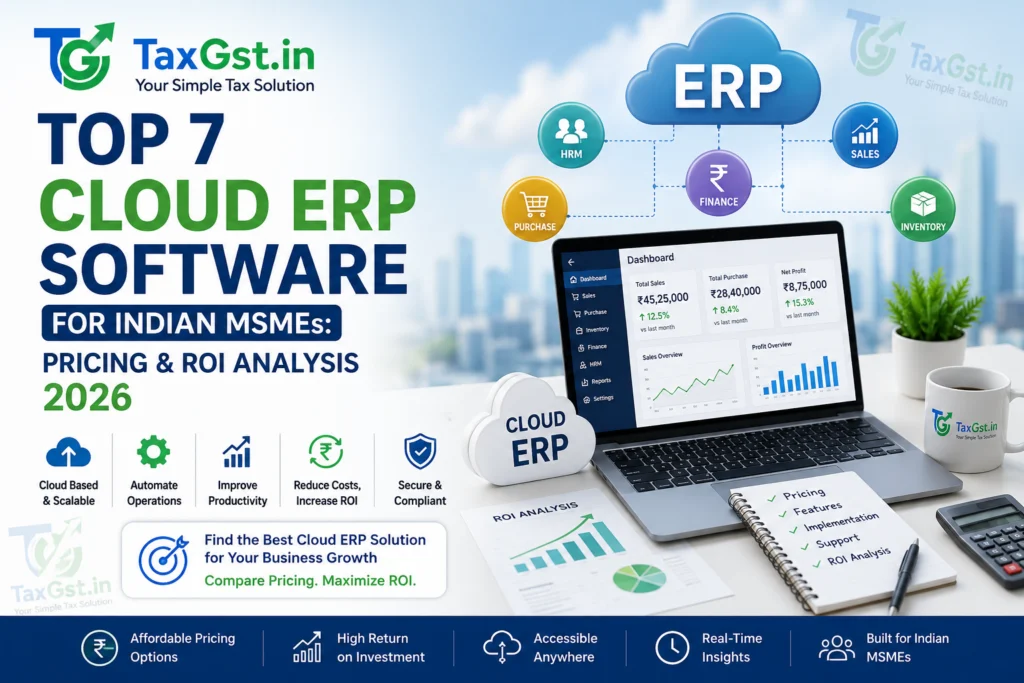
For Indian MSMEs navigating Udyam-linked subsidies, CGTMSE collateral-free loans, and Income-tax Act compliance, cloud ERP selection now directly determines eligibility for government schemes and optimizes Input Tax Credit (ITC) recovery. This guide evaluates the top 7 platforms—from ClearTax and Cygnet for GST-native compliance to Thomson Reuters ONESOURCE and Avalara for multi-country operations—with pricing benchmarks and ROI calculations tailored to MSME scheme beneficiaries.
Also Read-How to Do Udyam MSME Registration Online: MSME Certificate Download Guide
Quick Summary
- Cloud ERP selection for MSMEs is now tied to government scheme compliance—CGTMSE, CLCS-TUS, PMEGP, and PM Vishwakarma all require digital record-keeping and Udyam-linked documentation.
- ERPs must be capable of handling comprehensive TDS compliance under the Income-tax Act, to avoid portal validation rejections and short-deduction notices.
- ClearTax and Cygnet Tax lead for India-native GST compliance with IRP accreditation; Thomson Reuters ONESOURCE and Avalara serve MNCs needing unified global tax engines.
- Presumptive taxation under Section 44AD (turnover up to ₹3 crore) and Section 44ADA (gross receipts up to ₹75 lakh) requires ERPs with automated profit declaration at 8%/6% and 50% respectively, subject to digital receipt thresholds.
- ROI calculation must include three components: productivity savings, money recovery from optimized ITC, and assurance value from avoided litigation.
Why Do Indian MSMEs Need Cloud ERP for Government Scheme Compliance in 2026?
The convergence of three regulatory shifts has made cloud ERP adoption mandatory rather than optional for Indian MSMEs. First, the enhanced MSME classification limits—where Micro enterprises are defined by investment up to ₹1 crore and turnover up to ₹5 crore, Small enterprises up to ₹10 crore investment and ₹50 crore turnover, and Medium enterprises up to ₹50 crore investment and ₹250 crore turnover—require real-time classification tracking within the ERP to determine scheme eligibility.
Second, the Credit Guarantee Scheme under CGTMSE now provides guarantee coverage up to ₹10 crore per borrower (enhanced from ₹5 crore). This significant ceiling means MSMEs must maintain auditable digital trails of loan utilization, working capital cycles, and repayment schedules—all of which demand integrated ERP modules rather than standalone accounting software.
Third, accurate and timely compliance with the Income-tax Act, particularly concerning Tax Deducted at Source (TDS), is crucial. ERP systems must be configured to correctly apply various TDS sections. Businesses continuing with manual TDS deduction or using outdated systems face immediate portal validation rejection, automated short-deduction notices, and potential penalties for non-compliance. Integrated ERPs ensure that the correct rates and thresholds are applied automatically.
What Are the Top 7 Cloud ERP Platforms for Indian MSMEs with Pricing and ROI?
The Indian MSME cloud ERP market in 2026 segments into three tiers: India-native GST compliance platforms, global tax engines with India modules, and integrated business management suites. Selection depends on turnover bracket, GSTIN count, e-invoicing volume, and whether the MSME operates under presumptive taxation or maintains full books.
ClearTax is India’s most widely deployed enterprise tax compliance platform, trusted by over 5,000 enterprises. Its MaxITC engine matches more than 1 lakh documents within 10 minutes, directly addressing the money ROI component for MSMEs with high ITC volumes. The platform covers the full compliance lifecycle—GSTR-1 to GSTR-9C, e-invoicing, TDS compliance, the new Invoice Management System (IMS), and litigation management through its CCC Litigate module. For MSMEs availing CLCS-TUS subsidy of 25% on institutional credit up to ₹1 crore, ClearTax’s automated reconciliation ensures the subsidy-linked loan documentation aligns with DC-MSME reporting requirements.
Cygnet Tax distinguishes itself as one of only a handful of GSTN-authorised private Invoice Registration Portals (IRPs), processing 10-15% of India’s e-invoice traffic. With 250+ ERP integrations and support for 40+ countries, it suits MSMEs with export obligations under Stand-Up India or PMEGP who need both domestic GST compliance and international VAT reporting. Its 3-way ITC reconciliation (e-invoice + GST + e-way bill) prevents credit leakage and ensures accurate reporting.
Thomson Reuters ONESOURCE serves the upper end of the MSME spectrum—particularly those with foreign parentage or MNC clients requiring transfer pricing documentation. Its India GST module automates GSTR filings, IMS reconciliation, ISD, e-way bill, and e-invoicing with in-built SAP integration. Covering 205+ countries and 60,000+ global tax jurisdictions, it is the preferred choice for MSMEs under the Fund of Funds for MSMEs who receive equity infusion through SIDBI and must comply with both Indian and investor-country reporting standards.
Avalara (AvaTax GST) brings real-time GST rate calculation and high-volume transaction processing through pre-built connectors to SAP, Oracle, and e-commerce platforms. For MSMEs in retail and manufacturing with peak-period compliance demands—particularly those availing MUDRA Tarun loans up to ₹10 lakh—Avalara’s multi-GSTIN consolidated management prevents compliance gaps during seasonal volume spikes.
EY India Tax Platform expanded in February 2026 with three AI-enabled solutions: Global Trade Automation, EY India AI Tax Hub, and Accounts Payable Automation. Its unified direct + indirect tax ecosystem suits Global Capability Centres (GCCs) with EXIM exposure, particularly those leveraging the 2% Interest Subvention Scheme for MSMEs.
Zoho Books and Tally Prime occupy the volume segment. Zoho Books at an indicative ₹2,499/year (Standard plan, billed annually) serves professionals under Section 44ADA presumptive taxation with automated ITR-4 reporting at 50% profit declaration. Tally Prime at an indicative ₹18,000 + GST for a new single-user license remains the default for retail businesses and traders requiring inventory management alongside GST compliance, though it requires careful configuration for comprehensive TDS compliance when transitioning between the old and new Income-tax Acts.
How Should MSMEs Calculate ROI on Cloud ERP When Availing Government Subsidies?
Cloud ERP ROI for Indian MSMEs extends beyond license cost savings. When an MSME avails CGTMSE guarantee coverage, or claims CLCS-TUS subsidy of 25% on institutional credit up to ₹1 crore, the ERP becomes the audit trail that satisfies both the lending institution and the nodal agency. A compliance platform ROI calculator must therefore quantify three distinct value layers.
Productivity ROI measures person-days saved on manual GST return filing, e-invoice generation, and TDS deduction. For an MSME with 5 GSTINs and 2,000 B2B invoices annually, automation typically recovers 15-20 person-days per quarter.
Money ROI captures direct financial gains from optimized ITC matching. Under Section 44AD, where profit is deemed at 8% of turnover (6% for digital payments), even a 2% improvement in ITC recovery on ₹3 crore turnover yields ₹6 lakh annual cash flow improvement, provided cash receipts do not exceed 5% of total turnover.
Assurance ROI quantifies avoided litigation costs. MSMEs under presumptive taxation who file ITR-4 with automated ERP reports face lower scrutiny risk than those with manual books, particularly when claiming PMEGP margin money subsidy up to 35% of project cost.
| Platform | Best For | TDS Compliance | Presumptive Taxation Support | Indicative Pricing |
|---|---|---|---|---|
| ClearTax | Multi-GSTIN enterprises | Yes – Standard TDS forms auto-generated | Automated ITR-4 for 44AD/44ADA | Custom (enterprise) |
| Cygnet Tax | IRP-certified e-invoicing | Yes – accurate TDS calculation | 44ADA 50% declaration reports | Custom (enterprise) |
| Thomson Reuters ONESOURCE | MNCs with transfer pricing | Yes – global tax engine | Full book maintenance mode | Custom (premium) |
| Avalara AvaTax | Retail and e-commerce | Yes – real-time rate engine | Configurable profit declaration | Custom (enterprise) |
| Zoho Books | Micro businesses under ₹75L | Requires careful setup for advanced TDS | 44ADA ITR-4 auto-population | ₹2,499/year (Standard) |
| Tally Prime | Retail traders with inventory | Requires manual configuration or add-ons | Manual 44AD computation | ₹18,000 + GST (Single User) |
What is the ROI for a Manufacturing MSME Under CLCSS with ₹2.5 Crore Turnover?
Consider a manufacturing MSME in the food processing sub-sector (CLCSS-eligible) with ₹2.5 crore annual turnover, availing institutional credit of ₹80 lakh for technology upgradation. Under CLCSS, the MSME claims 15% subsidy—₹12 lakh. The ERP must track subsidy receipt, asset capitalisation, and depreciation separately for subsidy-compliant reporting.
Productivity ROI: With 3 GSTINs and 4,500 B2B invoices annually, manual compliance consumes approximately 25 person-days per quarter. At ₹3,500 per person-day, annual manual cost equals ₹3.5 lakh. Cloud ERP automation reduces this to 8 person-days, saving ₹2.38 lakh annually.
Money ROI: Under Section 44AD with 95% digital receipts, deemed profit is 6% of ₹2.5 crore = ₹15 lakh. At 30% tax rate plus surcharge, tax liability equals approximately ₹4.95 lakh. Optimised ITC recovery through MaxITC-style matching improves credit capture by 3% on ₹2.5 crore turnover = ₹7.5 lakh additional ITC, generating ₹7.5 lakh × 18% GST = ₹1.35 lakh cash flow benefit.
Assurance ROI: CLCSS subsidy of ₹12 lakh requires a DC-MSME audit trail. Non-compliance risks subsidy recall with 10% penalty = ₹1.2 lakh exposure. ERP documentation reduces this risk by 90%, yielding ₹1.08 lakh assurance value.
Total Annual ROI: ₹2.38 lakh (productivity) + ₹1.35 lakh (money) + ₹1.08 lakh (assurance) = ₹4.81 lakh against a typical enterprise ERP cost of ₹2.5-4 lakh, delivering payback within 8-10 months.
What Are the Eligibility Conditions and Documentation Requirements for MSMEs to Avail Cloud ERP-Linked Government Schemes?
Cloud ERP adoption alone does not automatically qualify an MSME for government subsidies. Each scheme imposes specific eligibility thresholds and documentation protocols that the ERP must generate in prescribed formats. The Credit Linked Capital Subsidy Scheme for Technology Upgradation (CLCS-TUS), administered through DC-MSME, provides an upfront capital subsidy of 15% on institutional credit up to ₹1 crore—capped at ₹15 lakh. To claim this, the MSME must procure plant & machinery from approved manufacturers, maintain a separate term loan account, and submit utilization certificates through the Primary Lending Institution (PLI). The ERP must generate asset-wise depreciation reports mapped to the subsidy sanction order.
The Credit Guarantee Scheme under CGTMSE now provides guarantee coverage up to ₹10 crore per borrower. Coverage varies by borrower category: micro enterprises up to ₹5 lakh receive 85% cover, while loans between ₹5 lakh and ₹50 lakh attract 75% cover. MSMEs must be Udyam registered, and the ERP must maintain loan-wise guarantee fee payment records for claim processing.
Presumptive taxation under Section 44AD requires the MSME to declare a minimum 8% of turnover as profit (6% if 95% of receipts are digital), with the turnover limit set at ₹3 crore for eligible businesses where cash receipts do not exceed 5% of total turnover. Section 44ADA applies to specified professionals with gross receipts up to ₹75 lakh and a deemed profit rate of 50%. The ERP must flag cash receipt percentages in real-time to determine which turnover slab applies and auto-generate ITR-4 compliant reports.
What Is the Step-by-Step Process for MSMEs to Migrate from Legacy Systems to Cloud ERP for Tax Compliance?
Migrating from legacy systems to a cloud ERP for robust tax compliance requires a structured transition approach. The first step is a comprehensive impact assessment to identify every hard-coded tax section within the existing ERP. Legacy systems typically embed sections like 194C (Contractors), 194J (Professional Fees), and 194H (Commission) as static deduction rules. The new ERP must be configured to accurately apply the correct TDS sections, rates, and thresholds, ensuring that any transaction processed after the migration adheres to the latest compliance requirements.
The second step involves master data mapping. Vendor, customer, and employee master files must be scrubbed and re-mapped. If your MSME is transitioning from the 1961 Income-tax Act to the 2025 Act rules, the ERP must correctly map legacy vendor codes to the new Section 393 tables to ensure seamless tax deduction without portal errors.
MSMEs opting for presumptive taxation under Section 44AD frequently select ERPs that cannot enforce the digital-payment threshold monitoring. An ERP without bank-feed integration cannot distinguish between digital and cash receipts in real-time, risking incorrect profit declaration and subsequent scrutiny under Section 68 for unexplained cash credits. Furthermore, the five-year continuity rule under Section 44AD requires the ERP to maintain opt-in/opt-out tracking with automated lock-in period alerts.
What Should You Do Next?
- Complete Udyam Registration on udyamregistration.gov.in if not already done—this is mandatory for availing CGTMSE, CLCSS, PMEGP, and PM Vishwakarma scheme benefits.
- Audit your current ERP or accounting software for compliance with the new Income-tax Act, 2025. Verify whether it can simultaneously process retrospective adjustments for FY 2025-26 and handle prospective Tax Year 2026-27 transactions.
- Calculate your specific compliance ROI using the three-component framework: productivity savings, money recovery from optimised ITC matching via IMS, and assurance value from avoided tax notices.
- Verify your CGTMSE eligibility under the enhanced ₹10 crore guarantee ceiling as per Circular No. 250/2024-25.
- For MSMEs under Section 44AD presumptive taxation (turnover up to ₹3 crore with 95% digital receipts), confirm your ERP automates profit declaration at 8% of turnover (6% for digital payments) and generates ITR-4 compliant reports.
- Request vendor demos specifically testing “crossover scenarios”—transactions recorded on March 31, 2026, versus April 1, 2026—to validate split-logic TDS deduction before committing to a cloud ERP platform.
Frequently Asked Questions
Can MSMEs avail CGTMSE coverage up to ₹10 crore for both term loans and working capital under the enhanced scheme?
Yes. As per Circular No. 250/2024-25, the credit guarantee ceiling has been enhanced from ₹5 crore to ₹10 crore per borrower. This applies to both fund-based term loans and non-fund-based working capital enhancements approved on or after the effective date. Coverage ranges from 75% to 90% depending on borrower category and loan slab.
Is cloud ERP mandatory for claiming CLCSS subsidy of 15% on technology upgradation loans?
While the CLCSS guidelines do not explicitly mandate cloud ERP adoption, the scheme requires auditable digital records linking plant & machinery procurement to institutional credit up to ₹1 crore. MSMEs using manual bookkeeping face higher rejection rates during verification. Cloud ERP ensures the documentation trail satisfies both the bank and the Ministry of MSME.
How does the transition to the Income-tax Act, 2025, affect MSMEs using Tally Prime for TDS compliance?
The Income-tax Act, 2025, came into force on April 1, 2026. Tally Prime requires customisation or middleware to handle dual-logic TDS under both the legacy 1961 Act and the new 2025 Act. Without this update, MSMEs risk portal validation rejection because transactions after April 1, 2026, quoting old section codes (like 194C or 194J) will face immediate system-level rejection during TDS return filing.
What is the current e-invoicing turnover threshold, and does it impact MSME scheme eligibility?
E-invoicing is mandatory for GST-registered businesses with Aggregate Annual Turnover (AATO) above ₹5 crore for B2B transactions. MSMEs below this threshold are legally exempt from IRP reporting. However, availing schemes like CGTMSE, CLCSS, or PMEGP often requires digital invoicing as part of the lending institution’s due diligence. Adopting a cloud ERP with IRP integration maintains audit-ready documentation for banks.
How Does Udyam Registration Integration with Cloud ERP Affect MSME Scheme Eligibility Tracking?
When an MSME’s turnover crosses the Micro threshold of ₹5 crore or the Small threshold of ₹50 crore, the ERP must immediately flag the classification change because it directly impacts CGTMSE guarantee coverage slabs and subsidy availability. Modern platforms automatically sync with government databases to prevent stale data rejections during loan renewals.
Article Information
Published: July 24, 2026
Last Reviewed: July 24, 2026
Category: Business Technology & Tax Compliance
Regulatory Bodies: CBDT & Ministry of MSME
Written by C.K. Gupta, M.Com & Tax Editor at TaxGST.in — helping businesses navigate GST/IT compliance, ERP transitions, and government subsidy audits across Delhi NCR since 2009.
Official Resources
Disclaimer: This article is for informational purposes only. Software features, pricing, and government scheme eligibility criteria are subject to change. Always verify current limits and compliance rules on official government portals before investing in an ERP ecosystem.
Discover more from TaxGst.in
Subscribe to get the latest posts sent to your email.

Never Miss a Tax Deadline Again
Due-date alerts, GST updates and tax tips — free on the app you already use.
event Next: GSTR-1 (IFF) · 13 Oct