
 C.K. Gupta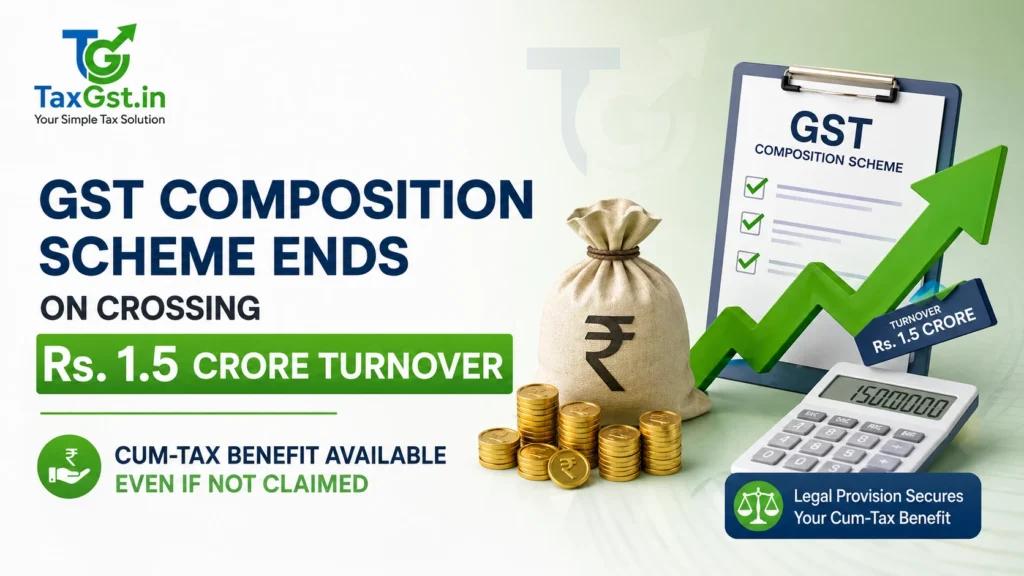
The GSTAT Hyderabad Bench has ruled that once a composition dealer’s aggregate turnover crosses the ₹1.50 crore threshold under Section 10(3) of the CGST Act, 2017, the composition option lapses automatically from that exact day. However, in a major relief for taxpayers, the tribunal held that the benefit of cum-tax valuation under Rule 35 of the CGST Rules must be extended even if the taxpayer did not specifically claim it, provided the dealer did not collect tax separately from recipients.
Quick Summary: GSTAT Ruling on Composition Withdrawal
- Composition scheme eligibility ends the day turnover exceeds ₹1.50 crore as per Section 10(3) of the CGST Act.
- Rule 35 cum-tax benefit applies automatically when tax was not separately collected from recipients.
- Taxpayers cannot be denied this benefit merely because they did not claim it explicitly in lower proceedings.
- Differential tax must be recomputed on a cum-tax basis, drastically reducing the final demand.
- The ruling in Sri Parameshwara Bricks provides a strong legal precedent for composition dealers who crossed the threshold mid-year.
What Happens to Composition Scheme Status When Turnover Crosses ₹1.50 Crore?
Under Section 10(3) of the CGST Act, 2017, the composition option lapses with effect from the day on which aggregate turnover during a financial year exceeds the prescribed limit. The proviso to Section 10(1) permits the Government to increase the threshold up to ₹1.50 crore, which is the current applicable limit for most States.
Once this threshold is crossed, the dealer is treated as a regular taxpayer from that exact date onwards. The taxpayer must file an intimation for withdrawal in FORM GST CMP-04 within seven days of the event, as required under Rule 6(2) of the CGST Rules. Failure to file this intimation does not extend composition eligibility — the lapse is automatic by operation of law.
In the Sri Parameshwara Bricks case, the assessee’s e-way bill turnover was ₹1,95,53,800 while the CMP-08 declared turnover was only ₹1,44,86,100. The GST department treated the difference of ₹50,67,700 as escaped turnover. The tribunal confirmed that the composition benefit ended once the ₹1.50 crore limit was crossed, but crucially, directed the department to recompute the tax on the correct valuation basis.
Why Does the Cum-Tax Valuation Under Rule 35 Matter for Ex-Composition Dealers?
Rule 35 of the CGST Rules provides that where the value of supply is inclusive of tax, the tax component must be determined by treating the value as the cum-tax amount. This means the taxable value is arrived at by dividing the invoice value by the applicable tax rate plus one hundred.
Section 10(4) of the CGST Act prohibits a composition dealer from collecting any tax from the recipient on supplies made. Since the assessee was legally not permitted to collect tax separately, and the department did not allege any separate collection, the tribunal held that the invoice value must be treated as inclusive of tax under Rule 35.
The tribunal observed that the assessee had not specifically claimed the benefit of Rule 35 before the lower authorities. However, this omission cannot disentitle a taxpayer from a statutory benefit available under the Act when the relevant facts are already on record. The proper officer was directed to recompute the differential tax liability applying the cum-tax formula.
How Should Tax Liability Be Recomputed After Crossing the Threshold?
When a composition dealer crosses the ₹1.50 crore limit, the tax liability for the period after crossing must be computed at the regular rate applicable to the goods supplied (e.g., 12% or 18%). However, the critical adjustment is that the invoice value must be treated as cum-tax since no separate tax was collected from the customers.
The recomputation formula under Rule 35 works as follows:
Taxable Value = Invoice Value × 100 / (100 + Applicable Tax Rate)
In the Sri Parameshwara Bricks case, the department had originally confirmed the demand at 5% on the differential turnover of ₹50,67,700 without applying the cum-tax benefit. The tribunal’s direction means the department must first back out the tax component from the invoice value before applying the regular rate, which substantially reduces the final demand payable by the taxpayer.
Key Differences: Composition vs. Regular Scheme (Post-Threshold)
| Parameter | Composition Scheme (Section 10 CGST) | Regular Scheme (Post Threshold) |
|---|---|---|
| Tax Rate | 1% for manufacturers/traders; 5% for restaurants; 6% for service providers under Sec 10(2A). | Applicable GST rate on goods/services (e.g., 5%, 12%, 18%, 28%). |
| Tax Collection | Not permitted to collect tax from recipient under Section 10(4). Must issue “Bill of Supply”. | Must collect tax separately and issue a standard “Tax Invoice”. |
| Input Tax Credit (ITC) | No ITC available to the dealer; no ITC passed on to the recipient. | ITC available on inputs; recipient can also claim ITC. |
| Valuation Basis | Turnover in State/UT as declared in CMP-08. | Cum-tax valuation under Rule 35 applies where tax is not separately collected. |
| Compliance Frequency | Quarterly statement in FORM GST CMP-08; annual return in FORM GSTR-4. | Monthly/quarterly returns in GSTR-1 and GSTR-3B as applicable. |
Practical Example: Cum-Tax Recomputation in Action
Consider a composition manufacturer whose turnover crosses ₹1.50 crore on 15th October. For supplies made from 16th October to 31st March, the aggregate invoice value is ₹40,00,000. The applicable GST rate on the manufactured goods is 18%. Since no tax was separately collected (the dealer continued issuing Bills of Supply by mistake), Rule 35 cum-tax valuation applies.
- Taxable Value = ₹40,00,000 × 100 / 118 = ₹33,89,831
- Tax at 18% on this value = ₹6,10,169
Without the cum-tax benefit, the GST department’s demand would have been ₹7,20,000 (18% flat on ₹40,00,000). The cum-tax ruling saves the trader over ₹1,09,831 on this differential alone. The proper officer must apply Rule 35 suo motu when recomputing demand in threshold breach cases.
How Should Dealers Handle ITC-01 Claims on Withdrawal?
When a composition dealer files FORM GST CMP-04 for withdrawal, the dealer becomes legally entitled to claim input tax credit (ITC) on the stock held on the exact date of withdrawal. This is governed by Rule 3(5) of the CGST Rules read with Section 17(1) and (2) of the CGST Act.
The dealer must furnish FORM GST ITC-01 within thirty days from the date of withdrawal, detailing inputs, inputs contained in semi-finished goods, and finished goods held in stock. Failure to file ITC-01 within the thirty-day window results in the complete forfeiture of this transitional credit.
| Stock Category on Withdrawal Date | ITC Eligibility Under Rule 3(5) |
|---|---|
| Inputs held in stock | Full ITC eligible (if used for taxable supplies). |
| Inputs in semi-finished/finished goods | Full ITC eligible (Must be quantified in ITC-01). |
| Capital goods | ITC eligible, but reduced by 5% per quarter from the date of invoice. |
| Exempted goods / Non-business assets | Blocked under Section 17(1) and Section 17(2). |
What Steps Should a Taxpayer Take After Crossing the Threshold?
- Calculate aggregate turnover from 1st April of the current financial year on a cumulative basis to identify the exact day the ₹1.50 crore threshold is breached.
- File FORM GST CMP-04 within seven days of the event on the GST Portal.
- File FORM GST ITC-01 within thirty days of withdrawal to secure your transitional input tax credit on closing stock.
- Immediately configure your billing software to issue “Tax Invoices” instead of “Bills of Supply” and begin collecting GST from customers.
- If a GST demand notice has been issued without applying the cum-tax benefit, file an appeal citing the GSTAT Hyderabad ruling in Sri Parameshwara Bricks.
Frequently Asked Questions (FAQs)
Does the composition scheme end automatically when turnover crosses ₹1.50 crore?
Yes. Under Section 10(3) of the CGST Act, the composition option lapses automatically on the exact day aggregate turnover exceeds the limit. No separate order from the tax authority is required. The dealer must file FORM GST CMP-04 within seven days.
Can I claim cum-tax benefit under Rule 35 even if I did not collect tax separately?
Yes. Rule 35 applies where the value of supply is inclusive of tax. The GSTAT held that this statutory benefit must be extended even if the taxpayer did not specifically claim it before the lower authorities, provided they did not collect tax separately.
What is the deadline to file FORM GST CMP-04?
The intimation for withdrawal in FORM GST CMP-04 must be filed electronically on the GST Portal within seven days from the date on which aggregate turnover exceeds the prescribed limit.
Is the ₹1.50 crore composition threshold uniform across all States?
No. For certain specified States—including Arunachal Pradesh, Manipur, Meghalaya, Mizoram, Nagaland, Sikkim, Tripura, and Uttarakhand—the composition scheme limit remains lower at ₹75 lakh.
Can a dealer re-enter the composition scheme in a future year?
Yes. If the aggregate turnover in the preceding financial year falls back below the prescribed limit, the dealer may opt for composition again by filing FORM GST CMP-02 before the commencement of the new financial year.
Sources & References
- CBIC — Section 10 of the CGST Act, 2017
- GST Portal User Guide — Withdraw from Composition Scheme
- CBIC GST — FAQ Manual on Composition Levy
Article Information
Published: August 24, 2026
Last Reviewed: August 24, 2026
Category: GST Case Law & Compliance
Regulatory Body: Central Board of Indirect Taxes and Customs (CBIC)
Written by C.K. Gupta, M.Com & Tax Editor at TaxGST.in — assisting MSMEs with GST registration, composition scheme transitions, and appellate litigation since 2017.
Official Resources
Disclaimer: This article provides a summary of the GSTAT ruling in the matter of Sri Parameshwara Bricks. Case laws are highly fact-specific. If you have crossed the GST Composition threshold and are facing a demand notice, please consult a practicing Chartered Accountant or GST Advocate to assess the applicability of Rule 35 cum-tax benefits to your specific case.
Try the free GST calculator for instant figures.
Discover more from TaxGst.in
Subscribe to get the latest posts sent to your email.



Never Miss a Tax Deadline Again
Due-date alerts, GST updates and tax tips — free on the app you already use.
event Next: TDS Return (138 / 140) · 31 Oct