
 C.K. Gupta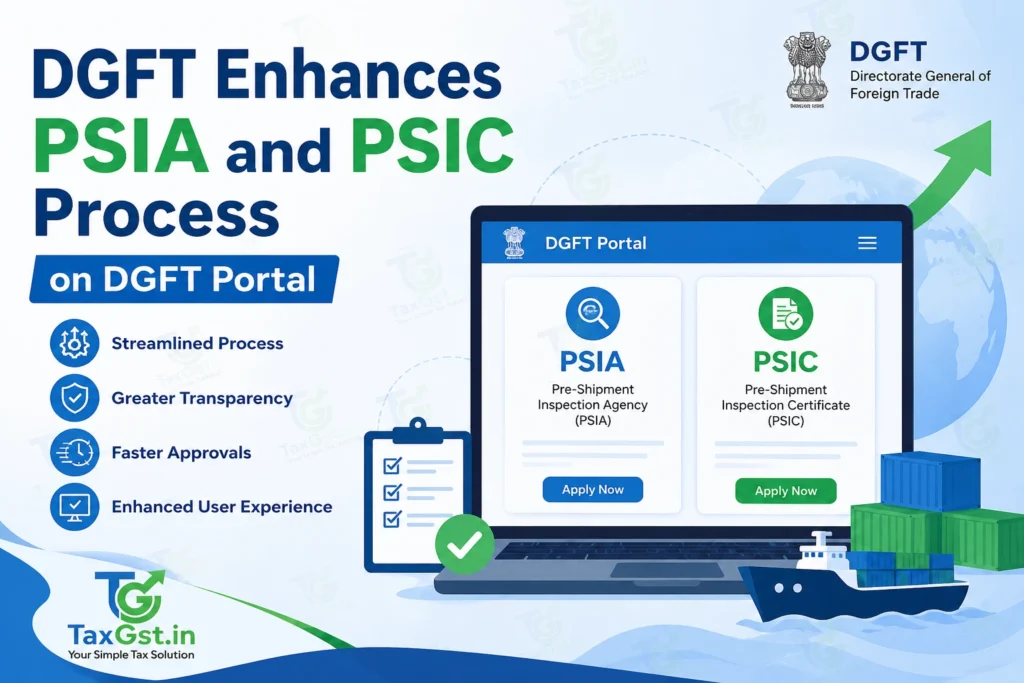
The Directorate General of Foreign Trade (DGFT) has issued Trade Notice No. 22/2026-27 dated August 25, 2026, mandating major digital enhancements for Pre-Shipment Inspection Agencies (PSIAs). Key changes include mandatory DD/MMM/YYYY date formatting, system-populated inspector names, automated signature and stamp embedding, and significantly increased upload limits for inspection photos and videos. These changes are designed to eliminate backdated certificates, prevent forgery, and strengthen the compliance framework for metal scrap imports into India.
Also Read – IFSCA SEZ Compliance FAQs: LOA, BLUT, Lease & IEC
Quick Summary: DGFT Enhancements to PSIC Issuance
- Trade Notice No. 22/2026-27-DGFT enhances the PSIA/PSIC digital process on the DGFT portal.
- PSIC inspection dates are standardized to DD/MMM/YYYY format; the certificate must be generated only on the actual inspection date.
- Authorized PSIA users can upload signature and stamp images for automatic embedding in all future PSICs.
- Inspection photograph limits have increased to 10 attachments (5 MB each); video limits raised to 50 MB.
- Instruments now display via a country-based drop-down with auto-fetched read-only details to prevent data entry errors.
- Inspectors must select their names from a system-populated list directly tied to the PSIA’s approved roster.
The Genesis of the Mandate: Why Metal Scrap Imports Face Intense Scrutiny
To understand the severity of the DGFT’s latest Trade Notice, one must look at the underlying reasons for Pre-Shipment Inspection Certificates. India is one of the world’s largest importers of metallic scrap (both ferrous and non-ferrous), which serves as a critical raw material for the secondary steel and metallurgical industries.
However, the global scrap supply chain carries immense risks. Unregulated scrap shipments have historically been a conduit for unexploded ordnance, arms, ammunition, and highly dangerous radioactive materials. A single radioactive source melted down in an Indian steel furnace can cause catastrophic health hazards and economic losses running into hundreds of crores.
To mitigate this, the DGFT, in consultation with the Atomic Energy Regulatory Board (AERB) and the Inter-Ministerial Committee (IMC), mandates that all metal scrap imported into India must be cleared by an enlisted Pre-Shipment Inspection Agency (PSIA) at the port of origin. The PSIA is legally responsible for verifying that the cargo is free of explosives and radiation before the container is sealed and loaded onto a vessel bound for India.
The digital enhancements under Trade Notice No. 22/2026-27 are designed to close lingering loopholes in this system. Previously, unscrupulous agencies could issue backdated certificates or manually type in the names of unverified inspectors. By forcing the entire workflow online with hard-coded validation checks, the DGFT is ensuring absolute accountability for every container of scrap entering Indian territory.
What Are the Latest DGFT Enhancements to the PSIC Process?
The Directorate General of Foreign Trade (DGFT) issued Trade Notice No. 22/2026-27-DGFT dated August 25, 2026, introducing significant digital enhancements to the PSIC workflow. These changes standardize how PSIAs issue certificates online and align with the broader electronic verification framework first introduced under Trade Notice No. 03/2022-23.
The most disruptive enhancement is the mandatory standardization of the PSIC inspection date in DD/MMM/YYYY format. Under the new portal architecture, PSIAs must generate and issue certificates only on the actual inspection date. The system cross-references the server date and blocks any attempt at backdated or post-dated certificate issuance. This ensures that the digital trail perfectly matches the physical inspection timeline.
Another critical change involves signature and stamp management. Historically, physical stamping on paper certificates was highly vulnerable to forgery. Now, authorized PSIA users must upload their official signature and stamp images to the DGFT portal. These images automatically embed into the PSIC during generation. This digital embedding creates a verifiable, tamper-proof document that customs authorities can trust unconditionally.
Deep Dive: The Anatomy of a Perfect PSIC Video/Photo Upload
Paragraph 2.56 of the Handbook of Procedures, 2023, places the burden of proof entirely on the PSIA. If Indian Customs suspects a container is contaminated, the primary defense the PSIA has is the digital evidence uploaded to the DGFT portal.
To accommodate rigorous inspections, Trade Notice No. 22/2026-27 substantially increased the attachment limits. Inspection photographs now permit up to 10 attachments at 5 MB each (up from the previous 5-photo limit). More importantly, the mandatory video attachment limit has risen from a mere 10 MB to 50 MB.
To pass muster during a customs audit, PSIAs must utilize these new limits effectively. A compliant 50MB video and 10-photo set should clearly capture:
- The Empty Container: Visual proof that the container was clean and free of false floors/walls prior to stuffing.
- The Material Loading: Footage showing the specific type of metal scrap being loaded, proving it matches the description on the invoice and bill of lading.
- The Radiation Sweep: The inspector actively scanning the cargo with a Handheld Radiation Survey Meter. The video must clearly show the digital display of the meter reading normal background radiation levels.
- The Sealing Process: Uninterrupted video footage showing the container doors closing and the high-security seal being applied. The final photograph must be a close-up of the seal, clearly showing the seal number matching the PSIC data.
How Do the New PSIC Changes Affect Inspector Accountability?
In the past, the “Inspector Name” field on a PSIC was a simple free-text box. This allowed administrative staff to type in any name, making it incredibly difficult for regulatory bodies to track who actually performed the physical inspection at the foreign port.
Trade Notice 22/2026-27 permanently closes this loophole. PSIA administrators must now pre-register all their authorized, technically qualified inspectors on the DGFT portal. When generating a PSIC, the user must select the inspector’s name from a system-populated drop-down list. This creates a definitive, unalterable audit trail linking each specific certificate to a verified inspector.
Furthermore, instrument selection has been automated. Instead of manually typing in the serial numbers of radiation meters, the portal now features a country-based drop-down. When the user selects the country of inspection, the system auto-fetches the registered instruments approved for that specific region with read-only details. This prevents data entry errors and ensures that a PSIA cannot claim to have used an instrument in a country where they are not authorized to operate.
What Compliance Obligations Must PSIAs Fulfill Under the Enhanced Framework?
Trade Notice No. 22/2026-27-DGFT operates within the broader compliance structure established under Paragraph 2.52(c) of the Handbook of Procedures, 2023. PSIAs enlisted under Appendix-2G of the Foreign Trade Policy, 2023, must simultaneously maintain all existing baseline conditions while adapting to the new digital requirements.
The foundational compliance conditions remain stringent. All PSIAs must maintain valid calibration certificates for their radiation detection instruments at all times, provide valid bank guarantees to the DGFT, update instrument mapping on the portal, and maintain a registered office with an operational bank account in India.
| Compliance Parameter | Requirement under FTP 2023 | Validity Period |
|---|---|---|
| PSIA Enlistment | Recognition under Appendix-2G for issuance of PSIC online | 3 years from date of notification |
| Calibration Certificates | Valid calibration for all approved instruments at all times | Continuous validity required |
| Bank Guarantee | Valid bank guarantee to be maintained | Co-terminus with enlistment |
| Instrument Mapping | Update mapping of instruments vis-à-vis areas of operation on DGFT Portal | As and when instruments or areas change |
| PSIC Generation | Certificates to be generated only on inspection date in DD/MMM/YYYY format | Per certificate |
How Does the Step-by-Step PSIC Generation Process Work on the DGFT Portal?
The electronic PSIC generation process follows a highly structured workflow on the DGFT portal. The process begins with PSIA registration through My Dashboard → Register → selecting ‘Register User As: Pre-Shipment Inspection Agency’. After account activation and IMC approval, the PSIA gains access to the Pre-Shipment Inspection module.
- Step 1: Login to the DGFT portal with PSIA credentials.
- Step 2: Navigate to Services → Pre-Shipment Inspection → Generate and upload PSIC.
- Step 3: Select country from the drop-down (this auto-fetches registered instruments).
- Step 4: Select inspector name from the system-populated list.
- Step 5: Enter inspection date in DD/MMM/YYYY format (system-validated to current date).
- Step 6: Upload up to 10 photographs (5 MB each) and a video (up to 50 MB).
- Step 7: System auto-embeds uploaded signature and stamp images.
- Step 8: Generate PSIC with a unique, cryptographically secure certificate number.
The Importer’s Guide to ICEGATE and PSIC Verification
The ultimate consumer of the PSIC is the Indian importer and the Indian Customs Authority. Under the previous manual regime, an importer had to wait for the physical certificate to be couriered from the foreign port, which often delayed the filing of the Bill of Entry on the ICEGATE portal.
Under the fully digitized framework, verification is instantaneous and login-free. Indian importers can download PSICs by simply navigating to Services → Pre-Shipment Inspection → Download Pre-Shipment Inspection Certificate on the DGFT website. They only need to enter the certificate number and the PSIA name.
Customs authorities at Indian ports (like Nhava Sheva or Mundra) use the same portal for clearance verifications. Because the DGFT portal captures the IP address of the PSIA during generation, customs intelligence can easily flag anomalies—for example, a PSIC supposedly issued for a physical inspection in South Africa, but generated from an IP address in New Delhi. This data integration allows customs to fast-track compliant shipments while holding high-risk containers for physical screening.
How Does the Enhanced PSIC Process Compare to the Previous System?
| Parameter | Earlier Process (Pre-August 2026) | Enhanced Process (Trade Notice 22) |
|---|---|---|
| Inspection Date Format | Free-text entry; prone to typos. | Mandatory DD/MMM/YYYY format. |
| Generation Timing | Could be generated before or after inspection date. | Must be generated only on the actual inspection date. |
| Signature & Stamp | Manual stamping on paper; scanned copy uploaded. | Auto-embedded from pre-uploaded portal images. |
| Inspector Selection | Manual name entry; no verification against roster. | Selection mandatory from a system-populated drop-down. |
| Photo Limits | Max 5 photographs (5 MB each). | Up to 10 photographs (5 MB each). |
| Video Limits | 10 MB maximum. | 50 MB maximum. |
Worked Example 1: The Cost of an Expired Calibration Certificate
To understand the financial implications of non-compliance, consider a PSIA enlisted under Appendix-2G operating out of Dubai. The PSIA uses a high-end Handheld Radiation Survey Meter. According to ISO/IEC 17025 standards and DGFT rules, these meters require annual calibration by a certified laboratory to ensure they detect radiation accurately.
The PSIA’s administrative team fails to set a calendar reminder, and the calibration certificate expires on September 1st. On September 5th, the inspector completes a physical inspection of 15 containers of heavy melting scrap (HMS) bound for Nhava Sheva. When the inspector attempts to generate the PSIC on the DGFT portal, the system recognizes the expired calibration date mapped to that specific instrument and blocks the generation of the certificate.
Because the PSIC cannot be generated on the actual date of inspection (a strict mandate under Trade Notice 22), the inspection is legally void. The scrap exporter must halt loading operations, the PSIA must rush to get the equipment re-calibrated (a process taking days), and the entire inspection must be re-conducted. The resulting vessel delay and port ground rent charges fall directly on the exporter, severely damaging the PSIA’s commercial reputation and exposing them to breach of contract claims.
Worked Example 2: The Customs Rejection Scenario
A different PSIA attempts to circumvent the portal rules. The inspector conducts a physical inspection on Monday but forgets to generate the PSIC. Realizing the error on Wednesday, and knowing the DGFT portal will not allow backdating, the PSIA manually creates a PDF certificate, stamps it physically, and emails it to the Indian importer, hoping it will pass.
The cargo arrives at Mundra Port. The importer’s Customs Broker files the Bill of Entry and submits the manual PSIC. The assessing customs officer logs into the ICEGATE-DGFT integrated system and finds no digital record of the PSIC number. Recognizing that manual issuance has been banned since July 2022, the officer rejects the clearance.
The 20 containers are moved to a customs bonded warehouse. Demurrage and detention charges begin accumulating at roughly USD 2,500 per day across the consignment. The importer must now arrange for a local, DGFT-approved agency to conduct a 100% physical inspection at the Indian port, incurring massive additional costs. The original foreign PSIA faces immediate suspension by the Inter-Ministerial Committee and forfeiture of their bank guarantee.
What Actions Should Pre-Shipment Inspection Agencies Take Next?
📋 Compliance Action Checklist
- PSIC Generation Protocol: Generate PSICs ONLY on the actual inspection date; backdated or post-dated certificates are strictly prohibited.
- Inspector Roster: Register all active inspectors under your PSIA account on the portal immediately so their names appear in the system-populated drop-down list.
- Digital Signatures: Upload your authorized signature and stamp images through the portal’s designated upload section to enable automatic embedding.
- Instrument Mapping: Verify that all approved instruments are correctly mapped against operational countries on the DGFT portal.
- Calibration & Bank Guarantee: Ensure calibration certificates remain valid at all times, with a minimum six-month buffer. Maintain a valid bank guarantee co-terminus with your 3-year enlistment period.
Frequently Asked Questions (FAQs)
What is the validity period of PSIA enlistment under Appendix-2G of FTP 2023?
PSIA enlistment under Appendix-2G of the Foreign Trade Policy remains valid for a period of three years from the date of the public notice. Agencies must apply for renewal before expiry to avoid suspension.
Can PSIAs issue PSICs for countries not listed in their approved area of operation?
PSIAs can inspect countries where they do not have a full-time equipped branch office, provided the country falls within their approved area of operation. Prior intimation to DGFT via email is required.
What are the attachment limits for inspection photographs and videos?
Under the enhanced process, PSIAs can upload up to 10 inspection photographs at 5 MB each. The mandatory video attachment limit has been raised to 50 MB to allow high-quality documentation of container sealing.
How can Indian importers verify the authenticity of a Pre-Shipment Inspection Certificate?
Importers can verify PSICs without logging in by navigating to Services → Pre-Shipment Inspection → Download Pre-Shipment Inspection Certificate on the DGFT website.
What is the new inspection date format mandated for PSICs?
As per Trade Notice No. 22/2026-27, the inspection date must be recorded in DD/MMM/YYYY format (e.g., 25/Aug/2026). The certificate must be generated only on the actual date of inspection.
Can PSIAs issue PSICs manually outside the DGFT portal?
No, manual issuance of PSICs outside the DGFT portal is not permissible. All PSIAs must generate PSICs exclusively through the DGFT portal. Manually generated PSICs will be rejected by Indian Customs Authorities.
Sources & References
- Directorate General of Foreign Trade (DGFT) Portal
- Trade Notice No. 22/2026-27-DGFT dated August 25, 2026
- Handbook of Procedures, 2023 (Paragraph 2.55 and 2.56)
Article Information
Published: August 25, 2026
Last Reviewed: August 25, 2026
Category: DGFT & Customs
Regulatory Body: Directorate General of Foreign Trade (DGFT)
Written by C.K. Gupta, M.Com & Tax Editor at TaxGST.in — assisting exporters and importers with DGFT compliance, foreign trade policy, and customs clearance workflows since 2009.
Official Resources
Disclaimer: This article provides a detailed analysis of DGFT Trade Notice 22/2026-27. Export-import policies and portal requirements change frequently. Always refer to the official DGFT notifications for authoritative guidance on PSIA compliance and metal scrap imports.
Related Reading
Discover more from TaxGst.in
Subscribe to get the latest posts sent to your email.



Never Miss a Tax Deadline Again
Due-date alerts, GST updates and tax tips — free on the app you already use.
event Next: TDS Return (138 / 140) · 31 Oct