
 C.K. Gupta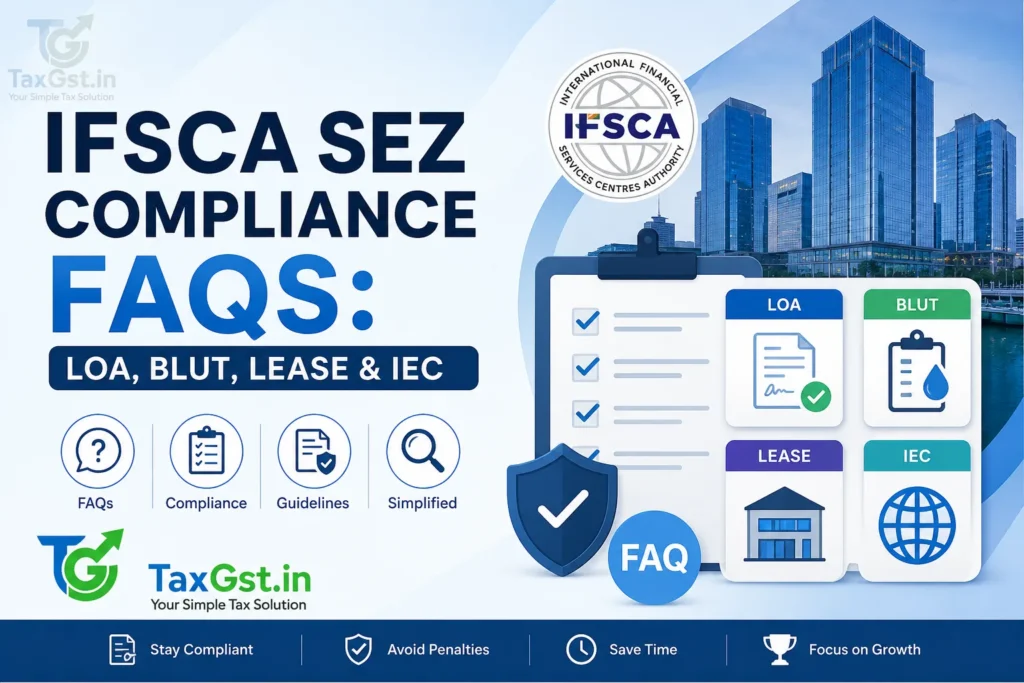
Every IFSC unit is automatically an SEZ unit under Section 18 of the SEZ Act, 2005, requiring strict dual compliance with both IFSCA regulations and the SEZ Rules, 2006. The Letter of Approval (LOA) under Rule 19 is the foundational document that authorizes specific operations. To avail of duty-free procurement benefits, units must execute a Bond-cum-Legal Undertaking (BLUT) under Rule 22, register their Lease Deed within six months, and file their Annual Performance Report (APR) in Form-I by September 30 every year.
Also Read-Financial Benefits for Senior Citizens in India: Higher Interest, Tax Breaks and Discounts
Quick Summary: IFSC & SEZ Compliance Checklist
- Every IFSC unit is deemed an SEZ unit by virtue of Section 18 of the SEZ Act, 2005.
- The Administrator (IFSCA) exercises Development Commissioner powers under Section 12(7) of the SEZ Act.
- LOA (Rule 19): Defines your authorized operations and must be kept valid at all times.
- BLUT (Rule 22): Mandatory for duty-free benefits. It can now be executed electronically (e-BLUT).
- Lease Deed (Rule 18(2)): A registered lease deed must be furnished to the Administrator within six months of LOA issuance.
- APR (Form-I): The Annual Performance Report must be filed within 180 days of the FY close (typically September 30).
- Foreign Remittances: Governed by Form 15CA/15CB under the Income-tax Act, 1961.
What Makes Every IFSC Unit an SEZ Unit?
Many practitioners mistakenly treat IFSCA registration and SEZ approval as separate, unrelated tracks. Under Section 18 of the SEZ Act, 2005, an International Financial Services Centre (IFSC) can be established only within a Special Economic Zone. This means every entity approved, licensed, or registered by IFSCA—whether a bank, a fintech startup, or an asset management company—is automatically an SEZ unit.
The SEZ Act, 2005 and SEZ Rules, 2006 therefore apply in full force. The unit must comply with both the IFSCA regulatory framework and the SEZ framework simultaneously. Non-compliance with SEZ conditions (such as failing to submit an APR) can jeopardize the IFSCA licence.
To streamline this dual compliance, Section 12(7) of the SEZ Act vests the powers of the SEZ Development Commissioner with an officer of the IFSCA designated as the “Administrator (IFSCA).” This unified structure means a single authority handles SEZ approvals, amendments, renewals, and exit proceedings for all GIFT-IFSC units.
How Does the LOA Process Work Through the SWIT Portal?
The Letter of Approval (LOA) under Rule 19 of the SEZ Rules, 2006 is the first mandatory milestone. No entity can commence operations in GIFT-IFSC without obtaining the LOA, and the IFSCA regulatory approval is strictly conditional upon it.
IFSCA has operationalized the Single Window IT System (SWIT) portal for this purpose. Applicants file a Common Application Form (CAF) for IFSCA regulatory approval. Section-D of the CAF specifically captures the SEZ LOA application. Once the CAF is signed using a Digital Signature Certificate (DSC), the LOA application is automatically pushed to the SEZ Online portal.
All further processing, including Unit Approval Committee (UAC) consideration and deficiency resolution, happens on the SEZ Online portal. For activities not yet fully enabled on SWIT (such as Foreign Universities and Bullion Trading), the LOA application must be filed directly on the SEZ Online portal using Form-FA.
The e-BLUT Process: Electronic Bond-cum-Legal Undertaking
The Bond-cum-Legal Undertaking (BLUT) under Rule 22 of the SEZ Rules, 2006 is the cornerstone document that binds a unit to its SEZ obligations, including the requirement to achieve positive Net Foreign Exchange (NFE). Until recently, this meant executing a physical deed on non-judicial stamp paper and securing a notary’s stamp.
Under the modernized e-BLUT regime, this process has been digitized. The BLUT can now be executed as an e-BLUT through e-stamping or other digital mechanisms aligned with ICEGATE. The requirement for physical stamp paper and manual notarization by a Notary Public has been dispensed with to reduce compliance friction.
| Aspect | Current E-BLUT Regime |
|---|---|
| Execution Mode | Electronic (e-BLUT) via e-stamp or digital mechanism |
| Notarization | Not required |
| Approval Authority | Jointly approved by the Specified Officer of Customs and Administrator (IFSCA) |
| Portal Filing | Direct filing of ‘New LUT’ request with signed PDF copy in SEZ Online portal |
Once the e-BLUT is filed through the SEZ Online portal, the Specified Officer and Administrator (IFSCA) approve it jointly. Upon approval, the bond amount and LUT validity dates are automatically updated in the unit’s profile, unlocking the unit’s ability to procure goods and services duty-free.
What Documents and Deadlines Apply for the Lease Deed (Rule 18)?
The registered Lease Deed is a statutory requirement with a hard deadline. Under Rule 18(2) of the SEZ Rules, 2006, every unit must furnish a copy of the registered Lease Deed to the Administrator (IFSCA) within six months from the date of LOA issuance. Missing this deadline triggers a condonation process that requires UAC approval.
| Requirement | Rule / Provision | Practical Detail |
|---|---|---|
| Deadline for Submission | Rule 18(2), SEZ Rules, 2006 | Six months from LOA issuance. |
| Minimum Lease Period | Rule 11(5), SEZ Rules, 2006 | Not less than five years; no upper limit prescribed. |
| Eligibility Certificate | Gujarat SEZ Act | Issued with approved BLUT; required for stamp duty exemption. |
When executing the Lease Deed, the unit must keep the certified copy of the LOA and the Eligibility Certificate ready. The Eligibility Certificate is necessary to claim State tax exemptions such as stamp duty relief under the Gujarat SEZ Act. Without it, the unit may face high upfront registration costs.
Foreign Remittances: Form 15CA & Form 15CB Compliance
IFSC units making remittances to non-residents or foreign companies must strictly comply with Rule 37BB of the Income-tax Rules, 1962. Before authorizing any foreign remittance, the unit must file Form 15CA on the Income Tax e-Filing portal.
If the remittance is chargeable to tax in India and exceeds ₹5 Lakhs in a financial year, the unit must first obtain a Chartered Accountant’s certificate in Form 15CB before filing Part C of Form 15CA. The CA will verify the applicability of Double Taxation Avoidance Agreements (DTAA) and ensure correct TDS is deducted under Section 195 of the Income-tax Act, 1961.
Failure to file Form 15CA before executing a foreign remittance attracts a severe penalty of ₹1 Lakh per default under Section 271I of the Income-tax Act, 1961. Furthermore, Authorised Dealer (AD) banks will not process SWIFT transfers for IFSC units without the Form 15CA acknowledgement.
What is the Deadline for Filing the Annual Performance Report (APR)?
After commencing operations, every unit must file its Annual Performance Report (APR) in Form-I to the Administrator (IFSCA) through the SEZ Online portal. As per Rule 22(3) of the SEZ Rules, 2006, the APR must be submitted within 180 days following the close of the financial year. This effectively means the deadline for any financial year is 30th September of the subsequent financial year.
The APR is not merely a formality. It captures the unit’s export performance, Net Foreign Exchange (NFE) earnings, employment data, and capital investment. A unit that fails to file the APR on time faces procedural hurdles at the time of LOA renewal and may be flagged for penal action by the Specified Officer.
What Happens If a Unit Fails to Maintain a Valid LOA?
On August 10, 2026, IFSCA issued a circular directing all regulated entities to maintain a valid and subsisting Letter of Approval (LOA) at all times. The LOA is a prerequisite for obtaining any IFSCA regulatory instrument — registration, licence, recognition, or authorisation — and for undertaking permissible activities in the IFSC.
LOAs carry prescribed validity periods (typically 5 years initially) and must be renewed in accordance with the SEZ Rules, 2006. Renewal applications must be submitted at least two months before expiry. Operating on an expired LOA constitutes a breach of the IFSCA Act, 2019, and the SEZ Act, 2005, inviting enforcement action, suspension of customs benefits, and the freezing of the unit’s SEZ Online portal access.
Frequently Asked Questions
What is the deadline for submitting the Annual Performance Report for an IFSC unit?
As per Rule 22(3) of the SEZ Rules, 2006, the unit must submit the APR (Form-I) to the Administrator (IFSCA) and the Specified Officer within 180 days following the close of the financial year. Effectively, the deadline is September 30th of the assessment year. Late submission affects the unit’s compliance rating and LOA renewal.
Can an IFSC unit carry on business activities without a valid LOA?
No. A valid LOA is a strict prerequisite for obtaining and maintaining any regulatory instrument under the IFSCA Act. Any violation constitutes a breach of both the IFSCA Act and the SEZ Act, 2005, inviting penal action and operational suspension. Renewal applications must be filed 2 months prior to expiry.
What income tax forms must an IFSC unit file before remitting money abroad?
An IFSC unit making a foreign remittance must comply with Rule 37BB of the Income-tax Rules, 1961 by filing Form 15CA on the Income Tax portal. If the remittance is taxable and exceeds ₹5 Lakhs, a Chartered Accountant’s certificate in Form 15CB is also mandatory. Failure to file attracts a ₹1 Lakh penalty under Section 271I.
What is the minimum lease period required for an IFSC unit under the SEZ Rules?
As per Rule 11(5) of the SEZ Rules, 2006, the lease deed period shall not be less than five years. The unit must furnish a copy of the registered lease deed to the Administrator (IFSCA) within six months from the issuance of the LOA under Rule 18(2).
How does a unit update its IEC details in the SEZ Online portal?
Once the DGFT issues the Importer-Exporter Code (IEC), the unit must file a ‘Free Form — IEC Application’ request in the SEZ Online portal and attach the PDF copy of the IEC Certificate. Upon approval, the IEC is automatically updated in the unit’s SEZ profile, allowing customs clearances.
Sources & References
- SEZ India — Official SEZ Rules, 2006 and Amendments
- Income Tax E-Filing Portal — Form 15CA/15CB FAQs
- IFSCA Circular — Requirement to Maintain Valid LOA
Article Information
Published: August 23, 2026
Last Reviewed: August 23, 2026
Category: Corporate Compliance
Regulatory Bodies: IFSCA & Department of Commerce (SEZ Division)
Written by C.K. Gupta, M.Com & Tax Editor at TaxGST.in — assisting banking units and corporate entities with dual SEZ-IFSCA compliance, LOA renewals, and cross-border taxation since 2009.
Official Resources
Disclaimer: This article provides a general overview of SEZ compliance for units operating in GIFT-IFSC. Procedural guidelines on the SWIT portal and SEZ Online portal undergo frequent updates. Always consult a practicing Company Secretary or SEZ consultant for specific operational approvals and condonation requests.
Try the free GST calculator for instant figures.
Discover more from TaxGst.in
Subscribe to get the latest posts sent to your email.

Never Miss a Tax Deadline Again
Due-date alerts, GST updates and tax tips — free on the app you already use.
event Next: TDS Return (138 / 140) · 31 Oct