
 C.K. Gupta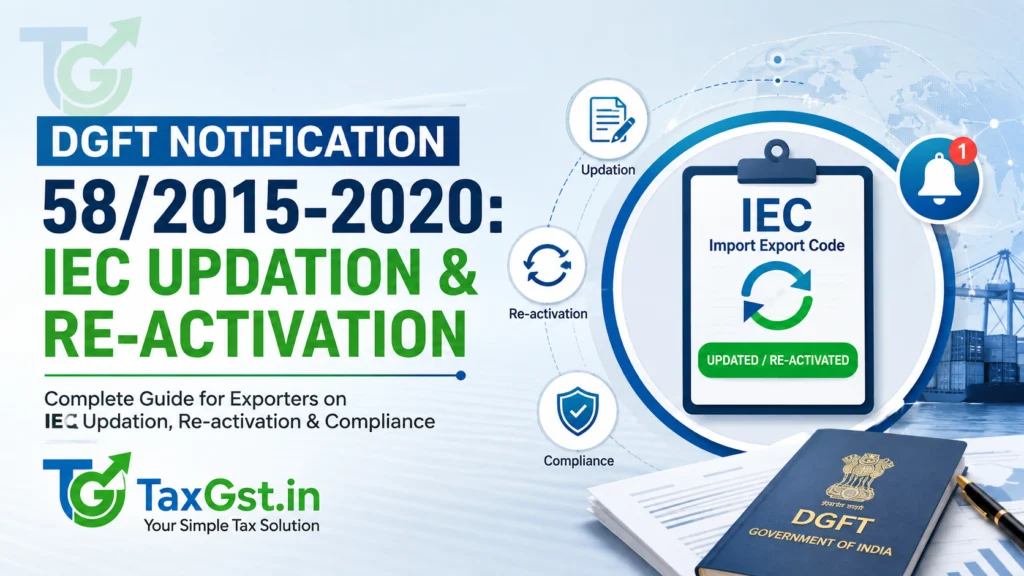
Quick Answer: As per Notification No. 58/2015-2020 dated 12.02.2021, every IEC holder must electronically update and confirm their Importer-Exporter Code (IEC) details annually on the DGFT portal during the April-June period — even if there are no changes. Failure to do so results in the automatic de-activation of the IEC, blocking all import and export activities at Customs until a successful online updation is completed.
Also Read-Import Duty Calculator India: BCD + IGST + Cess + SWS on Foreign Goods Step-by-Step Guide
Quick Summary: What Are the Key Requirements for IEC Holders?
- Mandatory Annual Updation: Every IEC holder must update or confirm IEC details online during April-June each year, as per para 2.05(d) of the Foreign Trade Policy inserted by Notification No. 58/2015-2020 dated 12.02.2021.
- No Change? Still Must Confirm: Even if there is zero change in IEC particulars, online confirmation is compulsory — silence is not treated as compliance.
- De-activation is Automatic: As per para 2.05(e) of the FTP, an IEC that is not updated within the prescribed time stands de-activated without further notice.
- Auto Re-activation Available: De-activated IECs can be re-activated automatically upon successful online updation — no manual intervention or visit to DGFT RA is required.
- Phased De-activation Continues: DGFT initiated phase-wise de-activation of non-updated IECs in 2021-2022. This automated process of de-activation for non-compliance is ongoing every financial year.
What Exactly Did Notification No. 58/2015-2020 Change for IEC Holders?
Before February 2021, an IEC once issued was valid for a lifetime with no periodic compliance requirement. That changed fundamentally when the Central Government, exercising powers under Section 3 of the FT(D&R) Act, 1992, issued Notification No. 58/2015-2020 dated 12.02.2021 to amend Chapter-1 and Chapter-2 of the Foreign Trade Policy.
The notification inserted two critical new sub-paragraphs under para 2.05. First, para 2.05(d) mandates that every IEC holder must ensure details in the IEC are updated electronically every year during the April-June period. Crucially, even where there are no changes in IEC details, the same must be confirmed online. This means a nil confirmation is mandatory — you cannot simply ignore the window.
Second, para 2.05(e) provides the consequence: an IEC shall be de-activated if it is not updated within the prescribed time. The de-activated IEC may be activated only upon successful updation. This re-activation is without prejudice to any other action taken for violation of any other provisions of the FTP. Additionally, an IEC may be flagged for scrutiny by the system, and the IEC holder must timely address any flagged risk — failure to do so also leads to de-activation.
The notification also streamlined the issuance process. The application for an e-IEC can now be made directly on the DGFT web portal at https://www.dgft.gov.in, and the entire process — including updation — is completely online as per the amended para 2.05(c).
Why Was the Updation Window Extended Beyond June 2021?
The original requirement under para 2.05(d) set the annual updation window as April-June. However, recognising that this was the first year of implementation and many IEC holders had not yet complied, the DGFT issued two specific extension notifications.
Notification No. 11/2015-2020 dated 01.07.2021 extended the period for the year 2021-22 only till 31st July 2021, and no fee was charged for modifications carried out during July 2021. When representations continued to pour in from IEC holders who had still not updated, Notification No. 16/2015-2020 dated 09.08.2021 further extended the deadline till 31st August 2021, with a fee waiver for August 2021 updations as well.
These extensions were explicitly for the year 2021-22 only. The underlying rule — annual updation during April-June — remains the standing statutory requirement. IEC holders should not expect automatic extensions every year. Compliance within the standard April-June window is the strict responsibility of every IEC holder.
How Does the Phased De-activation Process Impact Your Business Operations?
The DGFT did not stop at mandating annual updation — it backed the rule with a concrete enforcement mechanism through phase-wise de-activation. Trade Notice 18/2021-22 dated 20.09.2021 initiated the first wave, targeting IECs not updated after 01.01.2005 for de-activation from 06.10.2021, and IECs not updated after 01.01.2014 for de-activation from 06.12.2021. This was followed by Trade Notice 31/2021-22 dated 14.01.2022, which launched the third phase — de-activating all IECs not updated after 01.07.2020 with effect from 01.02.2022.
The practical consequence is severe. Once an IEC is de-activated, no import or export activity can be carried out. Customs systems will reject any bill of entry or shipping bill linked to a de-activated IEC. For businesses running on tight delivery schedules — especially those dealing in perishable goods, time-sensitive exports, or just-in-time manufacturing imports — a de-activation can mean cancelled orders, penalty clauses in client contracts, and reputational damage that far exceeds the effort required for a five-minute online updation.
Phased De-activation Timeline Under DGFT Trade Notices
| Phase | Trade Notice Reference | Cut-off Date for Last Updation | Effective De-activation Date | Interim Window to Update |
|---|---|---|---|---|
| Phase 1 | Trade Notice 18/2021-22 | IECs not updated after 01.01.2014 | 06.12.2021 | Till 05.12.2021 |
| Phase 2 | Trade Notice 18/2021-22 | IECs not updated after 01.01.2005 | 06.10.2021 | Till 05.10.2021 |
| Phase 3 | Trade Notice 31/2021-22 | IECs not updated after 01.07.2020 | 01.02.2022 | Till 31.01.2022 |
A critical relief provision runs through all phases: any IEC where an online updation application has already been submitted but remains pending with the DGFT Regional Authority for approval is excluded from the de-activation list. This means if you have filed your updation and it is stuck in processing, your IEC will not be de-activated. However, you should not rely on this as a strategy — file your updation well before the interim deadline closes.
What Is the Financial Cost of Missing the Updation Window?
Consider a practical scenario. A textile exporter in Tirupur holds an IEC that was last updated in March 2020. The proprietor overlooks the April-June window. By July, the IEC stands de-activated under para 2.05(e). The business has a confirmed export order worth ₹42 lakh to a buyer in Germany with a shipment deadline of 15th August. Because the IEC is de-activated, the shipping bill cannot be generated on the ICEGATE portal.
The exporter rushes to update the IEC online on 5th August. Upon successful updation, the IEC is re-activated automatically — but the re-activation transmission to the Customs system takes 24-48 hours. The shipment misses the vessel deadline. The German buyer imposes a 15% penalty clause — a direct loss of ₹6.3 lakh. Add to this the air freight cost of ₹2.8 lakh incurred to meet a renegotiated delivery date, and the total financial impact exceeds ₹9 lakh — all for failing to spend ten minutes on the DGFT portal during April-June.
This is not a hypothetical edge case. It is the exact sequence of events that plays out across thousands of small and medium exporting units every year. The updation itself carries no fee — as per Notification No. 58/2015-2020, no user charges are borne by the IEC holder for annual updation. The cost of non-compliance, however, is unbounded and can cascade through your entire supply chain.
What Documents and Details Must You Keep Ready Before Starting IEC Updation?
The IEC updation process on the DGFT portal is designed to be self-certification based, but this does not mean you can walk in unprepared. Before you log in to https://www.dgft.gov.in, ensure you have the following particulars verified and ready for entry or confirmation.
First, the PAN of the individual or business entity linked to the IEC must be active and correctly recorded. Second, the registered office address must be current — if your business has shifted premises since the last IEC record, have the new address proof ready. Third, a valid bank account in the name of the business entity must be linked, as DGFT cross-verifies banking particulars. Fourth, the details of the proprietor, partners, directors, or authorised signatory must be up to date — including their PAN, Aadhaar, and current contact information.
For the actual online process, after logging into the DGFT portal, navigate to the ‘Update/Modified IEC’ option. A tab will display your existing IEC details across multiple heads. If there is nothing to change, you must still open each head, verify the information, and save it. Only after every section is individually saved can you proceed to the application summary. To submit the summary, you must attach the Digital Signature Certificate (DSC) of the authorised representative. Without a valid DSC, the submission will not be accepted.
Who Exactly Is Required to Complete Annual IEC Updation — Are There Any Exemptions?
The mandate is broad and unambiguous. As per para 2.05(d) of the Foreign Trade Policy, every IEC holder — whether an individual proprietor, partnership firm, LLP, private limited company, public limited company, trust, or society — must update or confirm IEC details annually during the April-June period. There is no threshold-based exemption. A one-person consulting firm that obtained an IEC five years ago but has not executed a single import or export transaction since is equally obligated to comply.
A common misconception among small traders and occasional exporters is that an IEC that has been ‘dormant’ does not need maintenance. This is incorrect. Para 2.05(e) does not distinguish between active and dormant IECs — de-activation applies to any IEC not updated within the prescribed time. If you hold an IEC and intend to keep it available for future use, annual updation is the minimum compliance you must maintain.
For entities that have undergone structural changes — such as conversion from proprietorship to private limited company, change in directorship, or merger — the IEC details must reflect the current legal status. In such cases, the updation is not merely a confirmation of existing details but an active modification. Ensure that supporting legal resolutions, updated MOA/AOA or partnership deeds, and revised bank authorisations are in place before initiating the modification on the portal.
What Is the Difference Between De-activation and Cancellation of an IEC?
Many IEC holders confuse de-activation with cancellation, but the two have distinct legal consequences. De-activation under para 2.05(e) is a temporary status triggered by non-updation — it is reversible automatically upon successful online updation without any manual intervention. The IEC number remains the same, and upon re-activation, it is transmitted to the Customs system with updated status.
Cancellation, on the other hand, is a punitive action taken for violations of the Foreign Trade (Development and Regulation) Act, 1992 or other provisions of the FTP. Cancellation is not automatic — it follows an adjudication process. An IEC can be de-activated for non-updation and simultaneously face cancellation proceedings for, say, the declaration of false export values or the misuse of scrip benefits.
This distinction is particularly relevant in edge cases, such as the death of a proprietor. Under the IEC framework, a proprietorship firm’s IEC is linked directly to the proprietor’s PAN. When the proprietor dies, the IEC does not automatically transfer to the legal heir. The legal heir must first apply for transmission of the IEC on the DGFT portal, submit the death certificate and legal heir certificate, and then complete the annual updation. Until this process is finished, the IEC remains de-activated and no import or export can be undertaken.
How do De-activation, Cancellation, and Scrutiny Flags Differ for IECs?
| Parameter | De-activation (Non-Updation) | Cancellation (Violation) | Scrutiny Flag |
|---|---|---|---|
| Trigger | Failure to update IEC during April-June as per para 2.05(d) of the FTP | Violation of FT(D&R) Act, 1992 or FTP provisions | System-detected risk (e.g., mismatch in PAN, address, or bank details) |
| Reversibility | Automatic upon online updation | Only through appeal or fresh application | After addressing flagged risk with DGFT RA |
| IEC Number | Remains unchanged | Fresh IEC required after cooling period | Remains unchanged if resolved timely |
| Timeline for Resolution | 24-48 hours after updation for Customs transmission | 6-12 months through adjudication | Variable — depends on nature of flag |
What Are the Hidden Pitfalls Even After Successful Updation?
Even after an IEC holder completes the annual updation, certain pitfalls persist. First, the re-activation is not instantaneous at the Customs end. While the DGFT portal reflects the updated status immediately, the transmission to the ICEGATE/Customs system takes 24-48 hours. Exporters with shipments scheduled the next day after updation have faced rejection of shipping bills because the Customs system had not yet received the active status.
Second, if your IEC has been flagged for scrutiny by the system, mere updation will not suffice. The scrutiny flag requires the IEC holder to respond to the DGFT Regional Authority with supporting documents. Until the flag is cleared, the IEC remains de-activated regardless of updation compliance. Third, for partnership firms, any change in the constitution of the firm or a change that results in a new PAN requires a fresh IEC application, not merely an updation.
What Should You Do Next?
- Verify your IEC status today: Log in to the DGFT portal and confirm whether your IEC is active. If it shows de-activated, initiate updation immediately to resume import-export operations.
- Mark the April-June window permanently: Block the first week of April every year on your compliance calendar for IEC updation. This is an annual obligation under the Foreign Trade Policy.
- Confirm nil changes without fail: If your IEC details have not changed, you must still log in and submit a nil confirmation. Silence is treated as non-compliance.
- Keep your DSC active and accessible: The updation summary on the DGFT portal requires a digital signature certificate for submission. Ensure the DSC of the authorised representative is valid before you begin the process.
- Address flagged risks immediately: If the system flags your IEC for scrutiny — often due to mismatch in PAN details or bank account — resolve the discrepancy promptly with the Regional Authority.
Frequently Asked Questions
Is annual IEC updation mandatory even if there are no changes in my business details?
Yes. As per para 2.05(d) of the Foreign Trade Policy, every IEC holder must update details electronically every year during the April-June period. In cases where there are no changes, a nil confirmation is compulsory — the system does not treat inaction as compliance. Failure to confirm will result in de-activation.
What happens if I fail to update my IEC during the April-June period?
Your IEC will be de-activated automatically. Once de-activated, no import or export activity can be carried out. Customs systems (ICEGATE) will reject any bill of entry or shipping bill linked to a de-activated IEC. The IEC can only be re-activated upon successful online updation.
Can a de-activated IEC be re-activated, and how long does it take?
Yes, a de-activated IEC can be re-activated automatically without any manual intervention or physical visit to the DGFT Regional Authority. You must update the IEC online, and upon successful submission, the IEC is activated again. However, the transmission to the Customs system typically takes 24-48 hours, so plan your shipments accordingly.
Is there any fee for updating IEC details on the DGFT portal?
For the annual updation conducted during the April-June period, no user charges are borne by the IEC holder. For modifications outside the annual window or for specific changes that attract a fee as per the Handbook of Procedure, standard charges may apply.
What happens to goods already shipped if the IEC gets de-activated while a consignment is in transit?
Consignments already cleared and in transit before the de-activation date typically continue without interruption. The critical risk applies to pending clearances — if your IEC is de-activated before the bill of entry is filed or the shipping bill is generated, the clearance is blocked until re-activation completes.
Article Information
Published: August 10, 2026
Last Reviewed: August 10, 2026
Category: Customs & Foreign Trade
Regulatory Body: Directorate General of Foreign Trade (DGFT)
Written by C.K. Gupta, M.Com & Tax Editor at TaxGST.in — assisting exporters with DGFT compliance, Foreign Trade Policy, and IEC registration workflows since 2009.
Official Resources
Disclaimer: This article is for informational purposes only. Export-import policies and portal workflows change frequently. Always refer to the official DGFT notifications and ensure your Digital Signature Certificate (DSC) is active before attempting to modify your IEC records.
Try the free income tax calculator for instant figures.
ITR, GST returns, notices and registrations — fixed fees, human support, on-time filing.
Discover more from TaxGst.in
Subscribe to get the latest posts sent to your email.


Never Miss a Tax Deadline Again
Due-date alerts, GST updates and tax tips — free on the app you already use.
event Next: GSTR-1 (IFF) · 13 Oct