
 C.K. Gupta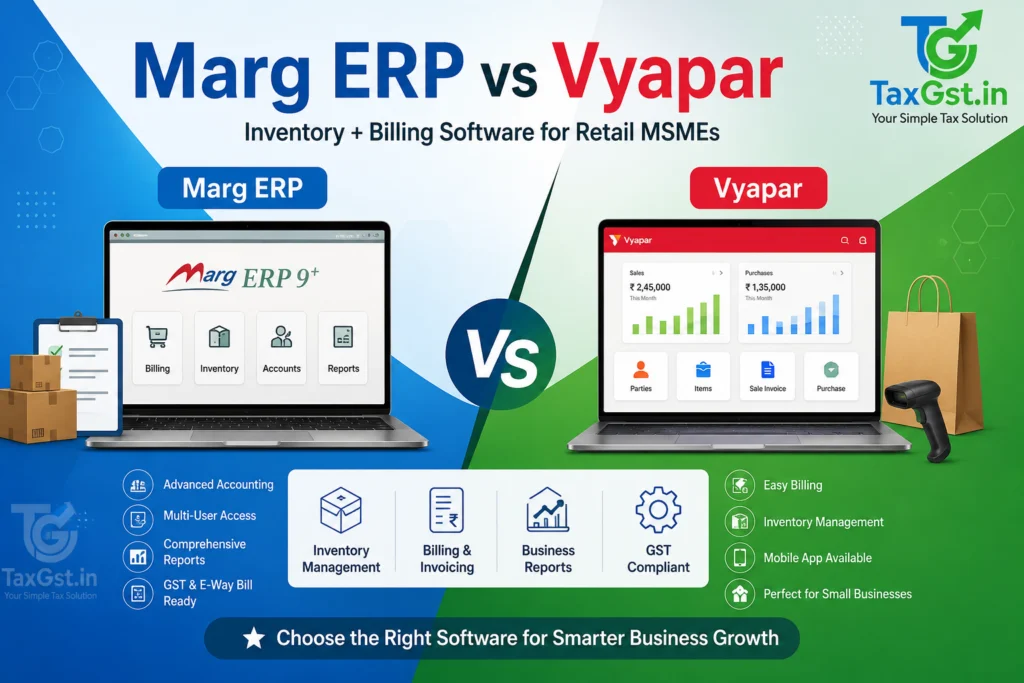
Marg ERP and Vyapar serve fundamentally different retail and distribution profiles. Marg ERP is an enterprise-grade solution built for multi-location distributors, pharmacies, and FMCG wholesalers who require strict inventory batch tracking, FEFO dispatch logic, and multi-GSTIN consolidation. Conversely, Vyapar is a mobile-first, user-friendly billing application designed for single-location retail shops and independent service providers who prioritize rapid invoicing and basic stock management over complex supply chain workflows. Your software selection must align directly with your daily transaction volume, tax audit disclosure requirements, and MSME compliance obligations.
Also Read-ITR Filing Guide: How To Report NSC and Kisan Vikas Patra Interest
Quick Summary
- Marg ERP targets heavy-volume distributors with features like batch-wise expiry tracking, multi-branch inventory, and comprehensive statutory reporting.
- Vyapar focuses on retail shop owners needing fast GST invoicing, barcode scanning, thermal printer integration, and simplified stock tracking without accounting jargon.
- Both platforms support e-invoicing compliance for businesses with an Aggregate Annual Turnover (AATO) exceeding ₹5 crore, allowing direct Invoice Reference Number (IRN) generation.
- Compliance with Section 43B(h) of the Income-tax Act requires strict tracking of 45-day payment cycles to MSME vendors—a feature natively handled by Marg but difficult to automate in Vyapar.
- Tax audit reporting under Clause 14 of Form 3CD requires businesses to formally disclose the name and server location of their accounting software, elevating software selection from an operational choice to a strict statutory compliance matter.
Marg ERP vs. Vyapar: Feature-by-Feature Comparison for Retail MSMEs
| Comparison Parameter | Marg ERP | Vyapar |
|---|---|---|
| Target Business Scale | Multi-location distributors, wholesalers, pharmacies, and large retail chains | Single-location retail shops, small traders, and service providers |
| Primary Architecture | Desktop-first (On-premise) with local database and cloud backup options | Mobile and desktop hybrid cloud-sync application |
| Inventory & Batch Control | Advanced batch-wise expiry, serial number tracking, and FEFO dispatch logic | Standard stock quantity tracking with basic item variants (size, color) |
| Multi-GSTIN & Branch Support | Native multi-branch consolidation and centralized warehouse management | Primarily single-GSTIN structure (multi-company requires separate files) |
| MSME 45-Day Tracking (Sec. 43B(h)) | Automated vendor tagging, ageing buckets, and compound interest computation | Basic overdue notification without statutory MSME classification |
| E-Invoicing & IRP Integration | Direct bulk API integration across all authorised IRP portals | Direct API integration for single invoice generation |
| User Learning Curve | Steeper; designed for accountants and distribution managers | Very low; built for non-accountant shop owners and cashiers |
Evaluating Inventory Complexity: Batch Tracking vs. Basic Stock
The most significant divergence between Marg ERP and Vyapar lies in their inventory architecture. Retail MSMEs evaluating these two platforms must first audit their supply chain requirements. Businesses operating in regulated sectors—such as pharmaceuticals, chemicals, FMCG, or perishable food goods—are legally required to maintain strict traceability of their products. This involves recording manufacturing dates, expiry dates, and specific batch numbers upon inward supply, and ensuring those exact batches are deducted from inventory upon outward supply.
Marg ERP is specifically engineered for this level of granularity. It employs First Expiry First Out (FEFO) dispatch logic, automatically preventing the billing of expired stock and alerting operators when inventory approaches its expiration date. Furthermore, Marg supports multiple units of measurement (e.g., purchasing in cases, selling in individual strips or strips and tablets) and manages multi-godown transfers natively.
Vyapar, conversely, utilizes a simplified, flat inventory structure. It is highly effective for hardware stores, mobile shops, apparel retailers, and general merchants who only need to track item quantities and variants (like size or color). While Vyapar allows users to define custom item fields and utilize barcode scanning for fast checkout, it does not enforce the rigid, batch-level accounting constraints that wholesale distributors require. If a business needs to trace a specific defective product back to a supplier’s original invoice using a batch code, Vyapar will require manual intervention, whereas Marg will generate a traceability report instantly.
How Does Software Selection Impact Tax Audit Reporting Under Form 3CD?
Software selection is no longer a purely internal operational decision; it is a statutory disclosure. Clause 14 of the tax audit report (Form 3CD), as amended by CBDT Notification No. 28/2021 and operationalized for recent assessment years, fundamentally changes how auditors interact with client IT systems. The clause requires tax auditors to explicitly disclose the name of the accounting software used by the assessee for maintaining books of accounts.
Crucially, if the books are maintained in a cloud environment, the auditor must report the name of the cloud storage provider, the location of the servers, the IP address, and the country where the data resides. This aligns with Section 128 of the Companies Act, 2013, read with Rule 3 of the Companies (Accounts) Rules, 2014, which mandates that books of account maintained in electronic mode must remain accessible in India at all times, with periodic backups retained on servers physically located within Indian jurisdiction.
Marg ERP is predominantly deployed as an on-premise (desktop-based) solution, meaning the data resides on the MSME’s local hard drives or local area network servers, simplifying the physical location disclosure. When utilizing Marg’s cloud backup features, the data is encrypted and stored locally. Vyapar operates as a hybrid application with strong cloud synchronization features to allow cross-device usage (mobile and desktop). When evaluating Vyapar or any cloud-sync billing tool, MSMEs must obtain written confirmation from the vendor that the primary data storage and backup servers reside in Indian data centers. Failing to provide this infrastructure detail to your auditor will result in an adverse qualification in the final tax audit report.
MSME Vendor Payment Compliance: Navigating Section 43B(h) and the MSMED Act
Recent amendments to the Income-tax Act have aggressively tightened the payment cycles between buyers and micro/small enterprises. Section 43B(h) of the Income-tax Act dictates that any sum payable by an assessee to a micro or small enterprise beyond the time limit specified in Section 15 of the Micro, Small and Medium Enterprises Development (MSMED) Act, 2006, shall be allowed as a deductible business expense only in the previous year in which the sum is actually paid.
Section 15 of the MSMED Act caps the maximum agreed payment period at forty-five days from the day of acceptance of goods or services. If there is no written agreement, the default payment period is fifteen days. If an MSME buyer fails to pay a micro or small supplier within this window, the expense is disallowed for that financial year, artificially inflating the buyer’s taxable income and resulting in an immediate cash outflow for income tax. Furthermore, Section 16 imposes a mandatory, non-deductible interest penalty at three times the prevailing RBI bank rate, compounded monthly.
To manage this immense compliance risk, the accounting software must actively track vendor classifications and age payables specifically against the 15/45-day statutory deadlines. Marg ERP includes dedicated MSME vendor tagging at the ledger level. Its accounts payable module generates distinct ageing analysis reports that flag invoices approaching the threshold and auto-computes the required penal interest for delayed payments. This data directly feeds into the MCA Form MSME-1 half-yearly returns.
Vyapar offers basic vendor ageing and outstanding payable reports but lacks automated statutory MSME classification and interest computation algorithms. Retailers using Vyapar must manually export their payables to Excel, cross-reference vendor Udyam Registration certificates to determine micro/small status, and manually calculate the 45-day limits and compound interest obligations. For a business processing hundreds of purchase invoices monthly, this manual workflow creates a high probability of tax disallowance under Section 43B(h).
E-Invoicing and IRP Integration: Managing the 30-Day Upload Window
Under GST regulations, e-invoicing is mandatory for all registered businesses whose Aggregate Annual Turnover (AATO) exceeded ₹5 crore in any preceding financial year from 2017-18 onwards. These businesses must generate an Invoice Reference Number (IRN) and a dynamic QR code from the Invoice Registration Portal (IRP) for every B2B transaction and export invoice. Additionally, a strict compliance window dictates that taxpayers with an AATO of ₹10 crore and above must report their invoices to the IRP within 30 days of the invoice date; invoices older than 30 days are rejected by the portal, denying the recipient their Input Tax Credit.
| E-Invoicing & GST Capability | Marg ERP | Vyapar |
|---|---|---|
| IRP API Integration | Direct API linkage with all 6 authorised IRP portals | Direct API linkage available on premium plans |
| Bulk Invoice Generation | Automated batch processing for hundreds of invoices | Primarily designed for single-invoice generation |
| 30-Day Window Alert (AATO > ₹10 Cr) | Proactive dashboard notification with escalation alerts | No automated deadline alert mechanism |
| Invoice Series Auto-Reset (1 April) | Automatic reset per GSTIN per Rule 46 requirements | Manual configuration required by the user |
| GSTR-1 & GSTR-3B Generation | Direct JSON export and API filing capability | JSON export available for offline utility |
Marg ERP handles heavy B2B invoice loads effectively by automating bulk IRN requests through direct API integration with multiple IRPs. If an IRP server goes down, Marg can route the request to an alternate portal. Crucially, Marg maintains the statutory requirement under Rule 46 of the CGST Rules, 2017, by automatically resetting the sequential invoice numbering series at the beginning of each financial year (April 1st). Failure to reset this sequence creates duplicate invoice errors on the GST portal.
Vyapar offers functional e-invoicing for small businesses directly from its mobile or desktop interface. When a user creates a B2B bill, Vyapar connects to the IRP, fetches the IRN and QR code, and embeds it on the final PDF. However, users must remember to manually adjust their invoice prefixes or starting numbers at the beginning of a new financial year to comply with Rule 46.
Handling Multi-Branch Operations and ISD Registration
For MSMEs operating across state borders, holding multiple GSTINs mapped to a single Permanent Account Number (PAN) creates heavy reconciliation burdens. Marg ERP addresses this through native multi-branch consolidation. A head office can view consolidated profit and loss statements while generating distinct GSTR-1, GSTR-2B, and GSTR-3B reports for each state-specific GSTIN. This architecture is vital for businesses executing stock transfers between their own branches (which qualify as taxable supplies under Schedule I of the CGST Act) or managing Input Service Distributor (ISD) registrations to distribute common input tax credits.
Vyapar operates on a fundamentally different architecture, designed primarily around single-GSTIN management. While a user can manage multiple companies within the app, consolidating their financial data requires external manual aggregation. Vyapar excels in its intended environment: a standalone retail store, a single-location pharmacy, or an independent service contractor. If an enterprise requires centralized control over pricing, inventory movements between warehouses, and consolidated tax liabilities, a full ERP like Marg is mathematically necessary to prevent compliance errors.
The Free Software Alternative: GST Portal Utility
When evaluating software costs, MSMEs should also consider government-provided alternatives. The GST Network (GSTN) offers free accounting and billing software specifically targeted at taxpayers with an annual turnover below ₹1.5 crore. This utility allows users to maintain sale and purchase ledgers, manage basic inventory, generate standard GST invoices, and prepare statutory returns.
However, the utility serves as a baseline tool. It lacks the advanced features critical for growth, such as FEFO batch tracking, barcode generation, thermal printer integration for fast retail checkout, API-based e-way bill generation, and the automated statutory logic required for MSMED Act tracking. Furthermore, once an MSME crosses the ₹1.5 crore turnover threshold during a financial year, they lose eligibility for the free tier and are subjected to the standard commercial licensing fees of the partnered software vendors. Consequently, businesses with aggressive growth projections typically implement Marg or Vyapar early to avoid painful data migrations mid-year.
What Should You Do Next?
- Conduct an inventory audit. If your business handles perishable goods, pharmaceuticals, or items requiring strict batch and expiry management, Marg ERP provides the necessary compliance framework. For general apparel, electronics, or hardware without expiry dates, Vyapar offers sufficient tracking.
- Review your accounts payable cycle. If you routinely purchase from MSME manufacturers or service providers, verify how you will track the 45-day payment limit to comply with Section 43B(h) of the Income-tax Act and avoid major tax disallowances.
- Confirm your Aggregate Annual Turnover (AATO). If it exceeds ₹5 crore, ensure that the specific software plan you select includes direct API integration with the Invoice Registration Portal (IRP) for automated e-invoicing.
- If registering as a Private Limited Company, formally request documentation from the vendor proving that their software maintains an immutable Edit Log as required by the Ministry of Corporate Affairs.
- Request written server location documentation from cloud-based vendors to supply to your auditor, ensuring compliance with the disclosure requirements of Clause 14 of Form 3CD.
Frequently Asked Questions
When does e-invoicing become mandatory for my business in FY 2026-27?
E-invoicing is mandatory for businesses with an Aggregate Annual Turnover (AATO) exceeding ₹5 crore in any preceding financial year from FY 2017-18 onwards. If your AATO crossed this threshold in FY 2025-26, the mandate applies immediately. You must register on the Invoice Registration Portal before generating your first e-invoice. For taxpayers with an AATO of ₹10 crore and above, there is a strict 30-day reporting window for uploading invoices to the IRP from the invoice date, beyond which the portal rejects them and your buyer loses their Input Tax Credit (ITC).
How does delayed payment to MSME vendors affect my income tax and compliance obligations?
Under Section 15 of the MSMED Act, 2006, the maximum agreed payment period is 45 days. If you exceed this, Section 16 imposes compound interest at three times the RBI bank rate. Crucially, under Section 43B(h) of the Income-tax Act, payments made to micro and small enterprises beyond this statutory limit are disallowed as business expenses in the current financial year, significantly increasing your tax liability. Marg ERP automates these tracking and interest computations, while Vyapar requires manual oversight.
What tax audit disclosures are required for accounting software under Form 3CD?
Clause 14 of the tax audit report (Form 3CD) requires auditors to explicitly disclose the name of the accounting software used. Furthermore, it mandates the disclosure of the name of the cloud storage provider, and the IP address and country where the data storage servers are located. This ensures compliance with Indian corporate laws requiring books of account to remain accessible in India at all times.
Can Vyapar handle batch-wise inventory tracking for pharmacies or FMCG retailers?
Vyapar offers efficient stock quantity tracking but lacks native batch number allocation, expiry date monitoring, and First Expiry First Out (FEFO) dispatch logic. Marg ERP includes dedicated batch-wise inventory masters essential for pharmacies, chemical distributors, and FMCG retailers handling regulated products. These businesses should avoid software that lacks batch-level traceability to maintain supply chain compliance.
How do Marg ERP and Vyapar compare for multi-GSTIN businesses operating across states?
Marg ERP provides native multi-GSTIN consolidation, allowing businesses with branches in multiple states to generate combined financial reports and branch-wise GST returns from a single dashboard. Vyapar operates primarily on a single-GSTIN architecture; managing multiple GSTINs requires separate datasets and manual consolidation, which drastically increases accounting overhead for distributed businesses.
Article Information
Published: August 8, 2026
Last Reviewed: August 8, 2026
Category: Business Software & ERP Compliance
Regulatory Bodies: CBIC & Ministry of Corporate Affairs
Written by C.K. Gupta, M.Com & Tax Editor at TaxGST.in — delivering technical insights on business software implementation, tax audits, and GST compliance workflows since 2009.
Official Resources
Disclaimer: This article provides a technical comparison based on currently available software features and statutory requirements. Software capabilities, pricing, and tax regulations (such as Section 43B(h) and Form 3CD disclosures) are subject to continuous updates. Always engage your Chartered Accountant and utilize free trial periods to test software against your specific business data before purchasing a license.
Discover more from TaxGst.in
Subscribe to get the latest posts sent to your email.



Never Miss a Tax Deadline Again
Due-date alerts, GST updates and tax tips — free on the app you already use.
event Next: GSTR-1 (IFF) · 13 Oct