
 C.K. Gupta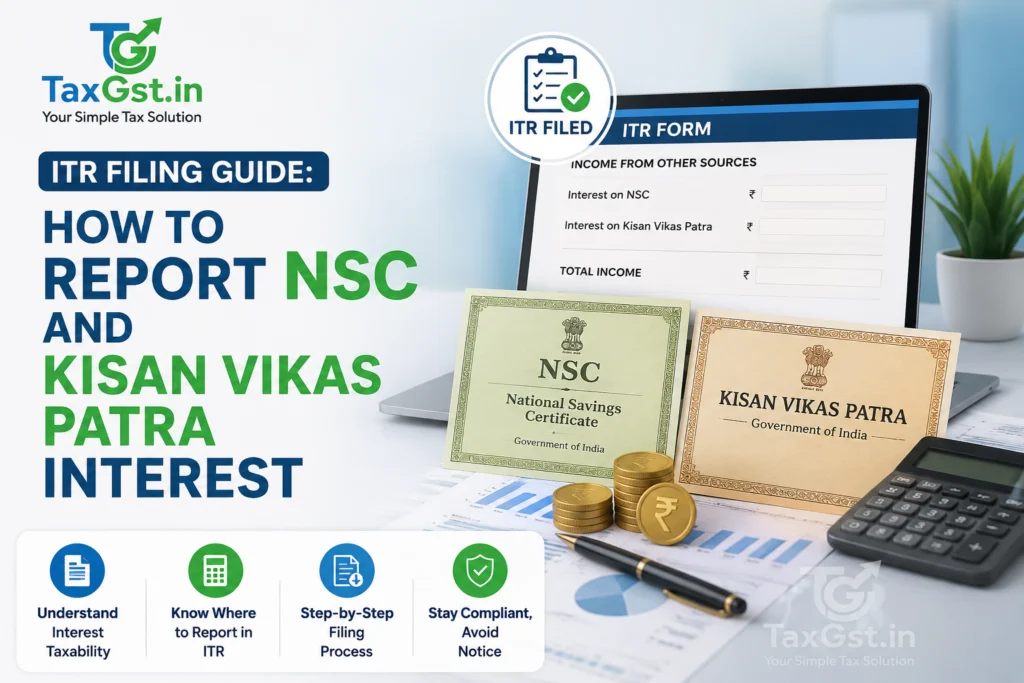
Interest earned on National Savings Certificate (NSC) and Kisan Vikas Patra (KVP) must be reported under the “Income from Other Sources” head in your ITR every financial year on an accrual basis, even though the amount is received only at maturity. NSC investment and accrued interest (except in the year of maturity) are eligible for Section 80C deduction, while KVP interest carries no such deduction and is fully taxable each year.
Quick Summary
- NSC VIII Issue carries an interest rate of 7.7% per annum for Q1 FY 2026-27 (April–June 2026), compounded annually but payable at maturity, as per the Office Memorandum F.No.1/4/2019-NS dated 30.03.2026 issued by the Ministry of Finance, Department of Economic Affairs.
- Kisan Vikas Patra (KVP) offers 7.5% per annum for Q1 FY 2026-27 (April–June 2026), with maturity in 115 months (9 years and 7 months), as per the Office Memorandum F.No.1/4/2019-NS dated 30.03.2026.
- NSC investment qualifies for deduction under Section 80C of the Income-tax Act, 1961, up to the prescribed ceiling. KVP investment does not qualify for any Section 80C deduction.
- Interest from both schemes is taxable under “Income from Other Sources” and must be declared annually on an accrual basis, not on a receipt basis.
- Reporting is done in Schedule OS (Other Sources) of ITR-2 or ITR-3, as applicable for the relevant Assessment Year, in accordance with Rule 12 of the Income-tax Rules, 1962.
How Do You Report NSC Interest in Your ITR?
NSC interest accrues each year even though you receive it only at maturity after 5 years. Under the Income-tax Act, this accrued income must be declared annually under the head “Income from Other Sources” in Schedule OS of your ITR.
From the second year of investment onwards, the accrued interest qualifies for deduction under Section 80C of the Income-tax Act, 1961, because the interest is treated as reinvested in the NSC. However, in the maturity year (Year 5), the final interest received is not eligible for Section 80C deduction since the total amount is being realised and withdrawn, not reinvested.
To report it, log in to the e-Filing portal at incometax.gov.in, navigate to e-File > Income Tax Returns > File Income Tax Return, select the appropriate Assessment Year, and fill Schedule OS under “Income from Other Sources.” Enter the accrued interest amount for the relevant financial year. If you are filing ITR-2, this schedule is available under Section 3.6 of the online filing flow as per the ITR-2 User Manual.
How Do You Report Kisan Vikas Patra Interest in Your ITR?
KVP interest is fully taxable every year on an accrual basis under “Income from Other Sources.” Unlike NSC, KVP does not qualify for any deduction under Section 80C, so the entire accrued interest each year adds to your taxable income.
The current KVP interest rate is 7.5% per annum for Q1 FY 2026-27 (April–June 2026), as per the Office Memorandum F.No.1/4/2019-NS dated 30.03.2026. The maturity period is 115 months (9 years and 7 months). Each financial year, calculate the interest accrued using annual compounding and report it in Schedule OS of your ITR.
KVP interest is not subject to Tax Deducted at Source (TDS) by the post office. Therefore, you will not find any TDS credit for KVP interest in your Form 26AS. The maturity proceeds themselves are not taxed again because the principal is your own capital and the interest has already been taxed on an accrual basis each year.
To report, use the same Schedule OS section in ITR-2 or ITR-3. Enter the gross interest accrued for the year. Verify the pre-filled data in your AIS against your own calculations to avoid a demand notice under Section 156.
What Are the Key Differences Between NSC and KVP Interest Taxation?
While both NSC and KVP are government-backed small savings schemes offered through post offices, their tax treatment differs significantly on three fronts: Section 80C eligibility, TDS applicability, and the timing of deduction claims. Understanding these differences prevents under-reporting and avoids scrutiny assessments.
NSC VIII Issue qualifies for deduction under Section 80C of the Income-tax Act, 1961, up to the prescribed ceiling of Rs. 1.5 lakh per financial year. Crucially, the accrued interest from the second year onwards is deemed reinvested and qualifies as a fresh 80C claim. However, in the fifth year — the maturity year — the final interest receipt does not qualify for 80C deduction because the principal and accumulated interest are being realised.
Kisan Vikas Patra offers no such benefit. The entire accrued interest each year is fully taxable under “Income from Other Sources” with zero deduction available under Section 80C. Unlike some other post office schemes, KVP interest is not subject to TDS.
Worked Example: Calculating Annual Accrual for NSC and KVP
Suppose you invested Rs. 1,00,000 in NSC VIII Issue on 1 April 2023 and Rs. 1,00,000 in KVP on the same date. Here is how the accrual works for FY 2026-27 (AY 2027-28):
NSC (7.7% p.a., compounded annually):
- Year 1 (FY 2023-24): Interest accrued = Rs. 7,700. This is added to the principal.
- Year 2 (FY 2026-27): Interest = Rs. 8,293 (7.7% on Rs. 1,07,700). Eligible for Section 80C.
- Year 3 (FY 2025-26): Interest = Rs. 8,932 (7.7% on Rs. 1,15,993). Eligible for Section 80C.
- Year 4 (FY 2026-27): Interest = Rs. 9,620 (7.7% on Rs. 1,24,925). Eligible for Section 80C. Report Rs. 9,620 in Schedule OS and claim deduction under Section 80C.
KVP (7.5% p.a., compounded annually):
- Year 4 (FY 2026-27): Opening balance = Rs. 1,24,327 (after 3 years of compounding). Interest accrued = Rs. 9,325 (7.5% on Rs. 1,24,327). The entire Rs. 9,325 is taxable in Schedule OS. No Section 80C deduction available.
In this example, for FY 2026-27, you would report a total of Rs. 18,945 (Rs. 9,620 + Rs. 9,325) under “Income from Other Sources” in Schedule OS of ITR-2. Against this, you can claim Rs. 9,620 as deduction under Section 80C for the NSC component. The KVP component of Rs. 9,325 offers no offset. Ensure your pre-filled AIS data matches these figures before submission to avoid a defective return notice.
What Documents Do You Need to Report NSC and KVP Interest in Your ITR?
Before you begin filing, gather the specific records that support your interest declaration. The Income-tax Department’s Annual Information Statement (AIS) now auto-populates small savings data, but you must verify these figures against your own documents.
For NSC, keep the following ready:
- NSC Certificate Number: If you hold a physical certificate, the number is printed on the certificate itself. For e-mode or passbook mode NSC purchased after 2016, log in to your post office internet banking or India Post Payments Bank app to retrieve the certificate number.
- Interest Computation Statement: Request an interest certificate from your post office showing the year-wise accrual. This is critical because NSC interest compounds annually and must be declared each year even though no cash is received.
- Previous Years’ ITRs: To claim Section 80C deduction on accrued interest from Year 2 onwards, you need to demonstrate that the interest was declared as income in the prior year.
For Kisan Vikas Patra, the documentation requirements differ slightly:
- KVP Identity Slip or Certificate: This contains the KVP serial number, investment amount, maturity date, and maturity value. If lost, you can apply for a duplicate by quoting the serial number.
- Interest Accrual Working: Prepare a year-wise interest computation using annual compounding at 7.5% p.a. The post office does not issue a separate interest certificate for KVP each year, so this working is your primary document.
How Do You Calculate the Accrued Interest for Each Financial Year?
Both NSC and KVP follow annual compounding, but the calculation method and tax treatment differ. You must compute the interest accrued in each financial year — not the total interest over the scheme’s tenure — because the Income-tax Act mandates accrual-based reporting.
For NSC VIII Issue (7.7% p.a. for Q1 FY 2026-27):
Use the compound interest formula: Interest = P × (1 + r/100)^n – P, where P is the opening balance (including previously accrued interest), r is 7.7%, and n is 1 year. For each financial year, calculate the difference between the closing balance and opening balance of that year. This difference is the accrued income to be reported in Schedule OS.
For Kisan Vikas Patra (7.5% p.a., maturing in 115 months):
Apply the same compound interest formula with r = 7.5%. KVP has a fixed maturity period of 115 months (9 years and 7 months). The final year’s accrual may span only a partial period if the purchase date does not align with 1 April. Calculate the exact interest for the period from the start of the financial year to the maturity date or 31st March, whichever is earlier.
Key calculation rules to remember:
- Year of Purchase: If you invested on 15 August 2026, the first year’s accrual covers the period from 15 August 2026 to 31 March 2027. The annual compounding interest will be calculated for this partial period.
- Maturity Year for NSC: In the fifth year, the final interest receipt does not qualify for Section 80C deduction. Report the full accrued interest in Schedule OS but do not include it in Schedule VI-A (deductions).
- Self-Assessment Tax for KVP: Since no TDS is deducted on KVP interest, you are responsible for paying the tax on the accrued interest as part of your self-assessment tax under Section 140A.
What Happens If You Miss Reporting NSC or KVP Interest in Earlier Years?
The Income-tax Department’s Annual Information Statement (AIS) now captures accrued interest data from post offices and banks for both NSC and KVP. If you have omitted declaring this income in any prior year, the AIS will show a mismatch, and the system may issue a notice under Section 139(9) flagging your return as defective, or initiate proceedings under Section 142(1) calling for additional information.
To correct a past omission, file a revised return under Section 139(5) of the Income-tax Act, 1961, before the end of the relevant Assessment Year. Enter the omitted interest in Schedule OS for that year and pay the additional tax along with interest under Section 234A, 234B, or 234C, as applicable. For NSC, if you also missed claiming the Section 80C deduction on accrued interest in years 2 to 4, the revised return allows you to claim that deduction and reduce your tax liability.
For KVP, since no Section 80C deduction is available, the correction is straightforward — add the omitted interest to “Income from Other Sources”. If you have already received a notice, respond within the stipulated time through the e-Filing portal’s “Response to Notice” utility.
How Does the New Tax Regime Change Your NSC and KVP Tax Outflow?
Under the new tax regime exercised under Section 115BAC of the Income-tax Act, 1961, most Chapter VI-A deductions — including the deduction under Section 80C — are not available. This has a direct impact on NSC investors: while you must still report the accrued interest annually in Schedule OS, you cannot claim the Section 80C deduction on that interest from the second year onwards. The entire accrued interest becomes taxable with no offset.
For KVP, the new regime makes no practical difference because KVP never offered Section 80C deduction. The interest continues to be fully taxable under “Income from Other Sources” regardless of which regime you choose. However, for NSC investors in the 30% tax bracket, the loss of the Section 80C shield can increase the effective tax cost of holding NSC by a meaningful margin.
Consider this comparison for FY 2026-27 (AY 2027-28) for an investor with Rs. 1,00,000 in NSC and total income above Rs. 16 lakh:
The worked example above assumes the investor falls in the 30% slab under both regimes. Under the old regime, the NSC interest is fully sheltered by Section 80C, leaving only the KVP interest taxable. Under the new regime, both interests are fully taxable, nearly doubling the tax outflow. If you hold NSC and are considering whether to opt for the new regime under Section 115BAC, factor in this loss of deduction on accrued interest for years 2 through 4 of the NSC tenure.
What Steps Should You Take Next for NSC and KVP Interest Reporting?
- Calculate the accrued interest on your NSC and KVP investments for FY 2026-27 using annual compounding — 7.7% for NSC VIII Issue and 7.5% for KVP.
- Log in to the e-Filing portal at incometax.gov.in and verify the interest figures in your Annual Information Statement (AIS).
- Determine the correct ITR form: if you have salary income and NSC/KVP interest, ITR-2 is appropriate; if you have business or profession income, use ITR-3.
- Report the accrued interest in Schedule OS under “Income from Other Sources” — do not defer reporting until maturity.
- For NSC, claim the accrued interest as a deduction under Section 80C from Year 2 to Year 4, if you are opting for the old tax regime. Do not claim 80C on the final interest received in the maturity year.
- For KVP, verify your AIS/Form 26AS. While KVP interest is generally exempt from TDS, it is fully taxable, and you must report the interest and pay tax on it annually.
- File your ITR before the applicable due date (e.g., July 31, 2027, for AY 2027-28) and e-Verify it within the prescribed time to avoid invalidation of the return.
Frequently Asked Questions
Can I claim Section 80C deduction on NSC interest in the fifth year (maturity year)?
No. In the maturity year, the final interest receipt does not qualify for Section 80C deduction because the principal and accumulated interest are being realised, not reinvested. Section 80C deduction on accrued NSC interest is available only from Year 2 to Year 4, where the interest is treated as a fresh investment in the NSC. In Year 5, you report the interest in Schedule OS but cannot claim any deduction against it.
Is KVP interest taxable on accrual basis or receipt basis?
KVP interest is taxable on accrual basis each financial year under “Income from Other Sources,” even though the amount is received only at maturity after 115 months. You must calculate the annual accrued interest using compounding at 7.5% p.a. and declare it in your ITR every year. Deferring the tax until maturity will attract interest and potential penalty for non-compliance.
What are the TDS implications for KVP interest?
Interest on Kisan Vikas Patra (KVP) is generally exempt from Tax Deducted at Source (TDS) under Section 194A of the Income-tax Act, 1961. However, the interest earned is fully taxable under the head “Income from Other Sources” on an accrual basis. You must report this income annually in your ITR and pay the applicable tax. You should still verify your Annual Information Statement (AIS) and Form 26AS for any tax deductions, though typically none are made on KVP interest.
Can I file ITR-1 if I have NSC or KVP interest income?
ITR-1 (Sahaj) does not have a detailed Schedule OS for reporting accrual-based interest from NSC or KVP, especially for complex calculations or multiple entries. If you have such income to report on an accrual basis, you should generally file ITR-2 or ITR-3, as applicable, where Schedule OS allows you to enter the accrued interest under “Income from Other Sources.”
Can I claim Section 80C deduction on NSC interest if I opt for the new tax regime under Section 115BAC?
No. Section 80C deductions are not available under the new tax regime introduced by Section 115BAC of the Income-tax Act, 1961. If you opt for the new regime for FY 2026-27, you cannot claim deduction on either the initial NSC investment or the accrued interest from the second year onwards. To claim the Section 80C benefit on NSC interest, you must file your return under the old tax regime.
What happens if I don’t report NSC or KVP interest accrual in my ITR for a financial year?
The Income-tax Department’s Annual Information Statement (AIS) now captures interest data from post offices. Non-reporting triggers a mismatch, leading to a notice under Section 139(9) or 142(1). You may face a demand under Section 156 for the tax shortfall, interest under Sections 234A, 234B, and 234C for late filing and deferred tax payment, and potential scrutiny assessment.
How do I report NSC interest if I hold certificates purchased in different years?
Calculate the accrued interest separately for each certificate for the relevant financial year. Aggregate the total accrued interest from all certificates and report the sum in Schedule OS under “Income from Other Sources.” You can claim Section 80C deduction only on the interest component from certificates that are in their 2nd, 3rd, or 4th year, provided you opt for the old tax regime.
Sources
- Income Tax India — Interest on National Savings Certificate
- ClearTax — Kisan Vikas Patra Guide
- ClearTax — National Savings Certificate Guide
- Income Tax India — ITR-2 Form and User Manual
- ClearTax — NSC Calculator
- TaxGuru — Small Savings Rates April-June 2026
- Income Tax Portal — How to File ITR-2
Next step: Before filing your ITR for AY 2027-28, download your AIS from the e-Filing portal and verify that the NSC and KVP interest figures match your own calculations. If there is a mismatch, correct it in Schedule OS and keep your post office passbook or e-certificate handy for future reference.
Article Information
Published: July 25, 2026
Last Reviewed: July 25, 2026
Category: Income Tax
Regulatory Body: CBDT (Central Board of Direct Taxes)
Written by C.K. Gupta, M.Com & Tax Editor at TaxGST.in — helping 500+ clients navigate IT notices, GST audits, and ITR filings across Delhi NCR since 2009.
Official Resources
Disclaimer: This article is for informational purposes only. For legal advice, consult a qualified tax professional. Always refer to the original source document for authoritative information.
Discover more from TaxGst.in
Subscribe to get the latest posts sent to your email.

Never Miss a Tax Deadline Again
Due-date alerts, GST updates and tax tips — free on the app you already use.
event Next: TDS Return (138 / 140) · 31 Oct