
 C.K. Gupta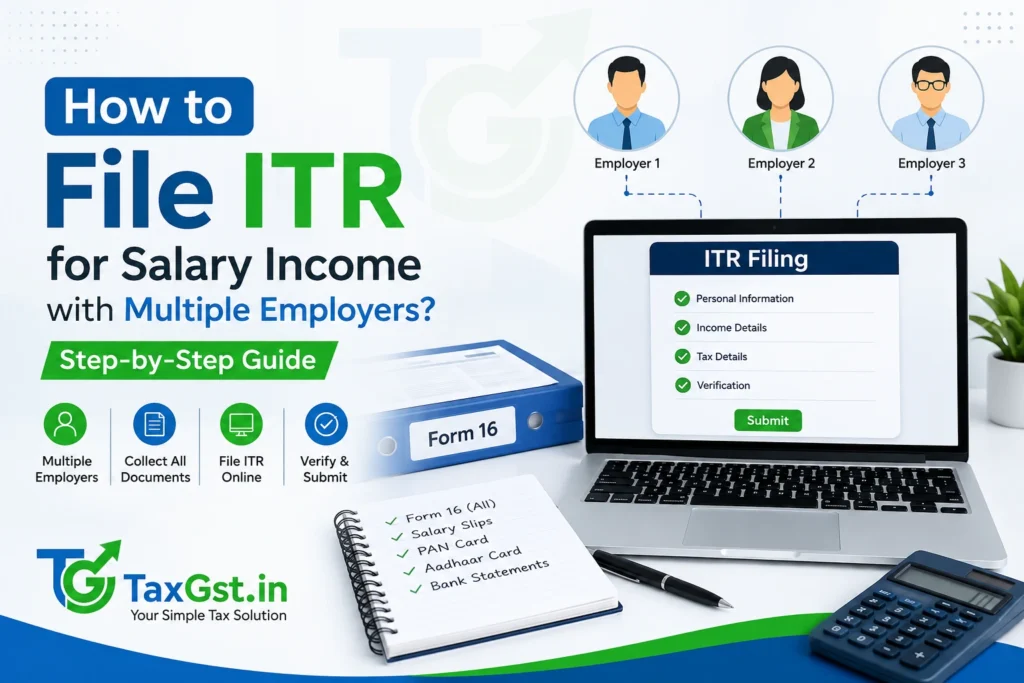
When you change jobs mid-year and receive two Form 16s, you must aggregate the salary from both employers into a single Income Tax Return (ITR). However, under the Income-tax Act, 1961, you can claim the ₹75,000 standard deduction and the Section 87A rebate only once per financial year. Because each employer deducts TDS in isolation—assuming they are your only source of income—your combined total often pushes you into a higher tax slab, stripping away your rebate and creating a sudden tax shortfall at filing time. To avoid heavy advance tax penalties (Section 234B/C), submit Form 12B to your new employer immediately upon joining so they can accurately calculate your aggregate TDS.
Also Check-Income Tax ITR Consultant
Quick Summary: Filing ITR with Two Form 16s
- Salary from every employer is taxable. Basic exemptions, slab benefits, and the standard deduction are available only once per financial year, regardless of how many jobs you hold.
- Each employer deducts TDS assuming they are your sole employer, leading to severe under-deduction when incomes are eventually clubbed together.
- Submit Form 12B to your new employer with previous salary and TDS details so they can deduct tax accurately on the aggregate income.
- You can still file ITR-1 (SAHAJ) with two Form 16s, provided your total income is below ₹50 Lakhs and you have no capital gains.
- For AY 2027-28, file your ITR by 31 July 2027 to avoid late fees up to ₹5,000 under Section 234F.
Why Does a Tax Demand Suddenly Appear When I Have Two Form 16s?
Every year, thousands of taxpayers panic during tax season when the income tax portal displays a massive “Tax Due” figure, despite their payslips showing that TDS was “fully” deducted by both employers. The reason for this shock is straightforward but often misunderstood: each employer calculates your TDS in complete isolation.
Under the Income-tax Act, 1961, your employer is legally obligated to deduct TDS based on the estimated salary they will pay you during the financial year. Employer A assumes you only earned income from them, so they grant you the full basic exemption limit, the full ₹75,000 standard deduction, and the full benefit of the lowest tax slabs. When you switch jobs mid-year, Employer B does the exact same thing, unaware of the benefits Employer A already provided.
When you combine both salaries in your Income Tax Return, your total income is much higher. A massive portion of this aggregated income is pushed out of the 5% or 10% brackets and falls into the higher 20% or 30% tax slabs. Because both employers withheld tax at the lowest possible rates, the total TDS deducted falls drastically short of your actual, combined tax liability.
Under the New Tax Regime (which is the default for AY 2027-28), this problem is severely amplified by the Section 87A rebate. The rebate of ₹60,000 applies only if your total income is up to ₹12 lakh. Each employer may have looked at your partial salary (e.g., ₹7 Lakhs each), applied the rebate independently, and deducted zero TDS. But once your combined income crosses ₹12 lakh in your ITR, the rebate vanishes entirely, and the full tax liability surfaces at filing.
What Documents Do I Need Before Starting My ITR?
To ensure a smooth, error-free filing process when juggling multiple employers, you must gather a specific set of documents before you log into the e-Filing portal.
- Form 16 (Part A & Part B): You need this from every employer you worked for during the financial year. Form 16 is the official TDS certificate issued under Section 203 of the Income-tax Act. Part A contains the summary of TDS deposited against your PAN, and Part B contains the detailed breakdown of your salary components.
- Form 26AS: This is your consolidated annual tax credit statement. It shows exactly how much TDS the government has actually received from your employers.
- Annual Information Statement (AIS): A more comprehensive document than 26AS, the AIS captures not just salary, but interest on savings accounts, mutual fund sales, and high-value transactions.
- Final Settlement Payslips: If an employer delays issuing Form 16, your final Full & Final (F&F) settlement payslip will contain the gross salary and TDS figures needed to file your return manually.
A mismatch between your physical Form 16 and the digital Form 26AS is the most common reason for defective return notices under Section 139(9). Always ensure the portal matches your paperwork before hitting submit.
Worked Example: The Math Behind the Tax Shortfall
To truly understand why the tax shortfall occurs, let us walk through a practical mathematical example under the New Tax Regime.
Consider Meera. She worked with Employer A from April to September earning a gross salary of ₹7,00,000. She then switched to Employer B from October to March, also earning ₹7,00,000. Her total gross salary for the financial year is ₹14,00,000.
What the Employers Did (In Isolation):
- Employer A: Saw a ₹7,00,000 salary. They applied the ₹75,000 standard deduction, bringing taxable income to ₹6,25,000. Because this is below the ₹12 Lakh threshold, they applied the Section 87A rebate. Result: ₹0 TDS deducted.
- Employer B: Did the exact same calculation for their ₹7,00,000 payout. Result: ₹0 TDS deducted.
What Happens at ITR Filing (The Reality):
Meera must aggregate her income. Her total gross salary is ₹14,00,000. The Income Tax Department only allows the standard deduction to be claimed once. Therefore, her net taxable income is ₹14,00,000 – ₹75,000 = ₹13,25,000.
| Income Slab (New Regime) | Calculation on ₹13,25,000 | Tax Amount |
|---|---|---|
| Up to ₹4,00,000 | Fully Exempt | Nil |
| ₹4,00,001 to ₹8,00,000 | 5% of ₹4,00,000 | ₹20,000 |
| ₹8,00,001 to ₹12,00,000 | 10% of ₹4,00,000 | ₹40,000 |
| ₹12,00,001 to ₹16,00,000 | 15% of ₹1,25,000 | ₹18,750 |
| Subtotal Tax | ₹78,750 | |
| Add: 4% Health & Education Cess | 4% of ₹78,750 | ₹3,150 |
| Total Final Liability | ₹81,900 |
Because her combined income (₹13.25 Lakhs) securely exceeds the ₹12 lakh threshold, Meera loses the Section 87A rebate entirely. Since neither employer deducted any TDS during the year, Meera must now pay the entire ₹81,900 out of pocket as Self-Assessment Tax, alongside significant interest penalties for the delayed payment.
How Do I Prevent This? (The Form 12B Solution)
The legal remedy to this problem is Form 12B. Form 12B is the bridge that connects your two employers to ensure accurate TDS computation. Under Section 192(2) of the Income-tax Act, 1961, you have the option to furnish details of the salary received from your previous employer to your current employer.
When you join a new company, submit Form 12B to your HR/Payroll department immediately. You must include:
- The Name, PAN, and TAN of your previous employer.
- A complete break-up of your previous salary (Basic, HRA, LTA, Perquisites).
- Deductions already allowed (e.g., standard deduction, professional tax).
- The total TDS already deducted and deposited by the previous employer.
Once submitted, your new employer is legally obligated to aggregate the previous salary with their own projected payout. They will compute tax on your total combined income for the whole year. They will give you credit for the TDS already deducted by the old employer, and proportionately deduct the remaining, higher tax burden from your remaining monthly paychecks. This ensures you owe zero extra tax (and zero penalties) when filing your ITR.
The Cost of Silence: Section 234B and 234C Advance Tax Penalties
What happens if you hide your previous salary and fail to submit Form 12B? The consequence is not just the principal tax due — it is the severe interest that accrues on that shortfall.
Under the Income-tax Act, if your total tax liability for the year (after subtracting TDS) exceeds ₹10,000, you are legally required to pay Advance Tax in quarterly installments. Because your employers under-deducted TDS, the tax department views you as an Advance Tax defaulter.
- Section 234B (Default in Payment of Advance Tax): If you fail to pay at least 90% of your assessed tax as Advance Tax by March 31st, you will be charged penal interest at 1% per month on the unpaid amount from 1st April of the assessment year until the date you finally pay the tax.
- Section 234C (Deferment of Advance Tax Installments): Interest at 1% per month is also charged if you miss the specific quarterly installment deadlines (15th June, 15th Sept, 15th Dec, 15th March) during the financial year.
In Meera’s example above, her ₹81,900 shortfall would attract approximately ₹4,914 in Section 234B interest alone if she filed in July (1% × 6 months). Honesty at the time of joining a new company via Form 12B is always cheaper than paying interest at the time of filing.
Step-by-Step Guide: Reporting Multiple Salaries in ITR-2 (Schedule S)
If your total income exceeds ₹50 Lakhs, or you have capital gains from selling stocks or mutual funds alongside your multiple Form 16s, you cannot use the simple ITR-1. You must file ITR-2.
In ITR-2, you must report your multiple salaries using Schedule S (Details of Income from Salary). Here is how to navigate it:
- Log into the e-Filing Portal: Navigate to e-File > Income Tax Returns > File Income Tax Return. Select the correct Assessment Year and choose ITR-2.
- Access Schedule S: The portal will likely pre-fill the data if your employers have filed their TDS returns. However, you must verify it.
- Add Employer Rows: You must enter details for each employer separately. Enter the TAN, Name, and Address of Employer A. Then, input the gross salary components exactly as shown in Form 16 Part B (Section 17(1) Salary, Section 17(2) Perquisites).
- Click “Add Another”: Create a second row and repeat the process for Employer B.
- Consolidate and Deduct: After entering all individual employer details, the form auto-calculates the Total Gross Salary. From this single aggregate figure, the system will apply the ₹75,000 standard deduction under Section 16(ia) only once.
- Verify TDS Credits: Move to the “Tax Paid” schedule. Ensure the TDS deducted by both employers is listed here, matching your Form 26AS.
- Pay Self-Assessment Tax: If the final computation shows “Tax Due,” click “Pay Now” to generate Challan 280 and clear the dues before submitting the return.
What Happens If My Previous Employer Hasn’t Issued Form 16?
If the July 31st deadline is approaching and your ex-employer is illegally withholding your Form 16, do not wait. You can and must file your ITR without it.
Gather all your monthly payslips and your Full & Final (F&F) settlement statement from the previous employer. Add up your basic salary, allowances, and perquisites to determine your Gross Salary. Next, log into the e-Filing portal and check Form 26AS. If the employer deposited the TDS, it will reflect there. Use the gross salary from your payslips and the TDS credit from Form 26AS to manually fill out your ITR.
Remember, salary income is taxable on a “due or receipt basis” under the Income-tax Act. The absence of a physical Form 16 does not absolve you of the legal responsibility to report that income and pay taxes on it.
Frequently Asked Questions (FAQs)
Can I file ITR-1 if I have two Form 16s from different employers?
Yes, you can file ITR-1 (SAHAJ) if you are a Resident Individual with a total income up to ₹50 lakh, and your income is only from salary, one house property, and other sources like interest. Having two Form 16s does not disqualify you. You simply add the gross salary from both forms together. However, if you have capital gains from stocks, you must use ITR-2.
What happens if I do not submit Form 12B to my new employer?
If you do not submit Form 12B, your new employer will compute TDS based only on the salary they pay you. Both employers will independently apply the standard deduction and tax slab benefits. When you file your ITR and combine the incomes, you will face a large tax shortfall and must pay it out of pocket, along with 1% monthly interest penalties under Sections 234B and 234C.
Do I need to claim HRA exemption from both employers separately?
No. The House Rent Allowance (HRA) exemption under Section 10(13A) is calculated on your total aggregate salary for the year. If you submitted rent proofs to both employers, you must recalculate the exemption based on your combined salary and claim it only once in your ITR to ensure you do not double-claim the benefit.
Is the Section 87A rebate available if my combined income exceeds ₹12 lakh?
No. Under the new tax regime, the Section 87A rebate of ₹60,000 is available only if your total income does not exceed ₹12 lakh for the year. If your combined salary pushes your total income to ₹12,00,001, the rebate vanishes entirely. There is no partial rebate.
What if my previous employer has not issued Form 16 yet?
You must still file your ITR. Use your monthly payslips and final settlement statement to calculate your gross salary. Cross-verify the TDS deducted with Form 26AS or AIS on the e-Filing portal. Claim the TDS credit based on what is reflected in Form 26AS, even if the physical certificate is delayed.
Can I choose different tax regimes for different employers during the same year?
No. While you may have declared the Old Regime to Employer A and the New Regime to Employer B for TDS deduction purposes, you must declare a single, consistent tax regime for your entire income when filing your final ITR. The portal will automatically compute your tax based on the single regime you select at filing.
How do I handle a mismatch between my Form 16 and Form 26AS?
If your Form 16 shows TDS was deducted, but it is not reflecting in Form 26AS, contact your employer immediately. They must file a revised quarterly TDS return to map the credit to your PAN. Do not file your ITR claiming TDS that is not in 26AS, as this will trigger a defective return notice under Section 139(9).
What penalties apply if I file my ITR after the due date?
Filing after the July 31st deadline attracts a late filing fee under Section 234F of up to ₹5,000 (reduced to ₹1,000 if your total income is below ₹5 lakh). Additionally, penal interest under Section 234A at 1% per month will be charged on any unpaid tax from the due date until the actual filing date.
Sources & References
- Income Tax Portal — Returns and Forms Applicable for Salaried Individuals
- Income Tax Portal — ITR-2 User Manual & Schedule S Guide
Article Information
Published: August 29, 2026
Last Reviewed: August 29, 2026
Category: Income Tax & Payroll Compliance
Regulatory Body: Central Board of Direct Taxes (CBDT)
Written by C.K. Gupta, M.Com & Tax Editor at TaxGST.in — assisting salaried individuals with complex ITR filings, Form 12B submissions, and Section 234 interest calculations since 2009.
Official Resources
Disclaimer: This article provides general guidance on filing an ITR with multiple Form 16s. The calculation of Section 234B/C interest and HRA exemptions can be mathematically complex when combining incomes across the financial year. Always cross-verify your TDS credits against the Annual Information Statement (AIS) before making self-assessment tax payments, and consult a CA if you face significant shortfalls.
Try the free income tax calculator for instant figures.
Discover more from TaxGst.in
Subscribe to get the latest posts sent to your email.
Never Miss a Tax Deadline Again
Due-date alerts, GST updates and tax tips — free on the app you already use.
event Next: GSTR-1 (IFF) · 13 Oct